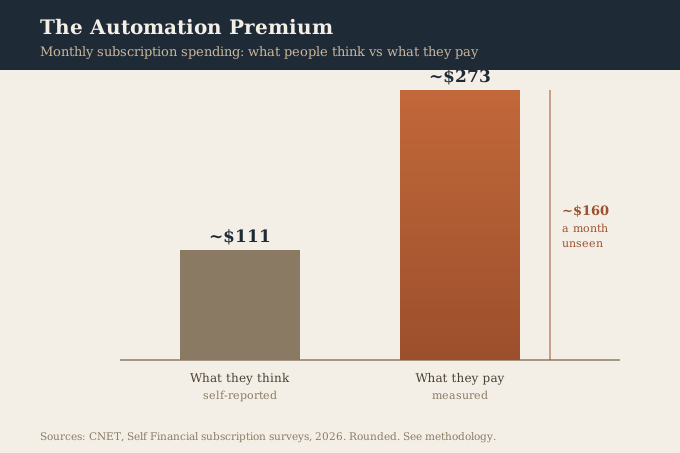
- Americans actually spend about $273 a month on subscriptions but guess closer to $96 even on a second try, a roughly $177 monthly gap they do not see.
- About 20% never shop for car insurance and three in four do not shop annually, even though most who shop save money.
- The same automation that prevents late fees removes the moment a person would notice a price and question it. The fix is to automate the payment, not the decision.
Autopay was supposed to be the responsible choice, and in one sense it was. It ended the era of late fees, missed due dates, and the small penalties that punished forgetfulness. But automation did something else at the same time, something quieter and harder to notice. It removed the moment each month when a person would look at a charge and ask whether it was still worth paying. Understanding the cost of autopay auto-renewal 2026 means recognizing how that missing moment compounds into invisible expenses over time.
That missing moment has a price. When money moves on its own, prices drift, unused services keep billing, and renewals happen without a decision. The convenience is real. So is the premium.
The finding
The clearest evidence sits in subscriptions, because one national survey directly compared what people guessed they spend against what they actually spend — twice.
West Monroe surveyed 2,500 U.S. consumers across 21 subscription categories in June 2021. Given ten seconds, people guessed they spent about $62 a month on subscriptions. Given thirty seconds to reconsider, the average guess rose to $96 a month. Measured spending, pulled from actual transaction data, averaged $273 a month — nearly three times the reconsidered guess. Every single respondent underestimated their own spending, and 66% were off by more than $200 a month, up from 24% in a comparable 2018 survey where actual spending averaged $237. The gap is not a rounding error. It is a systematic blind spot of roughly $177 a month, close to $2,100 a year, that never registers because the charges are small, automatic, and scattered. West Monroe has not published a comparable update since 2021 — this remains the most recent national data on the guess-versus-actual gap.
- Monthly
- ~$62
- Annual
- ~$744
- Monthly
- ~$96
- Annual
- ~$1,152
- Monthly
- ~$273
- Annual
- ~$3,276
- Monthly
- ~$177
- Annual
- ~$2,124
Insurance shows the same mechanism in a different market. Roughly 20% of Americans never shop for car insurance, and about three in four do not shop annually, per Motley Fool survey data, even though the majority of people who do shop end up saving. The JD Power 2026 U.S. Insurance Shopping Study found the share of customers shopping actually declined year over year. A policy that renews on its own is a policy no one is checking.
How to read this
The automation premium never appears as a single line item. It is spread across many small, automatic decisions no one is actively making. Three forces drive it:
- Invisibility. Subscriptions are engineered to be small and forgettable. Each one is easy to justify; the total is never presented.
- Default renewal. Insurance, memberships, and services renew unless you act, which means silence becomes consent to whatever the new price is.
- Price drift. Some providers raise prices on customers who do not shop, on the reasonable bet that automation has ended their vigilance.
Each force is individually rational to ignore and collectively expensive. And unlike a market loss, the automation premium is fully within a household's control. Nothing has to be timed or predicted. The money is recoverable the moment someone looks.
Why "just cancel autopay" is the wrong lesson
The temptation is to blame automation and switch it off. That is the wrong fix, because manual payment reintroduces the very late fees autopay solved. The problem was never the automatic payment. It was that the decision got automated along with it.
The better model separates the two. Keep autopay so nothing is ever late. Then put the decision back on a calendar: once or twice a year, list every recurring charge in one place, cancel what is unused, and reshop the services that renew, starting with insurance, which tends to carry the largest single premium for loyalty. Automate the payment, not the decision.
One scheduled review usually recovers more than any single price cut, because it catches the whole drifting stack at once instead of one line at a time.
Sources
- West Monroe, Americans are spending more on subscriptions and are less aware of their spending (June 2021 survey, n=2,500 U.S. consumers, 21 subscription categories).
- Motley Fool Money, car insurance shopping trends survey.
- JD Power, 2026 U.S. Insurance Shopping Study.
Subscription figures reflect West Monroe's most recent published national survey (June 2021); no more recent comparable study has been published as of this writing. Insurance-shopping figures are current as of 2026. All figures rounded.
What to Do Now
Frequently Asked Questions
Does autopay actually cost you money?
How much do Americans really spend on subscriptions?
Why do people overpay for insurance they could shop?
What should I do about automatic payments?
Answer a few questions about your situation and goals. Money Map points you to the highest-value next step across savings, mortgage, cards, and debt.
Editorial review
What changed since the last update
Was this guide helpful?
Found an inaccurate, outdated, or missing claim? Report a correction. We verify reports against the relevant source before changing a guide or ranking.
