- Roughly $1.6 trillion in CDs mature at U.S. banks during 2026, with the heaviest volume landing in the first quarter, according to Curinos' Consumer Deposit Analyzer. Much of it was locked in near the top of the cycle.
- The best nationally available 1-year CD APY peaked near 5.66% in December 2023. As of August 30, 2026, the best 12-month CD pays 4.40%, a full percentage point lower.
- A matured CD's auto-renewal rate and a bank's advertised new-money rate are set by the same desk, from the same funding model. The gap between them is not an oversight. It is priced on the assumption that most depositors will not act.
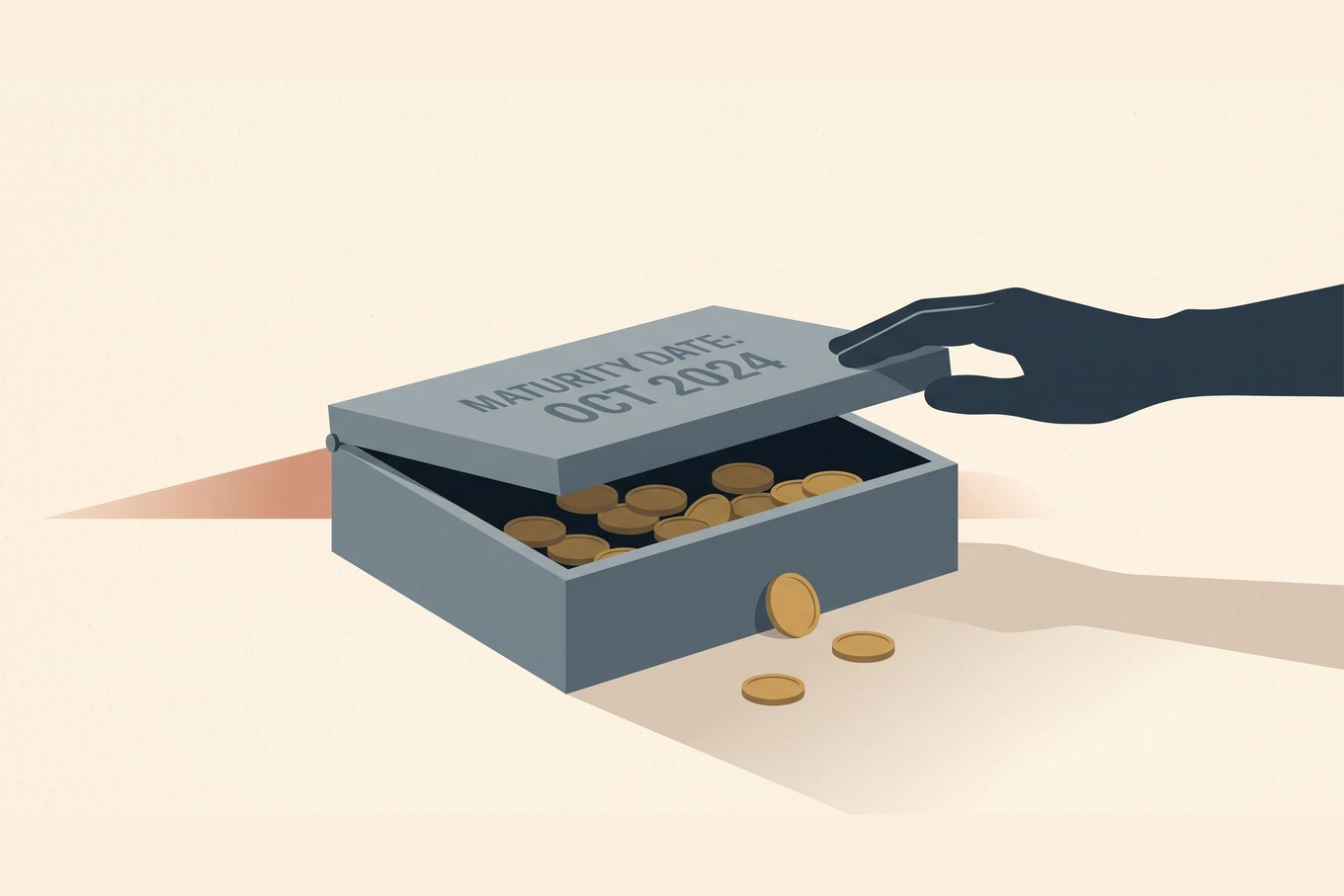
Roughly $1.6 trillion in certificates of deposit come due at U.S. banks in 2026, and the heaviest wave lands in the first quarter, according to Curinos' Consumer Deposit Analyzer. A large share of that money was locked in near the top of the cycle, when the best nationally available 1-year CD paid close to 5.66% in December 2023 and the Fed funds rate sat at a 22-year high of 5.25% to 5.50%, a level it held for fourteen months before the first cut in September 2024. That CD is maturing into a different world. The best 12-month CD today pays …, and every one of those maturity dates is a decision point a bank has already modeled.
I spent more than two decades on the other side of that decision, managing deposit pricing and interest rate risk as Treasurer at two bank holding companies. I can tell you what a treasury desk does with a CD's maturity date. It does not treat it as an open question. It treats it as an input.
What a treasury desk actually prices at maturity
A CD is not just a deposit to a bank. It is a funding liability with a known maturity date, and that certainty is valuable. A treasury desk builds its funding plan around it: how much of the back book will roll over automatically, how much will walk, and what rate clears that trade at the lowest cost to the bank. None of this is guesswork. It is the same forecasting discipline applied to a mortgage prepayment curve or a loan portfolio's runoff, just pointed at the liability side of the balance sheet instead of the asset side.
The forecast starts from a simple, well documented behavioral fact: most matured CD balances renew automatically unless the depositor acts within a short grace period, commonly seven to ten days. The bank does not need to guess whether that is true in general. It has years of its own back-book data showing exactly how its own depositors behave when a term ends. That data point, not a guess about the competitive market, is what actually sets the renewal rate.
Two rate sheets, one desk
Look at any bank's CD offerings and you will typically find two different numbers for the same term. One is the advertised rate, the number in the promotion, built to win new money in a competitive market. The other is the standard renewal rate a matured CD rolls into by default, and it is very often lower, sometimes by half a point or more.
This is not an inconsistency in the bank's pricing. It is two different products being priced for two different costs of acquisition. New money has to be won away from a competitor, so it gets priced against the market. A matured balance is already inside the institution, already past the friction of opening an account and linking a funding source, and the data says most of it will stay without a fight. Pricing that balance at the promotional rate would be paying a premium the bank does not need to pay to keep the money. The renewal rate is set high enough to look plausible on a statement and low enough to protect the spread, and the desk knows exactly how far it can push that gap before attrition costs more than the rate saved. Almost nobody is losing money on this calculation. Depositors are the ones paying for it, one renewal at a time.
None of this requires a bank to be acting in bad faith toward any individual depositor. It is a portfolio decision, not a customer-by-customer one. A treasury desk is not betting on you specifically. It is running an expected-value calculation across the entire back book, and the math holds as long as enough of that book renews without checking the number against the market. It usually does.
Why the timing makes this year's wall different
A maturity wall like this one is not new. What is different about 2026 is the direction the reset runs. Money that termed out near the 5% to 5.66% range from the 2023 rate peak is landing in a market where the best available CD, at any term, sits well below that.
That is a wider gap than a typical year's renewal cycle produces, and it means the dollar cost of letting the grace period close without checking the number is larger than usual. On a $50,000 balance, the difference between a renewal rate set a point below the best available market rate and the best available rate itself is roughly $500 a year, non-trivial money for the ten minutes it takes to compare and move it.
The bottom line
None of this means a CD is a bad product. Locking a known rate for a known period is genuinely useful when you have a fixed timeline for the money. What it means is that the maturity date is not a passive event to let happen to you. It is the one moment in a CD's life when the bank is relying on your inattention, and the entire renewal rate is built around the expectation that the moment will pass unexamined.
The fix does not require predicting the Fed or timing the market. It requires acting inside a window that is measured in days, not months. Set a reminder ahead of the maturity date, and check the actual best available rate at your term against whatever the renewal notice quotes, not against the rate you remember opening the CD at two or three years ago. If you would rather not track the date by hand, SwitchWize's CD tracking tools let you flag a saved CD with its maturity date and will alert you two weeks out, before the grace period is already closing. For the full decision on where the money should go next, renew, ladder, or move to savings, our CD maturity guide walks through the framework. Or run the Money Map to see how this balance stacks up against everything else you hold.
I built my career on the other side of this exact decision. Knowing how the rate gets set does not make the rate wrong. It just means the burden of catching it has always sat with the depositor, and this year, for a lot of savers, catching it is worth more than it has been in a decade.
Methodology
CD rates cited here are pulled from SwitchWize's tracked rate data as of the article's publish date. Rates last verified recently. Historical rate figures (the December 2023 peak, the 2023-2024 Fed funds range) are drawn from Bankrate's published rate surveys and Federal Reserve FOMC records. The 2026 CD maturity volume figure is from Curinos' Consumer Deposit Analyzer, published December 17, 2025. This is educational information, not personalized financial advice.
Sources
- Curinos: Expectations for 2026, CDs Remain Here to Stay (Andrew Jiang, December 17, 2025)
- Federal Reserve FOMC calendars and rate decisions
- Bankrate: Federal Funds Rate History
The maturity date on a CD is the one moment the bank is counting on your inattention. The renewal rate is priced assuming most balances roll over without a second look, and in 2026, with $1.6 trillion resetting well below the 2023 peak, the cost of not checking is larger than usual.
Frequently Asked Questions
Why is a CD's auto-renewal rate usually lower than the bank's advertised rate?
Is the bank doing anything wrong by pricing my CD's renewal below the market rate?
What should I do before my CD's grace period closes?
What should I do after reading The CD Maturity Wall: Why the Bank Is Betting You Won't Move?
Act on this: today's top cds



Ranked by SwitchWize's composite score. SwitchWize currently has no compensated product links.
Was this guide helpful?
Found an inaccurate, outdated, or missing claim? Report a correction. We verify reports against the relevant source before changing a guide or ranking.

Adeesh Setya is Head of Financial Research & Principal at SwitchWize, with 25+ years of experience in deposits, treasury management, banking products, and financial services. He previously served as Treasurer at Merrill Lynch Bank USA and Morgan Stanley Bank USA, where he managed bank funding, deposits, and interest-rate risk. He writes on Federal Reserve policy, the general marketplace for banking products, and what they mean for savers and consumers.
Available for on-record interviews, background briefings, and custom data cuts.
research@switchwize.com