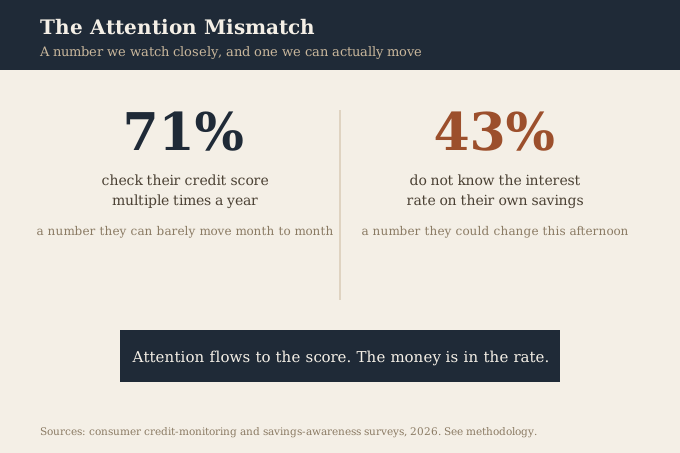
- 71% of Americans check their credit score multiple times a year, per a FICO/Harris Poll survey, even though a score moves slowly and mostly reflects behavior already set.
- Meanwhile 43% of savers cannot name the interest rate on their own savings, a number they could change the same afternoon.
- The attention is inverted: heavy monitoring of a slow number, near-zero attention on a fast, controllable one. Redirecting a fraction of it is a high-return move.
Open almost any banking or credit-card app and the credit score is right there on the home screen, updated, color-coded, sometimes with a little arrow. It has become one of the most-watched numbers in personal finance. And there is nothing wrong with knowing it. The strange part is what sits next to it, unwatched: the interest rate on the money in the very same app, a number most people cannot name. This attention mismatch credit score savings rate 2026 dynamic reveals why we fixate on what feels immovable instead of optimizing what we could change today.
This is the attention mismatch. We monitor the number we can barely move and ignore the one we could change today.
The finding
The contrast is stark once the two behaviors are placed together.
On one side, credit-score monitoring has become routine. 71% of Americans check their credit score multiple times a year, and 55% checked at least once in the past year specifically to improve their financial health, according to a survey The Harris Poll conducted on behalf of FICO (fielded Aug. 7-11, 2025; n=2,079 U.S. adults; margin of error ±2.5 points at 95% confidence).
On the other side sits the savings rate, and here attention collapses. About 43% of savers cannot name the interest rate on their own account, per a LendingClub-commissioned survey conducted by Talker Research (2,000 respondents, October 2025). The number that governs how much their cash earns is, for nearly half of savers, simply unknown.
- How closely watched
- 71% check several times a year
- How quickly it moves
- Slowly, over months
- How closely watched
- 43% do not know their own
- How quickly it moves
- Same day you switch
Set side by side, the mismatch is obvious. The heavily watched number is the one an individual can barely nudge in the short run. The ignored number is the one that responds immediately to a single decision.
Why the attention is backwards
A credit score is a lagging output. It is built from payment history, balances, and the age of accounts, forces that are already in motion and that respond over months of sustained behavior. Checking it weekly does not move it. Between two frequent checks, it usually has not changed at all. Monitoring a few times a year for errors or fraud is worthwhile; the compulsive version mostly delivers reassurance rather than any lever to pull.
A savings rate is the opposite kind of number. It is not an output of your habits. It is a feature of the account you happen to be in, and you can change the account. The gap between a national-average rate near 0.38% and the roughly 4% available at high-yield banks is a difference you can capture the same afternoon, on federally insured money, for a gain you can calculate before you act.
So the two numbers invite opposite treatment from the one they get. The score rewards patience and mostly punishes over-checking with anxiety. The rate rewards a single act of attention and punishes inattention with quiet, ongoing loss.
The behavioral trap
Why does attention flow the wrong way? Partly design and partly psychology.
The score is delivered to you, gamified, updated, and framed as a grade. A grade demands to be checked. The savings rate is delivered to no one; it sits in a disclosure you have to go find. Nothing pushes it toward you, so nothing pulls your attention toward it.
There is also a comfort asymmetry. Watching a stable or rising score feels like proof of responsibility. Looking up your savings rate risks discovering you have been earning almost nothing for years, which feels like the opposite. So the pleasant number gets watched and the potentially unpleasant one gets avoided, even though the unpleasant one is where the recoverable money is.
The result is a population highly engaged with a slow number and largely blind to a fast one.
The highest-return minute in personal finance
The fix is small and specific. It is not to stop checking your credit score. It is to spend one of those check-ins on the other number.
Look up the interest rate on your main savings account. If you cannot find it quickly, that difficulty is itself the finding, because a rate you have never checked is one you have implicitly accepted. Then compare it to current high-yield savings rates. If the gap is meaningful, and for anyone at a large traditional bank it usually is, moving the money is a guaranteed raise on insured funds.
Few minutes of financial attention pay as well. The credit score will keep improving on its own schedule regardless of how often you look. The savings rate will only improve when you finally do.
How we source this. Rates are sourced from primary institutions and the FDIC, not aggregated marketing pages, and are verified on a rolling basis; see our methodology and editorial team. This report was written by a former bank treasurer and reviewed by the SwitchWize Research Desk. We take no payment for organic rankings or citations.
Sources
- The Harris Poll on behalf of FICO, FICO Score Credit Insights Report (fielded Aug. 7-11, 2025; published Sept. 16, 2025; n=2,079 U.S. adults ages 18+; margin of error ±2.5 points at 95% confidence) — the 71% credit-score-checking figure and 55% who checked at least once in the past year.
- LendingClub-commissioned survey conducted by Talker Research (2,000 respondents, October 2025) — the 43% who do not know their own savings rate.
- FDIC, National Rates and Rate Caps, for the national-average savings rate referenced in the comparison.
Figures are current as of 2026 and rounded. Free to cite with attribution to SwitchWize.
What to Do Now
Frequently Asked Questions
How often do Americans check their credit score?
Why is checking your credit score constantly not that useful?
Why does not knowing your savings rate cost you money?
What is the single highest-return use of financial attention?
Act on this: today's top savings


Ranked by SwitchWize's composite score. We may earn a referral fee, and it never changes the ranking order.
Editorial review
What changed since the last update
Was this guide helpful?
Found an inaccurate, outdated, or missing claim? Report a correction. We verify reports against the relevant source before changing a guide or ranking.

Adeesh Setya is Head of Financial Research & Principal at SwitchWize, with 25+ years of experience in deposits, treasury management, banking products, and financial services. He previously served as Treasurer at Merrill Lynch Bank USA and Morgan Stanley Bank USA, where he managed bank funding, deposits, and interest-rate risk. He writes on Federal Reserve policy, the general marketplace for banking products, and what they mean for savers and consumers.
Available for on-record interviews, background briefings, and custom data cuts.
research@switchwize.com