- About 41% of US adults carry medical or dental debt, an estimated $220 billion on credit reports and perhaps ~$500 billion once cards, loans, and family borrowing are counted.
- It falls heavily on the insured: high-deductible plans expose people to thousands before coverage begins, and about half of those on employer high-deductible plans get a surprise bill.
- Medical debt is uniquely fightable: bills often contain errors, hospital financial assistance goes unclaimed, and small, recent, or paid medical debts are largely kept off credit reports.
Medical debt is unlike any other debt Americans carry, because almost no one chooses it. You do not decide to get sick or injured, and increasingly you do not even have to be uninsured to end up owing thousands. It is also strangely invisible, both because so much of it hides inside other debts and because the people carrying it often blame themselves rather than a system that bills first and explains later. This report lays out how much medical debt there really is, why it lands on the insured, and the one piece of genuinely good news: it is far more fightable than most debt. This page is reviewed by the SwitchWize Editorial Team; the figures are sourced below with dates. Our medical debt statistics 2026 analysis reveals the scope of this crisis and actionable strategies for fighting back.
The numbers
Four figures define the landscape:
- The reach. About 41% of US adults carry some medical or dental debt, per KFF.
- The visible total. An estimated $220 billion of medical debt sits on credit reports.
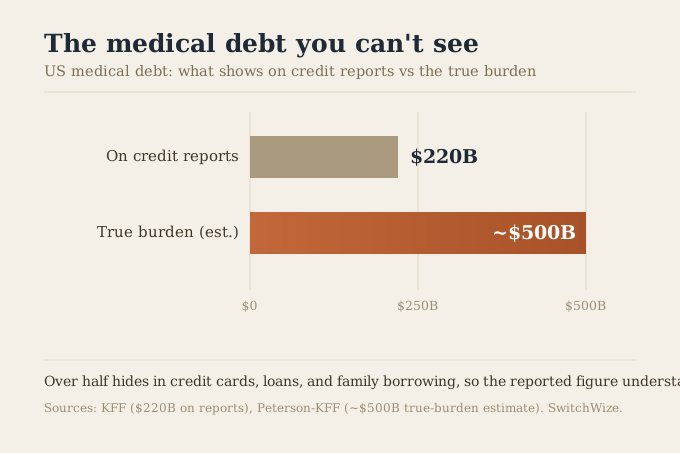
- The true burden. It may reach roughly $500 billion once amounts absorbed into credit cards, personal loans, and family borrowing are counted, per Peterson-KFF.
- The fragility. About 44% of Americans could not cover an unexpected $1,000 medical bill without borrowing or selling something.
The gap between the visible $220 billion and the estimated $500 billion is the report in one line: most medical debt does not look like medical debt, because people move it onto cards and loans to make it go away, where it quietly becomes ordinary, high-interest debt.
- Value
- ~41%
- Source
- KFF
- Value
- ~$220 billion
- Source
- KFF
- Value
- ~$500 billion
- Source
- Peterson-KFF
- Value
- ~44%
- Source
- Surveys
- Value
- ~50%
- Source
- Industry
The debt no one chooses
What makes medical debt different is that it is non-discretionary in origin. Other debts follow a decision: to buy a car, use a card, take a loan. Medical debt follows an event, an illness, an accident, a diagnosis, that no budget prevents and no discipline avoids. That is why moralizing about it misses the point, and why it shows up across income levels.
It also increasingly lands on the insured. The spread of high-deductible health plans, which trade lower premiums for thousands of dollars of out-of-pocket cost before coverage begins, means a person who dutifully carries insurance can still face a bill that becomes debt. About half of those with employer high-deductible plans report a surprise bill. Insurance, for a growing share of people, no longer means protection from a large medical expense.
Why it stays hidden
The official $220 billion counts only what appears on credit reports, and that is a fraction of the reality. To make a medical bill stop, people shift it onto a credit card, take a personal loan, or borrow from family. Once they do, it is no longer categorized as medical debt; it is card debt, loan debt, an IOU to a relative, often at far higher interest than the original bill would have carried.
That is why the estimated true burden is roughly $500 billion, more than double the visible figure. It also explains why medical debt is so easy for policymakers and the public to underestimate: over half of it is wearing a disguise. The practical lesson for anyone facing a bill is in the next section, because the worst move is exactly the common one, converting a fightable medical bill into permanent card debt.
Compare HDHP/HSA and PPO plans after premiums, deductibles, out-of-pocket maximums, employer HSA money, tax savings, expected medical use, worst-case exposure, and cash-reserve readiness.
Current-year IRS HSA contribution limit (confirm on irs.gov).
HDHP + HSA Net Annual Cost
$4,818
Use this result as one input in your broader Money Map, not as a one-off number.
What to do
Build this benefits plan in Money Map
Pre-tax estimates. For illustration only — not financial advice.
What you can do that other debt does not allow
Here is the good news, and it is real. Medical debt is uniquely fightable in ways a mortgage or a car loan never are. Three moves work.
First, check the bill. Request an itemized statement and review it, because medical bills frequently contain errors, from duplicate charges to services never rendered. Second, claim financial assistance. Nonprofit hospitals are required to offer charity care, and many patients qualify based on income but never apply. Third, negotiate. Hospitals and providers routinely accept less, or a zero-interest payment plan, if you ask, and doing so beats putting the balance on a high-interest card.
The one thing not to do is the reflex: paying a medical bill with a credit card you cannot clear, which trades a negotiable, low-consequence debt for an expensive, permanent one. See our guide on medical debt and credit reports, then attack the balance deliberately:
See your exact payoff date and total interest, and how much the avalanche method saves.
Find this on your card or loan statement
Find this on your card or loan statement
Total debt to eliminate
$8,500
Payoff in 22 months. Total interest: $2,373. Avalanche (highest rate first) is the math-optimal strategy.
What to do
At this pace, you will be debt-free in 1y 10m, paying $2,373 in interest. A balance transfer card at 0% APR could cut that to near zero.
Pre-tax estimates. For illustration only — not financial advice.
The credit-report picture in 2026
The rules changed, and the details matter. A federal rule that would have removed medical debt from credit reports entirely was struck down in court, so there is no blanket federal ban as of 2026. But voluntary changes by the three major credit bureaus remain in force: paid medical collections are removed, unpaid medical debts under $500 are not reported, and medical debts are not reported until they are at least a year old. So small, recent, or paid medical debts largely stay off your credit report, while a large, unpaid, older bill still can appear, which is one more reason to fight the bill early rather than let it age.
The honest counterargument
Not all medical debt is catastrophic. Much of it is small, gets resolved, or is paid off within a few months, and insurance does shield most people from the worst outcomes most of the time. It would be alarmist to suggest every American is one illness from ruin.
But the breadth of the problem, 41% of adults, and its nature, non-discretionary and increasingly borne by the insured, make it a distinct and serious category. The hidden half absorbed into cards and loans is precisely the part that turns a one-time medical event into lasting financial damage. The measured $220 billion is not the ceiling of the problem; it is the visible tip of it.
Methodology
The share of adults with medical debt and the $220 billion credit-report figure are KFF estimates; the roughly $500 billion true-burden figure is a Peterson-KFF estimate that includes medical costs shifted onto credit cards, loans, and informal borrowing, and is an upper-range estimate rather than a precise count. High-deductible-plan and surprise-bill figures are industry and survey data. The credit-reporting rules reflect the vacated federal rule and the credit bureaus' voluntary policies as of 2026. A machine-readable version of the headline figures is published at /data/medical-debt.json. Nothing here is individualized financial or medical advice.
How we source this. Prevalence and dollar figures come from KFF and Peterson-KFF, plan and survey data from industry sources, and the credit-reporting rules from the bureaus' published policies, all cited with dates. See our methodology and editorial team. We take no payment for organic rankings.
Sources
- KFF, the burden of medical debt in the United States: share of adults and the ~$220 billion on credit reports.
- Peterson-KFF Health System Tracker, medical debt burden: the ~$500 billion true-burden estimate.
- Industry and survey data on high-deductible plans, surprise bills, and the credit bureaus' voluntary medical-debt reporting policies.
Figures are current as of mid-2026; the true-burden figure is an estimate. This page is informational, not financial or medical advice. Free to cite with attribution to SwitchWize.
Frequently Asked Questions
How much medical debt do Americans have?
Why do so many insured people have medical debt?
Does medical debt hurt my credit score in 2026?
How do I fight or reduce a medical bill?
How can I avoid medical debt?
The 5-minute money briefing
One email per week. New rates, fed moves, and what to actually do about them.
No spam. Unsubscribe anytime.
Answer a few questions about your situation and goals. Money Map points you to the highest-value next step across savings, mortgage, cards, and debt.
Editorial review
What changed since the last update
Was this guide helpful?
Found an inaccurate, outdated, or missing claim? Report a correction. We verify reports against the relevant source before changing a guide or ranking.
