How to choose
What to weigh before you pick
It usually comes down to 3 things. Compare your options on each before deciding.
The all-in price, including fees that are easy to miss.
What each option actually does for your situation.
Which one matches how you will really use it.
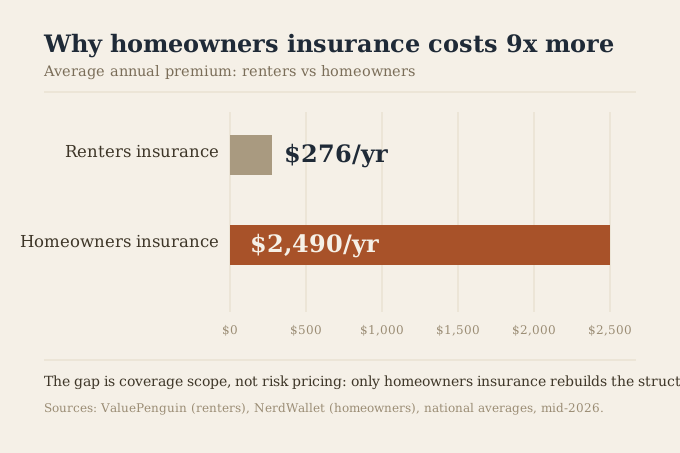
- Renters insurance averages $276 a year; homeowners insurance averages $2,490, roughly nine times more.
- The gap is driven by coverage scope, not risk pricing: homeowners insurance includes dwelling coverage to rebuild the structure, which renters insurance does not need because renters don't own the building.
- Personal property and liability coverage exist in both policy types in broadly similar form; dwelling coverage is the homeowners-only component that explains most of the cost difference.
Renters insurance averages $276 a year; homeowners insurance averages $2,490, roughly nine times more. The gap isn't risk pricing, it's coverage scope: homeowners insurance includes dwelling coverage to rebuild the structure, which a renter doesn't own and doesn't need covered. This report breaks down what each policy actually insures, where they overlap, and why the cost gap is as large as it is. This page is reviewed by the SwitchWize Editorial Team; the figures are sourced below with dates. Understanding renters insurance vs homeowners insurance helps you choose the right coverage for your living situation.
The numbers
- Renters insurance
$276/year ($23/month)- Homeowners insurance
$2,490/year ($208/month)
- Renters insurance
- $30,000 personal property, $100,000 liability, $500 deductible
- Homeowners insurance
- $400,000 dwelling, $300,000 liability, $1,000 deductible
- Renters insurance
- No
- Homeowners insurance
- Yes (dwelling coverage)
- Renters insurance
- Yes
- Homeowners insurance
- Yes
- Renters insurance
- Yes
- Homeowners insurance
- Yes
- Renters insurance
- No, but often lease-required
- Homeowners insurance
- No, but almost always mortgage-required
Homeowners insurance costs roughly 9x more on average. The gap is not evenly spread across coverage types: personal property and liability protection are broadly comparable in structure between the two policies. The difference is almost entirely dwelling coverage, which only exists in a homeowners policy, because only a homeowner has a structure that needs rebuilding.
What each policy actually covers
A renters policy has three main components: personal property (your belongings, up to a coverage limit you choose), personal liability (protection if someone is injured in your unit or you accidentally damage someone else's property), and additional living expenses if your unit becomes uninhabitable. A homeowners policy has all three of those, plus the component that drives most of its cost: dwelling coverage, which pays to repair or rebuild the physical structure itself after a covered loss like fire, wind, or certain types of water damage. Homeowners policies typically also extend to other structures on the property, a detached garage, a fence, a shed, which have no equivalent in a rental unit the tenant doesn't own.
This is why "renters insurance is cheaper because renters have less to lose" undersells what is actually happening. A renter can absolutely have $50,000 or more in belongings and still pay a fraction of a homeowner's premium, because the belongings and liability components are priced similarly in both policies. The homeowner is paying, overwhelmingly, for the building.
Why this matters for the "do I need it" question
For renters, the coverage is inexpensive precisely because it excludes the expensive part. That makes skipping it a weak trade: the average policy costs about $23 a month, and the alternative is paying to replace furniture, electronics, and clothing entirely out of pocket after a fire, theft, or burst pipe, with no protection at all if a guest is injured and sues. A landlord's own insurance, which many renters assume covers them, only insures the building; it does not cover a tenant's belongings or personal liability.
For homeowners, the relevant question isn't whether to carry the policy, since almost every mortgage lender requires it, but whether the dwelling coverage amount is accurate. Dwelling coverage should reflect what it would actually cost to rebuild the home at current construction costs and local labor rates, which can be meaningfully higher or lower than the home's market value. A home that appreciated in a hot market is not necessarily more expensive to rebuild; a home in an area with high construction-material or labor costs might be, even if its market value is modest. Under-insuring the dwelling is the more common and more costly mistake than over-insuring it.
The honest counterargument
These are national averages; your actual quote for either policy depends heavily on your state, your specific coverage limits, your claims history, and, for homeowners, your home's age, construction, and location relative to wildfire, flood, or hurricane risk. A homeowner in a low-risk area with an older, smaller home may pay well under the $2,490 national average; a renter in a high-risk state (Louisiana, among the most expensive for renters insurance, averages around $36/month) may pay meaningfully more than the $23 national average. The nine-times ratio is a useful way to understand why the two products cost what they cost, not a number that predicts your own specific quote.
Methodology
Renters insurance figures are ValuePenguin's national average, based on quotes collected from nine major insurers, for a policy with $30,000 personal property coverage, $100,000 liability, $1,000 guest medical protection, and a $500 deductible. Homeowners insurance figures are NerdWallet's national average, based on pricing data from more than 100 insurance companies and over 270 million rates, for a 40-year-old homeowner with good credit carrying $400,000 dwelling coverage, $300,000 liability, and a $1,000 deductible. The two figures come from different data providers using different underlying assumptions and are not a single unified rate table; we present them as directionally comparable national averages, which is the standard way both figures are reported industry-wide, not as quotes for any specific household.
How we source this. Renters insurance averages are ValuePenguin's; homeowners insurance averages are NerdWallet's, both cited with methodology and dates. See our methodology and editorial team. We take no payment for organic rankings.
Sources
- ValuePenguin, Average Cost of Renters Insurance (updated June 30, 2026) — national average renters insurance premium and coverage assumptions.
- NerdWallet, Average Homeowners Insurance Cost (updated May 6, 2026) — national average homeowners insurance premium, based on pricing data from 100+ insurers.
Figures are current as of mid-2026 and vary meaningfully by state, coverage amount, and individual risk factors. This page is informational, not insurance advice. Free to cite with attribution to SwitchWize.
What to Do Now
Frequently Asked Questions
How much does renters insurance cost compared to homeowners insurance?
Why is homeowners insurance so much more expensive than renters insurance?
Do I need renters insurance if my landlord has insurance?
What does homeowners insurance cover that renters insurance doesn't?
Is renters insurance required by law?
The 5-minute money briefing
One email per week. New rates, fed moves, and what to actually do about them.
No spam. Unsubscribe anytime.
Answer a few questions about your situation and goals. Money Map points you to the highest-value next step across savings, mortgage, cards, and debt.
Editorial review
What changed since the last update
Was this guide helpful?
Found an inaccurate, outdated, or missing claim? Report a correction. We verify reports against the relevant source before changing a guide or ranking.
