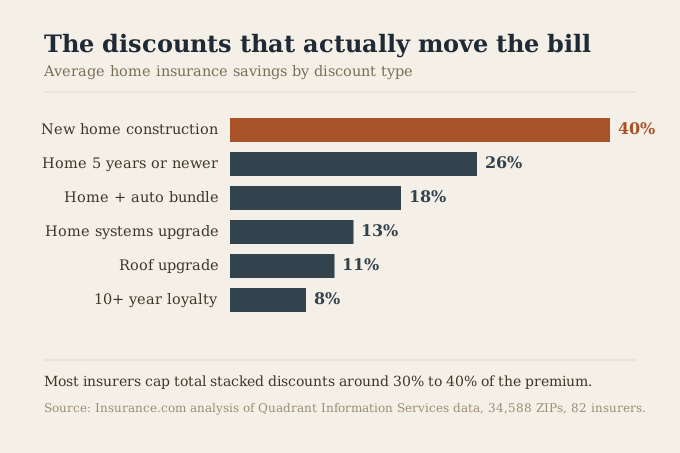
- New home construction is the single biggest discount at an average 40% off; bundling home and auto is the biggest discount most existing homeowners can act on today, at an average 18%.
- Discounts commonly stack, but most insurers cap the combined total around 30% to 40% of the premium, so collecting every discount rarely adds up to the sum of each percentage.
- The smallest, most commonly advertised discounts (smoke detector 2%, deadbolt 1%) move the bill the least; bundling, roof upgrades, and claims-free history move it the most.
The biggest home insurance discount is new construction, an average 40% off, followed by bundling home and auto at 18%, the largest discount most existing homeowners can act on today. Most insurers cap total stacked discounts around 30-40% of the premium. This report ranks every major discount by its real average savings, based on rate data across 34,588 ZIP codes and 82 insurance companies, so the ones worth pursuing are clear from the ones that are mostly marketing. This page is reviewed by the SwitchWize Editorial Team; the figures are sourced below with dates.
The full discount list, ranked
- Average savings
- 40%
- Notes
- Largest discount; varies by insurer (one major carrier offers up to 76%)
- Average savings
- 26%
- Notes
- Cannot be earned retroactively on an older home
- Average savings
- 18%
- Notes
- The largest discount most existing homeowners can act on today
- Average savings
- 13%
- Notes
- Average savings
- 13%
- Notes
- Requires documented upgrades, not just an older system still working
- Average savings
- 11%
- Notes
- Average savings
- 11%
- Notes
- A Class 4 impact-resistant roof alone can save 15-25%, up to 35% in high-hail states
- Average savings
- 9%
- Notes
- Average savings
- 8%
- Notes
- Average savings
- 8%
- Notes
- Only helps if your loyalty rate is still competitive; reshop to confirm
- Average savings
- 6%
- Notes
- Average savings
- 5%
- Notes
- Average savings
- 5%
- Notes
- Stacks with, but is distinct from, the broader Class 4 roof discount above
- Average savings
- 4%
- Notes
- Central station or fire department monitoring, not a standalone smoke detector
- Average savings
- 4%
- Notes
- Central station or police monitoring
- Average savings
- 2%
- Notes
- Basic, unmonitored device
- Average savings
- 1%
- Notes
- Average savings
- 1%
- Notes
Most insurers cap total stacked discounts around 30% to 40% of the premium, so a homeowner who qualifies for several of the smaller discounts above should not expect them to add on top of each other without limit.
Why the size gap matters
The list above is not evenly spread; it is lopsided toward a handful of large discounts and a long tail of small ones. New construction and home age make up the top of the list because insurers price almost entirely on expected claims, and a newer home's wiring, plumbing, and roof statistically fail and leak far less often than an older home's. Those discounts are real, but they are not actionable for most existing homeowners, since you cannot retroactively make your house five years old.
What is actionable is the next tier down: bundling (18%), a roof upgrade (11%, or 15-25% for a full Class 4 roof), and an upgrade package covering electrical, heating, and plumbing (13%). These require either a decision (switch your auto policy to the same insurer as your home) or a capital project you may already be planning (a roof replacement), rather than a home you would need to rebuild. The security-device discounts at the bottom of the list, smoke detectors, deadbolts, storm shutters, cost little to claim but move the bill by only a point or two each. Worth mentioning if you already have the equipment; not worth installing new equipment purely to chase the discount.
The honest counterargument
Discount percentages and availability vary meaningfully by state and insurer; the figures above are national averages, and a specific company might offer more or less for the same qualifying factor. One major carrier, for example, offers up to 76% for new construction against the 40% national average, per the same analysis. Advertised discount rates on a company's marketing page can also run higher than what a customer actually receives after underwriting, since eligibility rules narrow who qualifies for the advertised maximum.
None of that changes the ranking. Even allowing for company-by-company variation, bundling and home-condition discounts consistently outrank device-based discounts across insurers, because they reflect underwriting factors (a second policy, a newer roof) that materially change expected claims, not a $20 hardware purchase. The specific percentage may move; which discounts are worth prioritizing generally does not.
What to actually do
Ask your current insurer for a complete list of every discount it offers, not just the ones featured on its website, since some are not advertised but are available on request. If you have not bundled home and auto with the same company, get a quote for doing so before assuming your current split-carrier setup is cheaper. If a roof replacement is already on your list for maintenance reasons, ask specifically about impact-resistant (Class 4) roofing materials before the work starts, since the discount can be meaningfully larger than a standard replacement. And reshop at renewal: loyalty discounts only help if the underlying rate they are discounting is still competitive, which reshopping is the only way to confirm.
Methodology
Discount percentages are drawn from Insurance.com's analysis of home insurance rate data, sourced from Quadrant Information Services across 34,588 ZIP codes and 82 insurance companies. National average premium figures ($1,428/year for $250,000 of dwelling coverage; $2,151-$2,868/year range) are from the Insurance Information Institute. Individual insurer discount amounts, stacking rules, and eligibility vary by state and company; the figures here are national averages intended to rank discounts by typical size, not to quote your specific premium.
How we source this. Discount data is Insurance.com's analysis of Quadrant Information Services rate data; premium averages are the Insurance Information Institute's, both cited with sources. See our methodology and editorial team. We take no payment for organic rankings.
Sources
- Insurance.com, Best Homeowners Insurance Discounts, rate analysis via Quadrant Information Services across 34,588 ZIP codes and 82 insurance companies.
- Insurance Information Institute, national average homeowners insurance premium data.
Figures are current as of mid-2026 and vary by state, insurer, and individual home. This page is informational, not financial or insurance advice. Free to cite with attribution to SwitchWize.
Frequently Asked Questions
What is the biggest home insurance discount?
How much do you save by bundling home and auto insurance?
Can home insurance discounts be combined?
Do smoke detectors and deadbolts actually lower my premium?
What is the average cost of home insurance in 2026?
The 5-minute money briefing
One email per week. New rates, fed moves, and what to actually do about them.
No spam. Unsubscribe anytime.
Answer a few questions about your situation and goals. Money Map points you to the highest-value next step across savings, mortgage, cards, and debt.
Editorial review
What changed since the last update
Was this guide helpful?
Found an inaccurate, outdated, or missing claim? Report a correction. We verify reports against the relevant source before changing a guide or ranking.
