- What is the mortgage rate now? Freddie Mac's weekly survey put the 30-year fixed rate at 7.28% on November 19, 2026. It was 7.11% a week earlier and 6.26% a year ago.
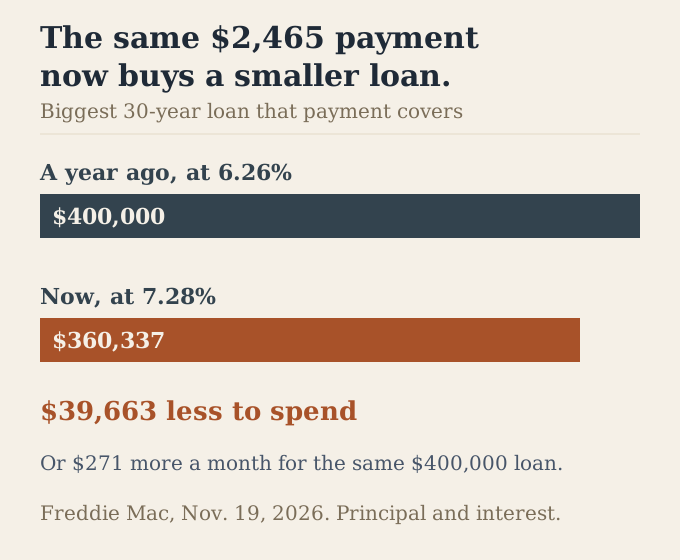
- A payment of $2,465.47 a month covered a $400,000, 30-year loan at 6.26%. At 7.28% that payment covers only $360,337, which is $39,663 less.
- Or keep the $400,000 loan and pay $271.38 more each month. That is about $3,257 a year, before taxes and insurance.
- The weekly average fell four weeks in a row, then turned up. It is one reading, and it can turn again.
Short answer: Freddie Mac's 30-year mortgage rate rose to 7.28% on November 19, 2026, from 7.11% a week earlier and 6.26% a year ago. The monthly payment that covered a $400,000 loan a year ago, $2,465.47, now covers only $360,337. That is $39,663 less. Or the same $400,000 loan costs $271.38 more each month.
Marisol ran her numbers last November. She had saved a down payment and worked out that she could afford a monthly mortgage payment of about $2,465. At the 6.26% rate she saw in the news, that payment paid for a $400,000 loan. She did not find a house she liked, and she decided to wait a year.
This week she ran the same math again. The answer was smaller.
The rate went up this week
Freddie Mac's weekly survey put the average 30-year fixed mortgage rate at 7.28% on November 19, 2026. A week earlier it was 7.11%, its lowest level in seven weeks. A year ago it was 6.26%. The 15-year loan averaged 6.66%, up from 6.45% a week earlier and 5.54% a year ago.
That ends a run of four weekly drops. The survey read 7.40% on October 15, then 7.32%, 7.24%, 7.18% and 7.11%. Our November 19 article explained why the drop was likely to reverse. The survey averages rates offered over the prior week, and the 10-year Treasury yield, which mortgage rates follow, had jumped after the window closed. This week's number covers that jump.
What the same payment buys now
Here is the math for a 30-year loan. All payments below are principal and interest only, which means they leave out property taxes and insurance.
A $400,000 loan at 6.26% costs $2,465.47 a month. At 7.11% it costs $2,690.83. At 7.28% it costs $2,736.85. The jump in one week adds $46.02 a month. The jump over one year adds $271.38 a month, or about $3,257 a year.
Turn it around. Marisol's budget is $2,465.47 a month. At 6.26% that covers a $400,000 loan. At 7.28% it covers $360,337. She can borrow $39,663 less, about 10% less. If she still wants a $400,000 loan, she also pays about $97,696 more interest over 30 years: $585,266 instead of $487,570.
Why the rate moved
Mortgage rates follow the 10-year Treasury yield, which is the rate the U.S. government pays to borrow for ten years. That yield rose from 4.84% on November 5 to 5.15% on November 13, after an October inflation report came in hotter than forecasters expected. Lenders raised their quotes to match. Freddie Mac's new number is the first weekly average that includes the move.
The Fed's own rate is not the direct cause. It raised its target range to 3.75% to 4.00% on September 16 and held it on October 28. Minutes of that October meeting, released November 18, showed officials expect more increases. Investors treat a quarter-point increase at the December 8 and 9 meeting as the likely outcome. Those expectations keep pressure on long-term yields.
How this compares with earlier years
Rates have been higher, and they have come down. Freddie Mac's survey peaked at 7.79% on October 26, 2023. At that rate a $400,000 loan cost $2,876.71 a month, which is $139.86 more than today. By December 28, 2023, the rate was 6.61% and the payment was $2,557.28. Over those nine weeks, the 10-year yield fell and the Fed had stopped raising rates.
This time the Fed has not stopped. The rate is now 1.02 percentage points higher than a year ago.
Where this math could mislead
Freddie Mac's survey is an average of real loan applications with a 20% down payment. Your offer can be higher or lower, depending on your credit score, down payment and the lender. Quotes we tracked earlier this month ran from below 7% at some lenders to above 8% at others.
This math also holds the loan term and budget steady. It ignores any change in home prices, property taxes and insurance over the year. And one week is only one reading. The rate fell four weeks in a row before this rise, and it can fall again if the 10-year yield eases.
What Marisol did next
Marisol did not give up on buying. She used a home affordability guide and the mortgage payment calculator to work out what to look for. She changed what she was shopping for. She set her price ceiling about $40,000 lower, at a $360,000 loan, to keep the payment near $2,465. Then she asked three lenders for same-day quotes with the same loan amount and no points. The lowest was a quarter point below her first quote. On $360,000, that saved her about $61 a month.
Sources
- Freddie Mac, Primary Mortgage Market Survey, release of November 19, 2026, read November 21, 2026. The 30-year averages (7.28%, 7.11%, 6.26% a year ago) and the 15-year averages (6.66%, 6.45%, 5.54%) are from that page.
- Freddie Mac weekly values for October 8 to November 12, 2026, as read for SwitchWize's November 19, 2026 article. The 2023 values (7.79% on October 26 and 6.61% on December 28) are from the same source.
- Board of Governors of the Federal Reserve System, 10-year Treasury constant-maturity yield (DGS10), via FRED, as read for SwitchWize's November 19, 2026 article.
- Federal Reserve, FOMC statement, October 28, 2026. Coverage of the October meeting minutes released November 18, 2026: Anchorage Daily News.
- Payments and loan sizes are SwitchWize calculations using standard 30-year fixed-rate loan math.
Marisol is a composite character. The rates, yields and historical figures are real. Payments are principal and interest only, before taxes and insurance. Rates were checked on November 21, 2026 and can change after publication. This article is educational information, not individualized financial advice.
Quick answers
What is the average mortgage rate right now? Freddie Mac's weekly survey put the 30-year fixed rate at 7.28% on November 19, 2026. The 15-year rate averaged 6.66%.
How much more does 7.28% cost than a year ago? On a $400,000 loan, $271.38 more a month, or about $3,257 a year, before taxes and insurance.
How much less can I borrow? The payment that covered $400,000 at 6.26% covers $360,337 at 7.28%. That is $39,663 less.
Did the Fed cause the rise? Not directly. Mortgage rates followed the 10-year Treasury yield up in mid-November. The Fed's next meeting is December 8 and 9.
What to Do Now
Frequently Asked Questions
What is the average mortgage rate right now?
How much more does a 7.28% rate cost than a year ago?
How much less can I borrow at 7.28% for the same payment?
Did mortgage rates rise because of the Fed?
The 5-minute money briefing
One email per week. The biggest changes in savings, money market, checking and CD rates.
Send me the weekly SwitchWize rate briefing: the biggest changes in savings, money market, checking and CD rates. Unsubscribe in one click. We never share your address.
Act on this: today's top mortgage



Ranked by SwitchWize's composite score. Some partner links may compensate SwitchWize.
Editorial review
What changed since the last update
Was this guide helpful?
Found an inaccurate, outdated, or missing claim? Report a correction. We verify reports against the relevant source before changing a guide or ranking.
