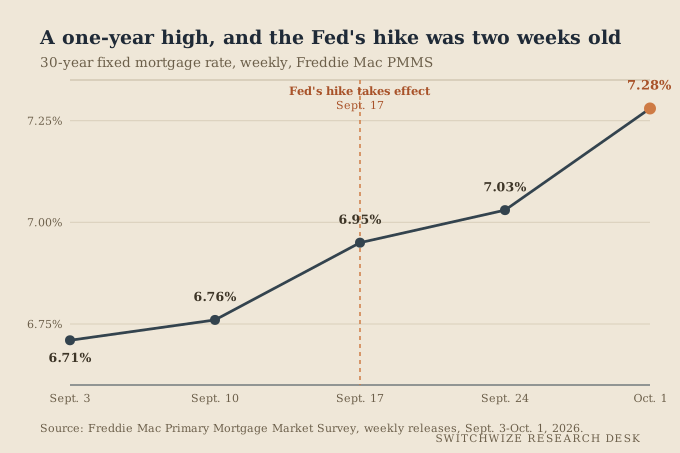
- The 30-year mortgage rate hit 7.28% on October 1, 2026, the highest in a year, per Freddie Mac. It rose 52 basis points in the three weeks after the Fed's own quarter-point hike on September 16, more than double the size of that hike.
- The real driver is the 10-year Treasury yield, which reached 5.33% on October 1, its highest level since early 2002, on oil prices tied to the Iran conflict and bets on another Fed hike rather than a cut.
- On a $320,000 loan, today's national average rate costs about $200 more a month than the same loan a year ago, and about $192 more a month than SwitchWize's best tracked rate, 6.38% at Langley FCU.
Diane, 41, had a rate lock expiring in nine days and a lender who kept calling to say rates were "all over the place because of the Fed." She almost believed it. The Fed had, in fact, just raised its overnight rate by a quarter point on September 16. But Diane's own loan estimate had moved by more than four times that in the three weeks since, and the Fed funds rate explains only a sliver of why. Diane is a composite. Her lender's story, that the Fed is the reason her mortgage rate keeps climbing, is the one that keeps her and most borrowers from asking the next question: climbing compared to what, and because of what.
A one-year high, three weeks in the making
The 30-year fixed mortgage rate averaged 7.28% as of October 1, 2026, Freddie Mac reported, up from 7.03% the week before. A year earlier, on October 1, 2025, it averaged 6.34%. That single week's jump, 25 basis points, is as large as the Fed's entire September rate move.
It did not happen all at once. Freddie Mac's weekly survey shows the climb: 6.71% on September 3, 6.76% on September 10 (the week before the Fed's decision), 6.95% on September 17 (the week the hike took effect), 7.03% on September 24, and 7.28% on October 1, according to Freddie Mac's own weekly releases. Three of those five weekly increases happened before or during the week of the Fed's announcement. The two biggest, including the jump to a one-year high, happened after it, when the Fed itself had already acted and had nothing left to announce.
Freddie Mac's chief economist, Sam Khater, put it plainly in the September 10 release, a week before the Fed met: "Aspiring buyers should remember shopping around for the best mortgage rate and getting multiple quotes can potentially save them thousands." He said that before the hike moved anything, because the rate was already climbing for reasons that had nothing to do with that week's Fed meeting.
Why mortgage rates don't take their cue from the Fed
A 30-year mortgage is a long-term loan. The Fed's rate decision sets the cost of overnight bank lending, a short-term number. What actually prices a 30-year mortgage is closer to the 10-year Treasury yield, the rate the government pays to borrow for a decade, plus a spread that covers a lender's costs and risk. When long-term borrowing costs rise for reasons unrelated to the Fed's overnight rate, mortgage rates can rise right alongside them, Fed decision or not. Our explainer on why mortgage rates won't just follow the Fed walks through that spread in more detail; the short version is that the Fed sets one end of the rope, and the market pulls on the other.
The 10-year Treasury yield reached 5.33% on October 1, 2026, its highest level since early 2002, and the 30-year Treasury yield climbed to about 5.67%, also a 2002-era high, Trading Economics reported the same day. The 2-year yield, the maturity most sensitive to the Fed's own near-term moves, sat at 4.91%, far below the 10-year. That gap is the proof: if the Fed's hike were doing the driving, the short end would be moving the most. Instead the long end, the one mortgage rates track, is moving more.
Two forces are pushing that long end up, and neither is the Fed's overnight rate. The first is oil. The conflict between the United States and Iran, which escalated again earlier this year, has kept crude prices elevated, and a 20% rise in oil prices translates to roughly three-tenths of a percentage point of added inflation, Charles Schwab's fixed income team has estimated in its research on the conflict's effect on bond markets. Bond investors demand a higher yield to hold a 10-year loan when they expect inflation to erode its value over that decade, and oil-driven inflation does exactly that. The second is that traders are no longer betting on relief. Trading Economics reported that investors "continued to believe the Fed would need to raise rates further to address inflationary pressures," not fewer. A market pricing in another hike, on top of oil-driven inflation fears, pushes the 10-year yield up from both directions at once.
The Fed's hike still played a small part
None of this means the Fed's September 16 decision was irrelevant. Raising the overnight rate is itself a signal that the central bank sees inflation as a live problem, and that signal can feed into the same long-term expectations driving Treasury yields higher. The data makes it hard to isolate the Fed's own contribution cleanly: the hike landed in the same three-week window as the oil-driven yield move, so some of the rise after September 16 is almost certainly the market absorbing the Fed's own message, not only the geopolitical news. What the timing does rule out is the simpler story Diane's lender told her, that the Fed's quarter-point move explains a jump more than twice its own size. The more complete answer is that an oil shock, renewed rate-hike bets, and the Fed's own signal are moving in the same direction together, and the first two account for most of the distance.
What the higher rate means in dollars
The math is simple amortization on a $320,000 loan, 20% down on a $400,000 home, the same scenario Freddie Mac's own survey assumes for a borrower with excellent credit. At a year ago's 6.34%, the principal-and-interest payment was $1,989 a month. At today's 7.28% national average, it is $2,189, about $200 more a month and roughly $72,000 more in total interest if the loan is held the full 30 years.
That national average is not the only rate on the market today. SwitchWize's own tracked rates for a 30-year fixed loan, verified October 1, 2026, range from 6.38% at Langley FCU to 7.03%, visible on our mortgage comparison page. At 6.38%, the same $320,000 loan costs $1,997 a month, about $192 less than the national average, and roughly $69,000 less in interest over 30 years. That gap is almost exactly the same size as the year-over-year increase this piece opened with: a Fed-driven news cycle one borrower cannot control is roughly matched, dollar for dollar, by a shopping decision the same borrower can.
What to do with a rate that's moving for reasons you can't control
A borrower cannot change the price of oil or when the war in Iran ends, and the data above shows that is most of what moved this rate. What a borrower can control is whether they get one quote or several. Three or more loan estimates from different lender types, a national bank, an online lender, and a credit union, routinely turn up a spread as wide as the one between today's national average and SwitchWize's best tracked rate. Our refinance guide covers the separate question of whether locking in a rate now versus waiting makes sense when the trend itself is still rising. A rate lock, typically 30 to 60 days, protects a buyer under contract from further moves while the loan closes.
What Diane did
Diane's rate lock had nine days left. She did not wait to see whether the Treasury yield would come back down, because nothing in the data suggested it would before her lock expired. Instead she requested two more loan estimates the same afternoon, from a credit union and an online lender her original lender had not mentioned. One came back at 6.9%, close to the number her lender had quoted. The other, from a credit union with a narrower branch footprint but no complaints about it on the rate, came back at 6.51%, a difference of about $87 a month on her loan size. She locked the credit union's rate the next morning, five days before her original lock would have expired anyway.
Quick answers
Why are mortgage rates going up right now? Mostly because the 10-year Treasury yield has climbed to its highest level since 2002, driven by oil prices tied to the Iran conflict and by traders pricing in another Fed hike instead of a cut. The Fed's own September hike is a smaller part of the story than the timing makes it look.
Is 7.28% a normal mortgage rate? It is a one-year high as of October 1, 2026, and well above the 2.65% record low set in January 2021, but still below the 7.79% cycle peak reached in October 2023. Rates this decade have ranged across both extremes within a few years.
How much can shopping around actually save? On a $320,000 loan, the gap between SwitchWize's best tracked rate and the national average is about $192 a month, or roughly $69,000 in interest over 30 years if the loan runs to term. Freddie Mac's own chief economist has said multiple quotes can save a buyer thousands.
Methodology
Weekly 30-year fixed mortgage rate figures come from Freddie Mac's Primary Mortgage Market Survey press releases for September 10, 17, and 24 and October 1, 2026, each opened directly at freddiemac.gcs-web.com, plus the September 3 figure cited in the September 10 release as the prior week's reading. The survey covers conventional, conforming, fully amortizing purchase loans for borrowers with excellent credit and 20% down. Treasury yield figures are from Trading Economics' October 1, 2026 report. The oil-to-inflation estimate is from Charles Schwab's fixed income research team. Payment figures are standard 30-year fixed amortization on a $320,000 loan with no points or fees, calculated independently and not inclusive of taxes or insurance. SwitchWize's best tracked 30-year rate reflects live rate observations verified October 1, 2026. The 2021 record low and 2023 cycle peak are also Freddie Mac PMMS figures, independently reported. Diane is a composite character; her situation is illustrative, and the math is real.
Sources
- Freddie Mac: Mortgage Rates Average 7.28%, Oct. 1, 2026
- Freddie Mac: Mortgage Rates Average 7.03%, Sept. 24, 2026
- Freddie Mac: Mortgage Rates Average 6.95%, Sept. 17, 2026
- Freddie Mac: Mortgage Rates Average 6.76%, Sept. 10, 2026
- Trading Economics: US 10-Year Treasury Yield Highest Since 2002, Oct. 1, 2026
- Charles Schwab: The Bond Market: Iran, Inflation & Interest Rates
- Freddie Mac: After a Multi-week Climb, Mortgage Rates Level Off, Nov. 2, 2023 (reporting the prior week, Oct. 26, 2023, at 7.79%, that cycle's peak)
- Freddie Mac: Mortgage Rates Hit a New Record Low the First Week of 2021, Jan. 7, 2021
- SwitchWize mortgage rate tracking, verified Oct. 1, 2026
Frequently Asked Questions
Why are mortgage rates going up in 2026?
Does the Fed control mortgage rates?
What is the average 30-year mortgage rate right now?
How much does shopping around for a mortgage actually save?
The 5-minute money briefing
One email per week. New rates, fed moves, and what to actually do about them.
No spam. Unsubscribe anytime.
Act on this: today's top mortgage

Ranked by SwitchWize's composite score. We may earn a referral fee, and it never changes the ranking order.
Editorial review
What changed since the last update
Was this guide helpful?
Found an inaccurate, outdated, or missing claim? Report a correction. We verify reports against the relevant source before changing a guide or ranking.