- The poverty premium is real: the same loans, banking, and insurance cost low-income households more, which makes escaping poverty harder.
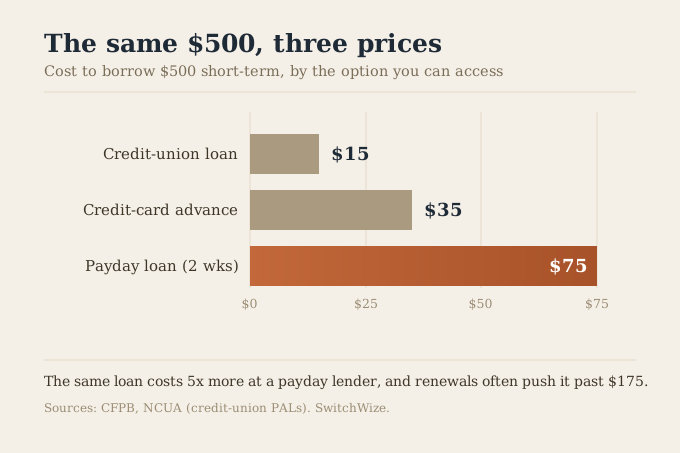
- A $500 emergency costs about $15 at a credit union but roughly $75, and far more after renewals, at a payday lender near 400% APR; weak credit adds about $1,600 a year to car insurance.
- The premiums compound into a trap, but they are beatable one step at a time: a mainstream bank account, a lower-cost loan, a credit-building step.
There is a cost that never appears in any budget line, because it is charged only to people who cannot afford it: the premium for being poor. The same emergency loan, the same paycheck cashed, the same car insured, all cost more when your income is low and your credit is thin. Each surcharge is defended as risk-based pricing, and each one, individually, looks small. Together they form a system in which having little money is itself expensive, and in which every extra dollar extracted makes the next shortfall more likely. This report puts numbers on that system, and maps the routes out of it. This page is reviewed by the SwitchWize Editorial Team; the figures are sourced below with dates. Understanding the cost of being poor is the first step toward breaking free from this cycle of compounding financial disadvantage.
The numbers
Four figures define the landscape:
- The lending premium. A payday loan runs about $15 per $100 for two weeks, an APR near 400%, per CFPB, versus roughly $15 to $20 for the same $500 through a credit-union loan.
- The insurance premium. A driver with a poor credit-based insurance score can pay about $1,600 more a year for identical car insurance than one with strong credit.
- The banking premium. About 5.6 million US households are unbanked and another 14% underbanked, per FDIC, paying 1.5% to 3% of each check to cash it.
- The compounding. Each premium worsens the others, so the total drain is larger than any single line, and it falls entirely on those least able to absorb it.
Put together, these describe not a set of unlucky prices but a structure: a poverty premium that taxes the condition of being poor and, in doing so, helps keep people there.
- The cost
- ~$15 per $100 / 2 wks (~400% APR)
- Source
- CFPB
- The cost
- ~$1,600 more a year
- Source
- Industry analysis
- The cost
- ~5.6 million (1.5%-3% per check)
- Source
- FDIC
- The cost
- ~$75+ vs ~$15
- Source
- CFPB / NCUA
- The cost
- ~41% of income
- Source
- Census
The lending premium
The clearest premium is the price of borrowing a small amount. When a car repair or a medical bill hits and there is no cushion, someone with good credit taps a card at around 20% or a bank loan cheaper still, while someone without those options faces a payday loan at nearly 400%. On $500, the two-week fee is about $75, but the structure is the trap: the whole balance plus fee is due on the next payday, so borrowers who could not spare $500 in the first place often cannot repay it, and renew, paying the fee again. A $500 loan renewed a few times commonly costs $175 or more.
The escape exists and is underused. A credit-union payday alternative loan (PAL) is capped near 28% APR and can cover the same $500 for roughly $15 to $20. The gap between $175 and $15 for the identical need is the poverty premium in a single transaction:
Annualize an entered short-term loan fee and compare it with a user-entered alternative APR over the same period.
Enter the fee disclosed for the specific short-term loan
Enter an available alternative quote; eligibility and fees vary
Effective APR of the Payday Loan
391.1%
Use this result as one input in your broader Money Map, not as a one-off number.
What to do
Compare personal loan rates
Pre-tax estimates. For illustration only — not financial advice.
The banking premium
Beneath the lending premium is a more basic one: the cost of not having a bank account. About 5.6 million US households are unbanked, and another 14% are underbanked, and they pay to do what a checking account does for free. Check-cashers take 1.5% to 3% of each check; money orders and prepaid cards carry per-use fees; paying bills without an account adds cost and friction at every step. Over a year the fees run to hundreds of dollars, and over a working life into the thousands, money a person with a free account simply keeps.
Overdraft belongs here too. As our overdraft report shows, those fees are concentrated on frequent overdrafters who skew lower-income, so the roughly $27-a-hit charge lands hardest on the households closest to zero. Opening a low-fee or free bank account is usually the single highest-value move out of the premium:
See what overdraft fees really cost you over a year and how much you keep by switching to a no-overdraft-fee checking account.
Annual Overdraft Cost
$1,260
Use this result as one input in your broader Money Map, not as a one-off number.
What to do
Compare no-overdraft-fee checking accounts
Pre-tax estimates. For illustration only — not financial advice.
The credit premium
The most insidious premium is charged through credit itself, because it reaches beyond loans. Most insurers use a credit-based insurance score to price car and home coverage, so a driver with weak credit pays about $1,600 more a year for the same policy as one with strong credit and an identical record. Landlords and utilities demand larger deposits from people with thin or poor credit. And subprime pricing follows low-credit borrowers into car loans, furniture, and more.
The result is that a low credit score is not just a lending problem; it is a surcharge on ordinary life. That also points to the highest-leverage escape: building credit lowers loan rates, insurance premiums, and deposits all at once, which is why it belongs at the center of any plan to beat the premium.
Why it is a trap, not just a cost
Each premium alone is survivable. What makes the poverty premium a trap is that the pieces reinforce each other. Low credit raises insurance and deposits, draining cash. The drain forces high-cost borrowing, which worsens credit. Worse credit raises the next premium. A single unexpected expense can set the loop spinning, and the loop is self-funding, because every turn extracts money that would otherwise have gone to the account, the lower-rate loan, or the credit-building payment that breaks it.
Seeing it as a loop rather than a list of prices is what makes it beatable, because it means a single well-placed step, opening the account, refinancing the payday loan, making the on-time payment, does double duty: it stops one drain and weakens the next. The premium was built one surcharge at a time, and it comes apart the same way.
The honest counterargument
Not every premium is pure exploitation. Some reflects genuine cost or risk: a small, short-term unsecured loan to a borrower with no credit history really is riskier to make, and pricing that risk is not by itself unjust. Servicing a check-cashing customer has real costs, and a thin-file borrower is, statistically, a less certain bet. It would be simplistic to call every higher price a scam.
But risk-based pricing does not explain the whole gap, and it does not make the effect any less damaging. A 400% APR is far above what default risk alone justifies, credit-based insurance scoring charges more for a circumstance rather than a behavior, and the compounding structure has no efficiency rationale at all. The honest reading is that the poverty premium is part real cost and part extraction, and that the policy response, and the personal one, is the same: widen access to the mainstream, lower-cost options that already exist, so fewer people are forced to pay the premium in the first place.
Methodology
The payday figures are CFPB data on typical fees and APR; renewal costs vary by state and borrower. The credit-based insurance figure is an industry-analysis estimate of the average premium difference between poor and strong credit-based insurance scores, which varies by state, insurer, and driver, and is banned or restricted in a few states. Unbanked and underbanked counts are FDIC survey data. The housing-burden figure is Census data for households earning under $30,000. The "poverty premium" is a well-documented concept without a single official US dollar total, so we quantify its components rather than a headline sum. A machine-readable version of these figures is published at /data/poverty-premium.json. Nothing here is individualized financial advice.
How we source this. Lending figures come from the CFPB, banking data from the FDIC, insurance figures from industry analysis, and housing data from the Census, all cited with dates. See our methodology and editorial team. We take no payment for organic rankings.
Sources
- Consumer Financial Protection Bureau, payday loans: typical fees and ~400% APR.
- FDIC, 2023 National Survey of Unbanked and Underbanked Households.
- Industry analysis on credit-based insurance scores and premium differences; US Census data on housing cost burden by income; NCUA on payday alternative loans (PALs).
Figures are current as of mid-2026 and vary by state and circumstance. The poverty premium is quantified by component; there is no single official total. This page is informational, not financial advice. Free to cite with attribution to SwitchWize.
What to Do Now
Frequently Asked Questions
What is the poverty premium?
How much does a payday loan really cost?
Why do people with bad credit pay more for car insurance?
How much does it cost to be unbanked?
How do you escape the poverty premium?
The 5-minute money briefing
One email per week. New rates, fed moves, and what to actually do about them.
No spam. Unsubscribe anytime.
Answer a few questions about your situation and goals. Money Map points you to the highest-value next step across savings, mortgage, cards, and debt.
Editorial review
What changed since the last update
Was this guide helpful?
Found an inaccurate, outdated, or missing claim? Report a correction. We verify reports against the relevant source before changing a guide or ranking.