- A full US financial identity is buildable without a Social Security number: an ITIN can substitute for banking, credit, and taxes.
- Open a bank account first (many banks accept a passport and ITIN), then build credit from zero with a secured card and rent reporting.
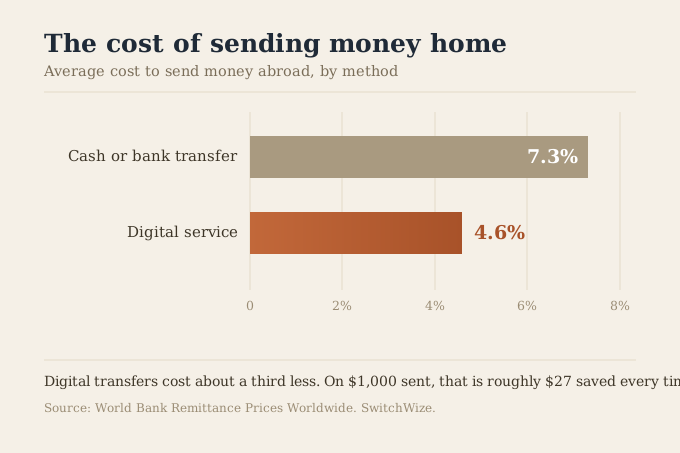
- Send money home through a low-cost digital service, which averages about 4.6% versus 7.3% for cash or bank transfers, saving roughly a third.
Moving to the United States means starting your financial life from nothing, not because you lack money or discipline, but because the system has no record of you. No credit history, so lenders cannot price you. Often no Social Security number, which so much of American finance is keyed to. And frequently money to send back home, through channels that quietly take a large cut. It can feel like a set of locked doors. The reassuring truth is that every one of them opens, in a known order, and you do not need an SSN to walk through them. This playbook is that order. This page is reviewed by the SwitchWize Editorial Team; the figures are sourced below with dates. We'll start by showing you how to build credit as an immigrant, even without an established financial history in America.
The reframe: you're building an identity, not just an account
The obstacle for a newcomer is not money; it is invisibility. The US financial system runs on records, a credit file, a taxpayer number, an account history, and when you arrive you have none of them here. That is why the goal is not simply to open one account but to build a financial identity the system can recognize, piece by piece.
There are four pieces: a bank account, a credit history, a low-cost way to send money home, and a taxpayer number that ties it together. None requires a Social Security number, and each makes the next one easier. Build them in order and the locked doors open one after another.
Get banked: you don't need an SSN
The first and highest-value step is a bank account, and the common belief that you need a Social Security number to open one is usually wrong. Many US banks, including large national banks and online banks, will open an account with a passport and an ITIN, and some accept a foreign passport plus other identification.
This matters because immigrants are far more likely to be unbanked, and being unbanked is expensive: it means relying on check-cashers, money orders, and prepaid cards that skim fees off every transaction. A bank account keeps your money safe, lets it earn interest, and starts the record that supports everything else. Look for a low-fee or no-fee account, and keep the balance earning:
Build credit from zero
With an account open, build the credit history the system is missing. The mechanics are the same for a newcomer as for anyone starting out, with one added step. First, get an ITIN if you lack an SSN, since credit reporting is tied to one or the other. Then open a secured credit card with a bureau-reporting issuer, where a deposit becomes your limit, and use it for small purchases you pay in full monthly. Add your rent and utility payments to your file through a rent-reporting service, and consider becoming an authorized user on an established account.
Within roughly six months to a year, these steps produce a real credit score, which lowers the cost of future apartments, car loans, and eventually a mortgage. Our guide on building credit from scratch covers each step, and the calculator shows the path from a secured card to an unsecured one:
Track secured-card graduation readiness after on-time payments, utilization, balance payoff needed, deposit unlock value, score trend, review timing, and starter-card next step.
Months Remaining Until Typical Review
4 months
Use this result as one input in your broader Money Map, not as a one-off number.
What to do
Compare secured and starter cards
Pre-tax estimates. For illustration only — not financial advice.
Send money home for less
For many newcomers, sending money to family abroad is a regular and important expense, and the method quietly determines how much reaches them. Sending money abroad costs an average of about 6.4% of the amount worldwide, but the channel matters enormously: digital services average about 4.6%, while cash and bank transfers average about 7.3%, per World Bank data.
On a $1,000 transfer, that difference is roughly $27 saved every time, which compounds fast for regular remittances. Compare a few licensed digital providers on the all-in cost, the fee plus the exchange-rate markup, because a low advertised fee can hide a poor exchange rate. Choosing the cheapest reliable digital option is one of the easiest recurring savings a newcomer can capture.
Taxes and the ITIN
The piece that ties it together is the ITIN. An Individual Taxpayer Identification Number lets people who are not eligible for a Social Security number file US taxes, and it doubles as an identifier for banking and credit. Filing taxes with it, if you earn income in the US, builds an official financial record, can produce a refund or tax credits, and demonstrates compliance that helps with future financial and immigration applications.
Because residency-status rules can be complex, a tax professional experienced with immigrant filers, or a free VITA volunteer tax site, is worth using in your first year. Our first-time tax-filing guide is a starting point.
A note on what varies, and staying safe
Circumstances differ, and immigration status can affect which options and benefits apply, so treat this as a framework rather than a one-size guide. Two cautions matter especially for newcomers. First, scams target immigrants, from fake fee demands to predatory lenders and notario fraud; be wary of anyone asking for payment to unlock a benefit or promising guaranteed results. Second, shop and compare rather than accepting the first product offered, since newcomers are sometimes steered toward high-fee accounts and cards. The mainstream, low-fee options in this playbook are open to you; the goal is to reach them directly rather than through costly intermediaries.
Methodology
The remittance figures are World Bank Remittance Prices Worldwide global averages by method; costs vary by destination corridor and provider, so compare all-in cost for your specific route. The point that immigrants are more likely to be unbanked reflects consistent findings across FDIC and Federal Reserve research, though exact rates vary by year and population. ITIN, banking, and credit-reporting practices reflect current issuer and IRS rules, which differ by institution and can change. Nothing here is individualized financial, tax, or immigration advice.
How we source this. Remittance costs come from the World Bank, unbanked findings from FDIC and Fed research, and ITIN and credit practices from IRS and issuer rules, all cited with dates. See our methodology and editorial team. We take no payment for organic rankings.
Sources
- World Bank, Remittance Prices Worldwide: average cost of sending money abroad by method.
- FDIC and Federal Reserve research on unbanked and underbanked households, including the foreign-born population.
- IRS rules on the Individual Taxpayer Identification Number (ITIN); issuer practices for ITIN-accepting bank accounts and credit cards.
Figures are current as of mid-2026 and vary by corridor, institution, and status. This page is informational, not financial, tax, or immigration advice. Free to cite with attribution to SwitchWize.
Frequently Asked Questions
Can I open a US bank account without a Social Security number?
How do I build credit in the US as a newcomer?
What is the cheapest way to send money home from the US?
What is an ITIN and why do I need one?
Do immigrants need to file US taxes?
The 5-minute money briefing
One email per week. New rates, fed moves, and what to actually do about them.
No spam. Unsubscribe anytime.
Answer a few questions about your situation and goals. Money Map points you to the highest-value next step across savings, mortgage, cards, and debt.
Editorial review
What changed since the last update
Was this guide helpful?
Found an inaccurate, outdated, or missing claim? Report a correction. We verify reports against the relevant source before changing a guide or ranking.
