- Your one irreplaceable advantage is time: $200 a month invested from age 25 grows to roughly $525,000 by 65, versus about $244,000 starting at 35, for the same effort.
- Claim the full 401(k) match first (often a 50% instant return), split your paycheck automatically, and open a Roth IRA while your tax bracket is low.
- Build credit with one card paid in full, and handle student loans alongside saving, not instead of it.
The first real paycheck is a strange milestone. After years of being told to save, you finally have something to save, and no one hands you the instructions. What you do in the first month, though, matters more than almost anything you do later, because the systems you set up now run automatically for the next four decades, compounding quietly whether or not you think about them. The goal of this playbook is to make those setup decisions once, correctly, so the rest takes care of itself. This page is reviewed by the SwitchWize Editorial Team; the 2026 figures are sourced below with dates. We've distilled the essentials into a financial checklist for new graduates to ensure you hit every critical milestone.
Your one advantage: time
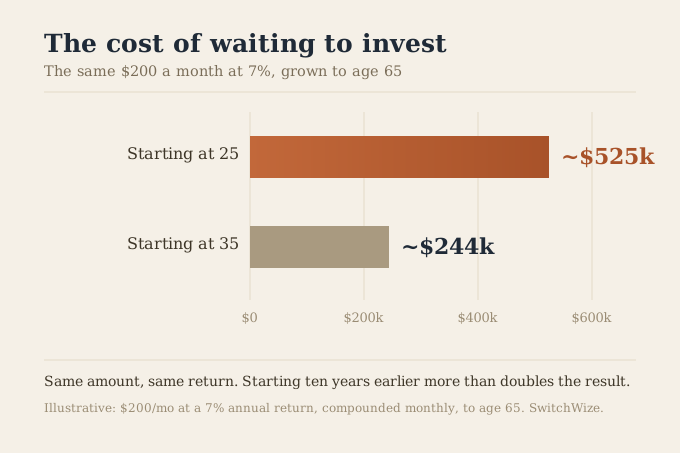
You will earn more later, but you will never again have as much of the one thing that matters most for building wealth: time for money to compound. The illustration above is the whole argument. Investing $200 a month from age 25 grows to roughly $525,000 by 65 at a 7% return; the identical $200 a month started at 35 grows to about $244,000. Same contribution, same return, less than half the result, because a ten-year head start lets four extra decades of growth stack on top of each other.
This is why the order of operations for a new grad is not "earn more first, then save." It is "start now, even small." A modest amount invested early beats a large amount invested late, and no future raise fully makes up for the years you did not start. Everything below is in service of starting now.
Set up the paycheck before you can spend it
The most reliable money system is the one you never have to think about. Two setups do most of the work. First, capture the full 401(k) match. The average employer match is around 4.5% of salary, commonly 50 cents per dollar up to 6% of pay. Contributing enough to get the full match is not optional saving; it is claiming an instant return of roughly 50% that you forfeit entirely if you skip it. Nothing else in finance reliably pays that.
Second, split your paycheck automatically. Direct part of each deposit into savings and a separate account for fixed bills before the money reaches your spending account, so saving happens by default rather than by willpower. Automation is what turns good intentions into results.
Estimate the employee contribution needed to capture a user-entered employer-match formula and compare it with the current contribution scenario.
100% = dollar-for-dollar match, 50% = fifty cents per dollar
The 2026 base limit is $24,500. Enter your higher applicable limit only if you are eligible for catch-up contributions.
Match Left on the Table
$1,800
Use this result as one input in your broader Money Map, not as a one-off number.
What to do
Compare IRA and 401(k) providers
Pre-tax estimates. For illustration only — not financial advice.
A budget that survives contact: 50/30/20
A budget only works if it is simple enough to keep. The 50/30/20 framework is a good default: roughly 50% of take-home pay for needs (rent, food, transportation, minimum debt payments), 30% for wants, and 20% for savings and extra debt payoff. If 20% is unrealistic at first because of rent or loans, start lower and raise the savings share with every raise, before lifestyle expands to absorb it.
The mechanic that makes any budget hold is the same as above: automate the savings portion so it leaves checking the day you are paid. What you cannot easily spend, you tend to keep.
Compare entered monthly spending with the 50/30/20 guideline and identify signed category differences.
Target Savings (20%)
$1,000
Use this result as one input in your broader Money Map, not as a one-off number.
What to do
Put your savings to work, compare savings rates
Pre-tax estimates. For illustration only — not financial advice.
Build credit and a starter safety net
Two foundations belong in the first year. Credit: use one card for small regular purchases and pay the statement balance in full every month, which builds a positive payment history, the largest factor in your score, without ever paying interest. Keep the balance low relative to the limit and never miss a due date. Good credit quietly lowers the cost of future car loans, mortgages, and even some insurance. Our guide on building credit from scratch covers the first card.
A starter emergency fund: aim first for a small buffer, then build toward three months of essential expenses. Keep it in a high-yield savings account, separate from spending, where it earns while it waits. These are current rates, live as of today, all FDIC-insured:
The Roth IRA is built for you right now
A Roth IRA is rarely a better deal than it is for a new grad. You contribute after-tax dollars and the money grows tax-free forever, so paying tax at today's rate and never again is a bargain precisely when your income, and your tax bracket, are as low as they will ever be. The 2026 Roth IRA income phase-out does not even begin until $153,000 for single filers, so nearly every new grad qualifies fully, up to the $7,500 annual limit.
Fund it after capturing the 401(k) match, and treat the two together: match first for the instant return, then the Roth for tax-free growth. Our contribution-limits guide has the current numbers.
Build a paycheck planning estimate using user-entered withholding rates and 2026 employee payroll-tax rules.
Estimate from your W-2 or last return
Varies by state. Many states have 0%
Estimated Net Take-Home Pay
$1,712
Use this result as one input in your broader Money Map, not as a one-off number.
What to do
See where to put your monthly cash surplus
Pre-tax estimates. For illustration only — not financial advice.
Handle student loans without stopping everything else
Student debt is real, the average borrower leaves school with about $39,457, but it should be one line in a balanced plan, not an emergency that halts saving for a decade. The sequence: always get the full 401(k) match first, because a 50% match beats almost any loan's interest rate. Then compare each loan's rate to expected investment returns. High-rate private loans are worth paying down aggressively; lower-rate federal loans can be paid on schedule while you also invest and build the safety net.
The instinct to throw every spare dollar at loans is understandable, but pausing retirement contributions in your twenties surrenders the exact head start the first section showed is so valuable. Balance beats all-or-nothing.
Methodology
The compounding figures assume $200 invested monthly at a 7% average annual return, compounded monthly, from age 25 versus 35 to age 65; 7% is an illustrative long-run assumption, not a guarantee, and real returns vary. The 401(k) match figures are 2026 employer-plan averages that differ by company. Contribution limits and the Roth income phase-out are the IRS's 2026 figures. The student-debt figure is a 2026 national average that varies widely by degree and school. The 50/30/20 split is a guideline, not a rule. Nothing here is individualized financial advice.
How we source this. Contribution limits and Roth phase-outs come from the IRS, match and student-debt figures from 2026 industry data, and the compounding math is standard, all cited with dates. See our methodology and editorial team. We take no payment for organic rankings.
Sources
- IRS, 2026 contribution limits and Roth IRA income phase-outs.
- Education Data Initiative, average student loan debt at graduation.
- 2026 employer 401(k) match averages; compounding figures are standard future-value math at an illustrative 7% return.
Figures are current for 2026 and vary by employer, school, and market. This page is informational, not financial advice. Free to cite with attribution to SwitchWize.
What to Do Now
Frequently Asked Questions
What should I do with my first paycheck out of college?
How much of my first salary should I save?
Should a new grad use a Roth or traditional retirement account?
Should I pay off student loans before investing?
How does a new grad build credit?
Answer a few questions about your situation and goals. Money Map points you to the highest-value next step across savings, mortgage, cards, and debt.
Editorial review
What changed since the last update
Was this guide helpful?
Found an inaccurate, outdated, or missing claim? Report a correction. We verify reports against the relevant source before changing a guide or ranking.
