- Americans pay about $12 billion a year in overdraft and NSF fees, at roughly $27 a hit, concentrated on frequent overdrafters who can least afford it.
- A 2024 rule would have capped most overdraft fees at $5, but Congress repealed it in 2025 before it took effect.
- Overdraft is among the most avoidable costs in finance: opt out of coverage, bank fee-free, and set alerts to pay zero.
Some bank fees pay for something. Overdraft fees mostly pay for a moment of inattention, and they are engineered to be triggered. When your balance dips below zero, the bank covers the shortfall and charges a flat fee, around $27, that often dwarfs the amount you were short. Multiply that across the country and it comes to roughly $12 billion a year, drawn heavily from the households living closest to the edge. This report lays out what overdraft really costs, why a rule that would have shrunk it never happened, and how to pay nothing. This page is reviewed by the SwitchWize Editorial Team; the figures are sourced below with dates. Understanding overdraft fees 2026 means recognizing how banks continue profiting from customers' financial mistakes.
The numbers
Four figures define the landscape:
- The total. Americans pay roughly $12 billion a year in overdraft and NSF fees, per CFPB and consumer-advocate data.
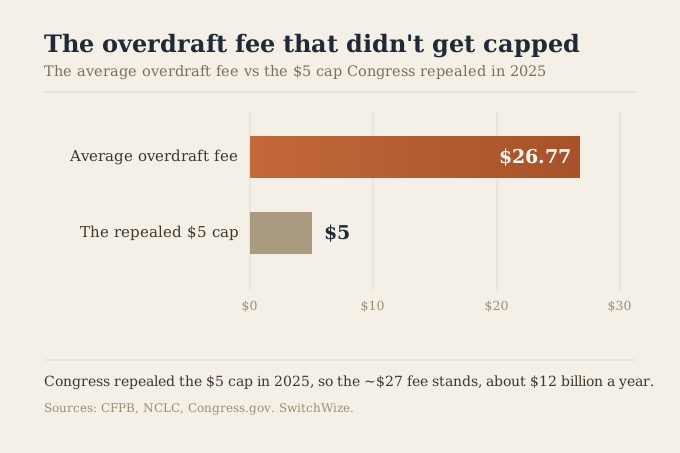
- The fee. The average overdraft fee is about $27, and the average NSF fee about $17.
- The cap that wasn't. A 2024 rule would have capped most overdraft fees at $5, before Congress repealed it in 2025.
- The savings lost. The cap was estimated to save households about $5 billion a year, roughly $225 for each family that pays these fees.
The pattern is a fee that is large relative to the shortfall it covers, applied automatically, and concentrated on a minority who overdraft often. That combination is what makes it a defining example of a junk fee.
- Value
- ~$12 billion
- Source
- CFPB / advocates
- Value
- ~$27
- Source
- 2025 data
- Value
- ~$17
- Source
- 2025 data
- Value
- $5
- Source
- CFPB (2024 rule)
- Value
- ~$5 billion
- Source
- CFPB
The fee engineered to trigger
Overdraft is unusual among fees because the bank designs the conditions that trigger it. When a debit-card purchase or payment would take your balance below zero, the bank can either decline it at no cost or approve it and charge a fee. Overdraft coverage, often enabled by default until you opt out, chooses the second, turning a declined $20 purchase into an approved one with a roughly $27 charge attached.
The result is a fee that is frequently larger than the shortfall it covers, applied to the people with the least cushion. Overdraft revenue is highly concentrated among frequent overdrafters, who skew lower-income, so a small stumble near payday produces a fee that makes the next stumble more likely. That is why it draws so much scrutiny: it is not priced like a service, it is priced like a penalty.
The $5 cap that Congress killed
For a moment, this was about to change. The Consumer Financial Protection Bureau finalized a rule in 2024 to cap most overdraft fees at the largest banks at $5, a change projected to save households about $5 billion a year. In 2025, Congress used the Congressional Review Act to repeal the rule, and it was signed into law before ever taking effect. The roughly $27 fee, and the roughly $12 billion in annual charges, remain in place.
The policy whiplash matters less than the takeaway for you: do not wait for a rule to protect you from this fee, because the rule that would have is gone. The protection you control is in the next section.
See what overdraft fees really cost you over a year and how much you keep by switching to a no-overdraft-fee checking account.
Annual Overdraft Cost
$1,260
Use this result as one input in your broader Money Map, not as a one-off number.
What to do
Compare no-overdraft-fee checking accounts
Pre-tax estimates. For illustration only — not financial advice.
How to pay zero
Overdraft is one of the most avoidable costs in personal finance, and three moves eliminate it. First, opt out of overdraft coverage on debit and ATM transactions, so a purchase that would overdraw your account is simply declined for free instead of approved with a fee. Second, bank somewhere fee-free; many online banks and a growing number of large banks charge no overdraft fee at all, so switching removes the risk entirely. Third, set a low-balance alert and keep a small buffer, so you are warned before you cross zero.
If a fee still slips through, call and ask for a waiver; banks routinely reverse them for customers in good standing. See our guide on avoiding overdraft fees, and check what a fee-free account looks like:
Calculate annual overdraft fees and the potential savings from a linked transfer or checking cash buffer.
Annual Overdraft Cost
$840
Use this result as one input in your broader Money Map, not as a one-off number.
What to do
Compare checking accounts
Pre-tax estimates. For illustration only — not financial advice.
The honest counterargument
Overdraft coverage is not pure predation. There are moments when having a payment go through, a rent check, a utility bill, beats having it bounce, since a bounced payment can trigger its own late fee or returned-payment charge. For someone facing that specific choice, paying an overdraft fee can be the lesser cost.
But that is a narrow case, and it does not justify the broader system. A roughly $27 fee to float a $20 shortfall for a few days is an astronomically expensive form of credit, and the far better protection, a linked savings account or a small buffer, costs nothing. The occasional legitimate use does not change the conclusion: for nearly everyone, overdraft is a fee to design out of your financial life, not one to rely on.
Methodology
The $12 billion annual total and the average fee figures are from CFPB research and consumer-advocacy analysis for 2024 to 2025; totals vary modestly year to year. The $5 cap and its repeal reflect the CFPB's 2024 final rule and the 2025 Congressional Review Act resolution that overturned it. Concentration among frequent overdrafters is a consistent finding across CFPB studies. A machine-readable version of the headline figures is published at /data/overdraft-fees.json. Nothing here is individualized financial advice.
How we source this. Fee totals and averages come from the CFPB and consumer advocates, and the rule's repeal from Congress, all cited with dates. See our methodology and editorial team. We take no payment for organic rankings.
Sources
- Consumer Financial Protection Bureau, overdraft research: fee totals, averages, and concentration.
- US Congress, repeal of the CFPB overdraft rule via the Congressional Review Act, 2025.
- National Consumer Law Center and industry data on 2024 to 2025 overdraft and NSF fee totals.
Figures are current as of mid-2026 and vary by year and bank. This page is informational, not financial advice. Free to cite with attribution to SwitchWize.
Frequently Asked Questions
How much are overdraft fees in 2026?
Why did the $5 overdraft cap not happen?
Who pays overdraft fees?
How do I avoid overdraft fees?
Is an overdraft fee ever worth it?
The 5-minute money briefing
One email per week. New rates, fed moves, and what to actually do about them.
No spam. Unsubscribe anytime.
Act on this: today's top checking



Ranked by SwitchWize's composite score. We may earn a referral fee, and it never changes the ranking order.
Editorial review
What changed since the last update
Was this guide helpful?
Found an inaccurate, outdated, or missing claim? Report a correction. We verify reports against the relevant source before changing a guide or ranking.
