- The best 5-year CD SwitchWize tracks jumped from 4.50% to 4.95% APY on September 29, 2026, when Popular Direct raised every CD term it offers. The best 1-year CD stayed at 4.45%.
- That makes the reward for locking up money four extra years about $125 a year on $25,000, up from about $12.50 a year on September 19. Held for five years, the 5-year CD earns about $751 more than rolling 1-year CDs at today's rate.
- The gap is not market-wide. Of 60 banks and credit unions SwitchWize tracks that post both terms, 33 pay less for five years than for one. And Popular Direct charges two years of interest for leaving its 5-year CD early.
Yes, a 5-year CD now pays clearly more than a 1-year CD, but only at the very top of the market. On September 30, 2026, the best 5-year CD SwitchWize tracks paid 4.95% APY, half a percentage point above the best 1-year CD at 4.45%. Most banks still pay less for five years than for one, so the gap exists only for savers who shop for it, and only for money that can stay locked up until 2031.
Lorraine, 63, has $25,000 sitting in a savings account from the sale of her late mother's car and furniture. She plans to use it for a new roof, probably in 2031, when the current one hits 25 years. On September 19 she read that a 5-year CD paid almost nothing extra over a 1-year, and decided to wait. Eleven days later, the gap she had decided to wait out was ten times wider. Lorraine is a composite. The rates she is weighing are real.
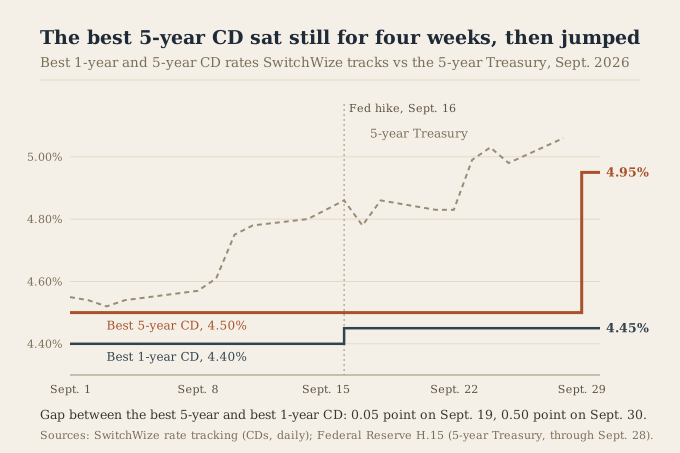
The top 5-year rate moved on September 29
Popular Direct, the online arm of Popular Bank, raised every CD term it offers between September 28 and September 29. Its 5-year CD went from 4.50% to 4.95% APY, its 3-year from 4.50% to 4.80%, and its 12-month from 4.25% to 4.40%, according to SwitchWize's daily readings of its rate page. The bank's own CD rate table showed the same figures on September 30: 4.95% for 60 months, 4.85% for 48 months and 4.80% for 36 months, each with a $10,000 minimum deposit.
That one change moved the top of the market. For the first 28 days of September, the best 5-year CD SwitchWize tracked sat at 4.50%, shared at times by Popular Direct, Bread Savings, Sallie Mae Bank and Third Federal. The best 1-year CD rose from 4.40% to 4.45% on September 16, when EagleBank took the top spot. That was the day the Fed raised its target range by a quarter point, to 3.75% to 4.00%. On September 19, the gap between the two was 0.05 point, about $12.50 a year on $25,000. On September 30 it was 0.50 point, about $125 a year.
How far CD rates trailed Treasury yields
Banks set their own CD rates, and those rates often trail what the government pays to borrow for the same length of time. In September, the government's 5-year borrowing cost rose much faster than the best 5-year CD.
The 5-year Treasury yield went from 4.55% on September 1 to 5.06% on September 28, a rise of about half a point, according to the Federal Reserve's H.15 release. The 1-year Treasury rose from 4.18% to 4.59% over the same stretch. So all month, the government paid between about 0.37 and 0.47 point more for five years than for one. The best CDs paid 0.05 to 0.10 point more.
That lag has a history. In 2023 and 2024, when markets widely expected the Fed to start cutting, banks paid more for short CDs than long ones: in mid-2024, as our earlier analysis noted, Capital One paid 5.00% on a 1-year CD and 3.90% on a 5-year. A bank that expects rates to fall does not want to promise today's rate for five years, so it pays less for long terms. After two years of Fed cuts and one surprise hike, most banks still price that way.
Most banks still pay less for five years
The 4.95% offer is an outlier, not a trend across banks. Of the 60 banks and credit unions in SwitchWize's tracking that post both a 1-year and a 5-year rate on September 30, 33 pay less for five years than for one, 11 pay the same, and 16 pay more. The middle 1-year rate among the banks we track is 3.85%; the middle 5-year rate is 3.00%. Some of the gaps are large: Citibank posts 4.25% for a year and 2.00% for five, and CIT Bank 4.00% for a year and 0.50% for five.
The FDIC's own averages, which cover far more banks, show the same shape. Its national rate table effective September 21, 2026 puts the average 12-month CD at 1.73% and the average 60-month CD at 1.38%. On $25,000, that is $432.50 a year for one year of commitment and $345 a year for five.
At a bank priced like that, a 5-year CD is the worse deal on both counts: a lower rate and a longer lock.
What the gap is worth on $25,000
Here is Lorraine's $25,000 under four outcomes. The first two assume she keeps the money in CDs the full five years; the last two assume she needs it early at Popular Direct, which charges 730 days of simple interest for cashing out a CD of 60 months or longer, according to the CD FAQ on its rate page. Its 5-year CD has a stated interest rate of 4.831%, which compounds to the 4.95% APY.
Held to the end, the 5-year CD earns about $6,831 in interest, against about $6,080 from five 1-year CDs at 4.45%: roughly $751 more. The 5-year comes out behind only if 1-year CD rates average more than about 5.08% over the following four years, which would take a much bigger rise than September's.
Breaking the CD early changes the math. The penalty, $25,000 times 4.831% times two years, comes to about $2,416. After one year the CD would have earned about $1,238, so the penalty is bigger than all the interest. After two years it would have earned about $2,536, leaving about $121. Rolling 1-year CDs over those same two years would have earned about $2,275.
Our guide to CD early-withdrawal penalties shows how to work out the break-even point for any bank's penalty.
The Treasury alternative
There is a second complication. On September 28, the 5-year Treasury note yielded 5.06%, a little more than the best 5-year CD, and Treasury interest is exempt from state and local income tax. For a saver in a state with an income tax, that difference grows; our chapter on Treasury interest and state taxes walks through it. A Treasury note has no early-withdrawal penalty, but selling one before it matures can mean a loss if rates have risen since it was bought, and a CD is FDIC insured up to $250,000 per depositor, per bank, per ownership category. The two yields are quoted slightly differently, so treat the comparison as close, not exact.
Matching the term to the date
Whether rates rise or fall next matters less here than when the money will be needed.
Money with a fixed date five or more years out can earn the top 5-year rate, and right now that rate pays a real premium over shorter CDs. Money that might be needed sooner belongs in a shorter CD or savings, because a 5-year CD with a two-year-interest penalty is a poor place for money with an uncertain date. And the 4.95% figure is not what most banks pay: at a bank paying less for five years than for one, a 5-year CD gets the worst of both.
Current CD rates by term are on our CD rate table, and savings rates are on the savings table. SwitchWize also tracks how banks passed through the September Fed hike.
What Lorraine did
Lorraine split the money by date instead of by forecast. She put $15,000, the part set aside for the roof, into the 5-year CD at 4.95%, a CD that matures in October 2031, a few months before the roofer's estimate says she will need it. The other $10,000 stays in a 1-year CD, because she might need part of it before then, and she would rather give up half a point on that money than risk paying two years of interest to get it back.
Quick answers
Is a 5-year CD worth it right now? For money you will not need for five years, yes, at the top of the market: the best 5-year CD paid 4.95% on September 30, 2026, against 4.45% for the best 1-year CD. For money you might need sooner, no, because the early-withdrawal penalty can exceed the interest.
Do most banks pay more for a 5-year CD? No. Of 60 banks and credit unions SwitchWize tracks that post both terms, 33 pay less for five years than for one.
How much more does the best 5-year CD earn? About $125 a year more than the best 1-year CD on $25,000, or about $751 more over five years if 1-year rates stay at 4.45%.
Methodology
CD rates are the best APY by term among banks and credit unions in SwitchWize rate tracking, read daily from September 1 to September 30, 2026; Popular Direct's figures were also checked against its own rate page on September 30. The 60-institution count includes every tracked bank or credit union with both a 12-month and a 60-month rate observed in the 30 days to September 30; the middle rates are medians across all tracked institutions for each term. Treasury yields are the Federal Reserve's H.15 constant-maturity yields, through September 28. FDIC averages are from its national rate table effective September 21, 2026. The $25,000 examples compound interest once a year at the stated APY, assume 1-year CDs renew at 4.45% each year, and apply Popular Direct's disclosed penalty of 730 days of simple interest at its 4.831% stated rate; actual penalties depend on each bank's account agreement. Lorraine is a composite character; her situation is illustrative, and the math is real.
Sources
- Popular Direct: CD rates and CD FAQ, checked Sept. 30, 2026
- Federal Reserve: H.15 Selected Interest Rates, release of Sept. 29, 2026
- FDIC: National Rates and Rate Caps, September 2026
- SwitchWize CD and Treasury rate tracking, Sept. 1 to Sept. 30, 2026
Frequently Asked Questions
Is a 5-year CD worth it right now?
Why do some banks pay less for a 5-year CD than a 1-year CD?
What is the penalty for breaking a 5-year CD early?
Is a 5-year Treasury better than a 5-year CD?
The 5-minute money briefing
One email per week. New rates, fed moves, and what to actually do about them.
No spam. Unsubscribe anytime.
Act on this: today's top cds



Ranked by SwitchWize's composite score. SwitchWize currently has no compensated product links.
Editorial review
What changed since the last update
Was this guide helpful?
Found an inaccurate, outdated, or missing claim? Report a correction. We verify reports against the relevant source before changing a guide or ranking.
