- Six U.S. banks have failed in 2026, the most since 2017. In every one, insured deposits of up to $250,000 per person, per bank, per ownership category moved to another bank or stayed fully protected.
- A CD's rate is the part that is not protected. The bank that takes over a failed bank's deposits can lower it. In 2009, a $100,000 CD went from 5.7% to 1.6%, or $4,100 less interest a year.
- The same rule lets the depositor leave with no early-withdrawal penalty. With the best 18-month CD at 4.40% today, a $100,000 CD cut from 4.00% to 3.00% would earn about $2,100 more over 18 months by moving.
When an FDIC-insured bank fails, deposits up to $250,000 per depositor, per bank, per ownership category are safe, and a CD keeps its balance and the interest it has already earned. What a CD does not keep for certain is its rate: the bank that takes over the deposits can lower it, and in return the depositor can leave without a penalty.
Gene, 68, read about Nano Banc over coffee on Saturday, September 26. California regulators had closed the Irvine bank the day before, and its only branch was set to reopen Monday under a different name. Gene has never banked there. But he has a $100,000 CD with 18 months left at a small bank near his house, paying 4.00%, and a sentence in the news story stopped him: the new bank would notify customers "in writing" of any rate changes. Gene is a composite. His question, whether a failure can change what his CD pays, is a real one, and the answer is yes.
Nano Banc's closure
The California Department of Financial Protection and Innovation closed Nano Banc on Friday, September 25, 2026, and named the FDIC as receiver, per the FDIC. The bank had $736 million in assets and $686 million in deposits as of June 30. Sunwest Bank of Sandy, Utah, agreed to take over substantially all of its deposits and buy about $476 million of its assets. The FDIC estimates the failure will cost the Deposit Insurance Fund about $114 million.
For depositors, the weekend was uneventful. Checks, debit cards and direct deposits kept working with the same account numbers, the FDIC's question-and-answer page says, and interest earned through September 25 is paid at the old rates. That same page carries the sentence that matters for anyone with a CD: depositors may withdraw from any transferred account "without an early withdrawal penalty until you enter into a new deposit agreement with Sunwest Bank," and Sunwest will tell customers in writing about any rate changes.
The state regulator had ordered the bank in March to raise its capital to at least 9.5% of assets or sell, merge or liquidate, Banking Dive reported. By September, its shareholder equity had fallen below the state's 3% legal minimum. An earlier Federal Reserve order had focused on how much of its lending was concentrated in commercial real estate.
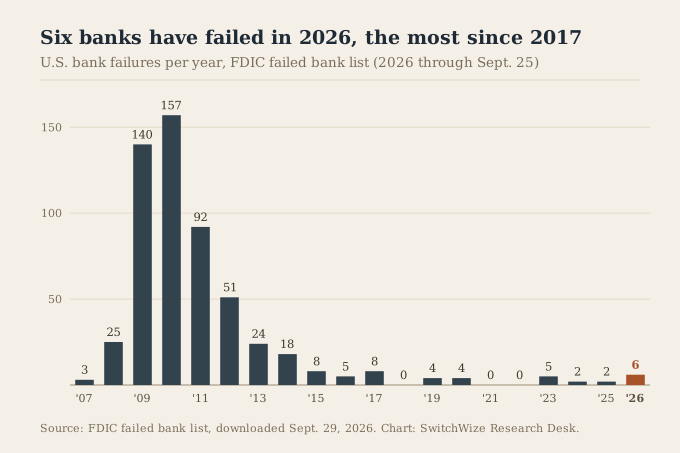
Bank failures since 2007
Nano Banc was the sixth U.S. bank to fail in 2026, and the largest this year, according to the FDIC's failed bank list. The others were Metropolitan Capital Bank & Trust in Chicago (January 30), Community Bank and Trust - West Georgia (May 1), Kentland Federal Savings and Loan Association in Indiana (July 10), Small Business Bank in Kansas (July 17) and Tioga-Franklin Savings Bank in Philadelphia (August 21).
Six is the most in a year since 2017, when eight banks failed. In 2024 and 2025, two failed each year, and none failed at all in 2018, 2021 or 2022. It is still a small number next to the last crisis: 140 banks failed in 2009 and 157 in 2010, and 389 failed from 2009 through 2011 alone.
Many of the documented cases of CD rates being cut after a failure come from those years, when hundreds of failed banks' deposits were being handed to new owners.
Insured deposits move to a new bank
The FDIC handles most failures in one of two ways, it explains in its deposit insurance guide. Usually it arranges for a healthy bank to take over the failed bank's deposits, which is what happened at Nano Banc. If no bank will, the FDIC pays depositors directly, by check, up to the insured amount, usually within a few days.
Either way, insured money is protected. Coverage is $250,000 per depositor, per insured bank, per ownership category, a limit made permanent by the Dodd-Frank Act on July 21, 2010. The FDIC says no depositor has lost a penny of insured funds since it began in 1934. Our guide to judging a bank's safety beyond FDIC insurance covers the payout timeline and how to size what you hold above the limit.
The new bank can change a CD's rate
A CD is a contract between a saver and a bank. When the bank fails, that contract goes with it. The bank that takes over the deposits gets the balances, but the FDIC says plainly that it has "no obligation to maintain either the failed bank rates or terms of the account agreement." It can keep the old rate or set a new one.
The same logic frees the saver. Their deal was with the failed bank, so they are not bound to the new one either: until they agree to its terms, they can take the money out without the early-withdrawal penalty that would normally apply.
In 2009 that trade mostly hurt savers. The Center for Public Integrity reported on retirees whose CDs were cut after their banks failed. One had $100,000 in a five-year CD at CapitalSouth Bank in Alabama paying 5.7%. After IberiaBank took over the deposits, the rate dropped to 1.6%. That is $5,700 a year of interest becoming $1,600, or $4,100 less. Another retiree, at Temecula Valley Bank in California, saw part of a 00,000 CD balance go from 4.0% to 2.1% after First-Citizens Bank took over. The penalty waiver did not help much, because rates everywhere had fallen, and there was no better CD to move to.
In 2026 the market looks different. The Fed raised rates on September 16, and the best CDs SwitchWize tracks pay 4.45% for 12 months and 4.40% for 18 months as of September 29. Take Gene's CD as an example: $100,000 at 4.00% with 18 months left.
If a new bank cut that CD to 3.00%, staying would earn about $4,500 over the remaining 18 months, instead of the $6,000 Gene signed up for. Taking the penalty-free exit and moving to a 4.40% CD would earn about $6,600 over the same 18 months: $2,100 more than staying, and $600 more than the original deal. In a year when rates are rising, a forced rate change can come with a better option attached.
Money above the $250,000 limit
Insurance stops at $250,000, and this year's failures show what can happen above that line. In five of the six failures this year, the buying bank took over all deposits, including balances above $250,000, according to the FDIC's 2026 press releases. Uninsured depositors at those banks lost nothing.
The sixth was different. When Community Bank and Trust - West Georgia failed on May 1, Anchor Bank took over only the insured deposits. About $27 million of the bank's $268 million in deposits was above the insurance limit, per the FDIC, and that money stayed with the FDIC as receiver. Those depositors will get paid only as the failed bank's leftover assets are sold, in "advance dividends" whose timing and final amount the FDIC says will not be known for some time.
There is no way to know in advance which kind of deal a bank will get. Federal law requires the FDIC to choose the resolution that costs the insurance fund the least, and whether a buyer is willing to take the uninsured deposits is part of that math.
The rate limits on weak banks
It would be convenient if a high CD rate were a warning sign. The rules do not make it one. Banks that fall below "well capitalized" are limited in what they can pay: under 12 CFR 337.7, they cannot offer more than a national rate cap. But the FDIC's September 2026 table puts that cap at 5.74% for a 12-month CD and 4.38% for savings. The best 12-month CD SwitchWize tracks, at 4.45%, is well under that cap, and so is the best savings rate we track, 4.25%.
In practice, that means a struggling bank can legally pay the same top rates as a healthy one. The rate a bank offers says little about its health. The $250,000 limit and the ownership categories are what actually protect a saver.
Checking your own bank
For anyone with a CD, the steps are short. Confirm the bank is FDIC insured on the FDIC's BankFind tool, or that a credit union is covered by the NCUA. Add up everything held at that bank under the same ownership category and keep it under $250,000, or spread it across banks or ownership categories; our guide to FDIC insurance limits and ownership categories shows how. And if a letter ever arrives from a new bank with a lower rate, compare it with what the market pays for the time left on the CD before signing anything.
Current CD rates by term are on our CD rate table, and savings rates are on the savings table. SwitchWize also tracks how banks passed through the September Fed hike.
What Gene did
Gene looked up his bank on BankFind and confirmed it is FDIC insured. His $100,000 CD and $40,000 in savings there add up to $140,000 in his own name, well under the limit. Then he took out his CD statement and wrote one number on the back: 4.40%, the best 18-month rate that morning. If a letter ever comes with a lower rate, that is the number he will compare it to, and he already knows he can move the money that week without a penalty.
Quick answers
Is my CD safe if my bank fails? Yes, up to $250,000 per depositor, per bank, per ownership category, if the bank is FDIC insured. The balance and interest earned up to the failure date are protected.
Can the new bank change my CD rate? Yes. The bank that takes over a failed bank's deposits is not required to keep the old rate, and must tell depositors in writing if it changes.
Do I pay a penalty to withdraw? No, not until you agree to the new bank's terms. Until then, you can move the money without an early-withdrawal penalty.
Methodology
Failure counts come from the FDIC's failed bank list, downloaded as a CSV on September 29, 2026, counted by closing year; the list starts in October 2000, and 2026 runs through September 25. Nano Banc figures come from the FDIC's September 25, 2026 press release and its Nano Banc question-and-answer page. The Community Bank and Trust - West Georgia figures come from the FDIC's May 1, 2026 press release. The reasons for Nano Banc's closure come from reporting on the California regulator's order, which we did not read directly. The 2009 CD examples come from the Center for Public Integrity's November 3, 2009 report. CD rates are the best rates by term in SwitchWize rate tracking on September 29, 2026. The 2026 example is illustrative: it assumes a $100,000 CD at 4.00% with 18 months left and a hypothetical cut to 3.00%, and uses simple interest (rate times balance times 1.5 years) without compounding. Gene is a composite character; his situation is illustrative, and the math is real.
Sources
- FDIC: Sunwest Bank assumes all deposits and certain assets of Nano Banc, Sept. 25, 2026, and Nano Banc questions and answers
- FDIC: Failed bank list and 2026 press releases
- FDIC: Anchor Bank assumes insured deposits of Community Bank and Trust - West Georgia, May 1, 2026
- FDIC: Your Insured Deposits and Deposit Insurance at a Glance
- FDIC: National Rates and Rate Caps, September 2026; 12 CFR 337.7
- Center for Public Integrity: When banks fail, so do those promised CD rates, Nov. 3, 2009
- Banking Dive: California's Nano Banc fails
Frequently Asked Questions
What happens to a CD when a bank fails?
Can a bank lower my CD rate after taking over a failed bank?
Do you lose money above $250,000 when a bank fails?
How many banks have failed in 2026?
The 5-minute money briefing
One email per week. New rates, fed moves, and what to actually do about them.
No spam. Unsubscribe anytime.
Act on this: today's top cds



Ranked by SwitchWize's composite score. We may earn a referral fee, and it never changes the ranking order.
Editorial review
What changed since the last update
Was this guide helpful?
Found an inaccurate, outdated, or missing claim? Report a correction. We verify reports against the relevant source before changing a guide or ranking.
