How to choose
What to weigh before you pick
It usually comes down to 3 things. Compare your options on each before deciding.
The rate that actually sticks after any promo expires.
Monthly fees and the balance needed to earn the top rate.
Transfer speed, withdrawal limits, and ATM reach.
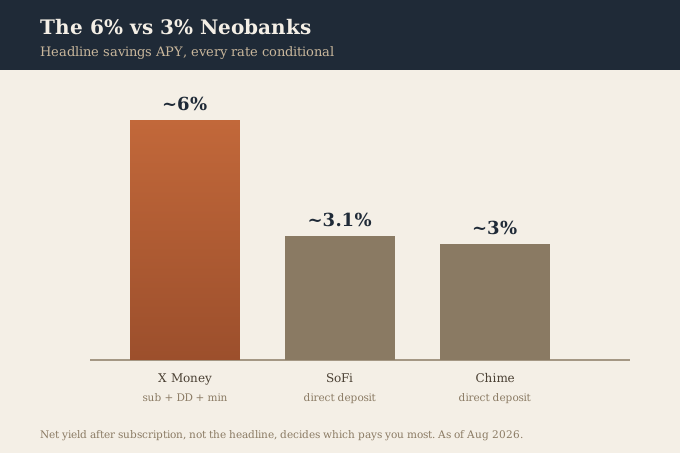
- Headline rates rank X Money (6%) above SoFi and Chime (around 3%), but every rate is conditional on direct deposit, and X Money adds a paid subscription and minimum balance.
- The account that pays you most depends on your balance size and which requirements you can meet, not the advertised number.
- SoFi and Chime suit a steady paycheck with no subscription; X Money can win on a large balance where the subscription is a small drag.
On paper this looks like the easiest comparison in banking: one account pays 6%, two pay around 3%, so the 6% wins. Real accounts do not work that way. Each of these app-first banks gates its best rate behind conditions, and the one with the biggest headline also asks the most to earn it. Once the conditions are on the table, the ranking can flip depending on your balance and your paycheck. Rates on this page were last verified recently. For a detailed breakdown of how these accounts stack up, see our full X Money vs SoFi vs Chime 2026 comparison.
Here is how X Money, SoFi, and Chime actually stack up, and how to tell which one pays you the most.
The headline rates, and their strings
- X Money advertises a headline 6% APY, but earning it generally requires a paid X Premium subscription, a qualifying direct deposit, and a minimum balance around $1,000. The rate is variable. See the full breakdown in our X Money review.
- SoFi pays around 3.10% APY on savings with a qualifying direct deposit (or a set monthly deposit total, or paid membership), with a higher limited-time boost for new members, and roughly 0.80% without direct deposit.
- Chime pays around 3% on savings, also tied to a qualifying direct deposit routed through its checking account.
Every one of these is conditional. The differences are in what they ask and how much the top rate is worth after those conditions.
Side by side
- X Money
- ~6%
- SoFi
- ~3.10% (boosted for new members)
- Chime
- ~3%
- X Money
- Yes
- SoFi
- Yes for standard rate
- Chime
- Yes for top rate
- X Money
- Yes (X Premium)
- SoFi
- No (Plus optional)
- Chime
- No
- X Money
- ~$1,000
- SoFi
- None for standard
- Chime
- None
- X Money
- Pass-through via partner banks
- SoFi
- Pass-through via partner banks
- Chime
- Pass-through via partner banks
The test that decides it
The right comparison is net yield on your balance, not the headline. Two questions settle it:
Can you meet the direct deposit requirement? If you can route a paycheck, all three pay their better rate. If you cannot, they all fall toward their base rates, and a plain high-yield savings account near 4% with no direct-deposit strings may beat them.
Does the extra rate cover the subscription? For X Money, subtract the annual X Premium cost from the interest 6% earns on your actual balance. On a large balance, that subscription is a rounding error and 6% can genuinely win. On a small balance, it can wipe out the advantage, leaving SoFi or Chime, or a free savings account, ahead.
Who each one fits
- SoFi fits a saver who wants a strong rate and a full-featured account with no subscription, and can route a direct deposit.
- Chime fits someone who wants simplicity and a solid rate through a checking-plus-savings setup with a qualifying deposit.
- X Money fits a large balance where the subscription is a small drag and the 6% clearly beats the alternatives, and who is comfortable with a newer provider after reviewing the underlying bank.
Sources
- X Money launch terms and rate conditions, TheStreet; see our full X Money review.
- SoFi published savings rates and direct-deposit requirements, SoFi.
Rates are as of early August 2026 and change frequently; confirm current terms on each provider's own disclosures. This is general educational information, not a recommendation.
What to Do Now
Frequently Asked Questions
Which pays the highest interest, X Money, SoFi, or Chime?
Do all three require a direct deposit?
Are these neobank accounts FDIC insured?
Is X Money's 6% worth switching for?
Act on this: today's top savings



Ranked by SwitchWize's composite score. We may earn a referral fee, and it never changes the ranking order.
Editorial review
What changed since the last update
Was this guide helpful?
Found an inaccurate, outdated, or missing claim? Report a correction. We verify reports against the relevant source before changing a guide or ranking.

Adeesh Setya is Head of Financial Research & Principal at SwitchWize, with 25+ years of experience in deposits, treasury management, banking products, and financial services. He previously served as Treasurer at Merrill Lynch Bank USA and Morgan Stanley Bank USA, where he managed bank funding, deposits, and interest-rate risk. He writes on Federal Reserve policy, the general marketplace for banking products, and what they mean for savers and consumers.
Available for on-record interviews, background briefings, and custom data cuts.
research@switchwize.com