- One Social Security check may stop when a spouse dies; the survivor's actual amount depends on both work records, claiming history, age, and eligibility.
- Compare income the survivor can count on with bills that will remain. The example's $1,900 monthly check difference is not automatically the household's budget deficit.
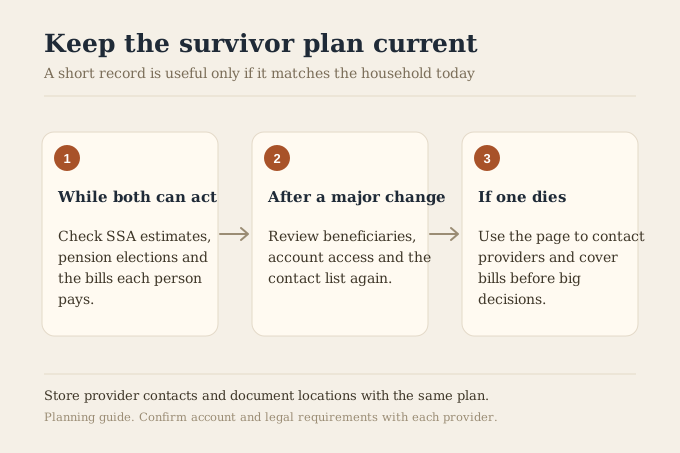
- While both spouses can act, review pension elections, beneficiary forms, account access, and the documents needed to manage money.
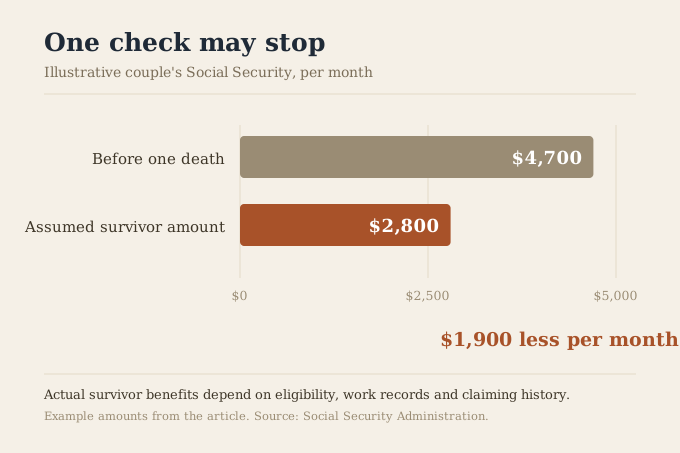
When one spouse dies, Social Security generally does not add the couple's two full checks together. This example assumes the couple currently receives a combined $4,700 a month. If the survivor qualifies for $2,800 after one death, the $1,900 smaller check stops—a $1,900 monthly reduction before pension income, taxes, insurance, or bills. The actual benefit depends on work records, ages, and claiming choices.
This is a hypothetical planning example, not a report about a real couple. Use it to answer questions while both spouses can review the records.
Start with the income the survivor could actually receive
Download each spouse's Social Security Statement through a my Social Security account or request a paper copy. The statement includes estimates of survivor benefits that may be payable on that worker's record. Then confirm the survivor's actual options and estimates with Social Security; age, eligibility, and claiming history can change the amount.
If eligible for benefits on both records, a survivor generally receives the higher total payment, not two full checks. When the survivor's own retirement benefit is lower, Social Security may add a survivor supplement to bring the payment up to the eligible amount on the deceased worker's record. In some cases, a survivor can claim one benefit first and switch later. The amount and timing depend on the survivor's age, eligibility, and the worker's claiming history. Check both records with Social Security before relying on a specific amount.
- Amount
- $2,800
- Amount
- $1,900
- Amount
- $4,700
- Amount
- $2,800
- Amount
- $1,900
The $2,800 survivor amount is an assumption for this illustration, not an SSA estimate. If the actual difference were $1,900 every month, it would equal $22,800 over a year. The monthly budget shortfall could be smaller or larger after other income and expenses change.
Check pension and insurance choices while they can still be changed
Ask each pension administrator for the current payment and the survivor payment in writing. A pension option that continues some or all of the payment to a spouse may lower the check while both spouses are alive. The amount, inflation adjustment, deadline, and whether the choice can later be changed depend on the plan.
For each life insurance policy, record the owner, insured person, beneficiary, coverage amount, premium, and end date. Check whether the policy is in force and who can contact the insurer. Do not count the stated death benefit as available cash until the insurer confirms the claim and payment rules.
Compare the survivor's income with bills that remain
Make a monthly list of the bills the surviving spouse would still face. Start with housing, utilities, property tax, food, transportation, health coverage, debt payments, and care costs. Some spending may fall after a death, but a mortgage, rent, taxes, and many household bills do not automatically fall by half.
Compare those bills with income the survivor could use: Social Security, any pension continuation, wages, insurance proceeds after payment, and savings or investments they can access. Use after-tax amounts when possible. A tax professional can estimate how filing status and account withdrawals may affect the survivor's take-home income.
The $1,900 difference in the example is a change in monthly benefits, not necessarily the amount the survivor needs to take from savings. If it lasted for three, six, or twelve months with no replacement income, the difference would total $5,700, $11,400, or $22,800. Other income, taxes, insurance, and changed expenses determine how much cash the household would actually need.
- Example benefit difference
- $5,700
- Example benefit difference
- $11,400
- Example benefit difference
- $22,800
Use the calculation to ask how the survivor would cover a temporary gap. It is not a recommendation to hold a particular amount in cash.
Review who receives each account and who can reach it
For each retirement account, insurance policy, annuity, bank account, and brokerage account, record the owner and the primary beneficiary (first in line) and contingent beneficiary (backup) on file. Confirm the form with the institution; an old statement or a will may not show the current record.
A valid beneficiary form often tells the institution who receives an account without using the will. The result still depends on the plan or contract and applicable law. Most workplace plans require a married participant to get written spousal consent before naming someone else; the exact protections depend on the plan. Ask the plan administrator before making a change. State rules can also affect jointly owned property and payable-on-death or transfer-on-death accounts.
Add the institutions, account numbers or last four digits, customer-service contacts, recurring bills, and document locations to the same household record. Do not put passwords in an unprotected document. Use a password manager's emergency-access feature or another secure method the household understands.
A one-page review to finish together
Set aside time and complete this list. If an answer is unclear, write down who can confirm it.
- What to record
- Both current amounts and the survivor estimate for each possible first death
- What to record
- Current payment, survivor option, survivor amount, inflation adjustment, and election deadline
- What to record
- Current coverage, premium, end date, owner, and beneficiary
- What to record
- Essential costs the survivor would still pay, including debt and health coverage
- What to record
- Owner, institution, last four digits, primary and contingent beneficiaries
- What to record
- Location of wills, powers of attorney, health directives, and account records
- What to record
- Names and contact details for the plan administrator, insurer, tax professional, and estate attorney
- What to record
- How the survivor can reach statements, bill-pay records, and a secure password manager
Repeat the review after retirement, a move, a marriage or divorce, a new child, a pension election, or a major account change. Put a date on the page so you know when the information was last checked.
If a death happens, handle the urgent items first
The survivor can use the page to contact Social Security, pension administrators, insurers, and financial institutions. Ask each organization what it needs before moving or retitling an account. Order death certificates through the appropriate local office and keep a record of who received each copy.
Do not assume every account transfers immediately or that every bill can be paid from a joint account. Access depends on account ownership, the institution's procedures, plan terms, and state law. The existing surviving-spouse money playbook covers the steps after a loss, including benefit claims, short-term cash, taxes, and decisions that can wait.
What this checklist cannot decide
This example does not predict a household's Social Security payment, decide which pension option is best, or determine who inherits an account. The Social Security Administration can estimate benefits from the couple's records. The plan administrator can explain its pension and beneficiary rules. An estate attorney can apply the relevant state's law, and a tax professional can estimate the filing and withdrawal consequences.
Start with both Social Security estimates, the pension statements, and the monthly bill list. Write down the survivor estimate and the first three people to call.
Sources
- Social Security Administration, What you could get from Survivor benefits, accessed October 28, 2026. Survivor amounts depend on age and eligibility; a person eligible for retirement and survivor benefits generally receives the better amount, not both added together.
- Social Security Administration, How can I get a Social Security Statement?, accessed October 28, 2026. Online statements include estimates for retirement, disability, and survivor benefits the worker and family may qualify for.
- Social Security Administration, Who can get Survivor benefits, accessed October 28, 2026. Eligibility varies by relationship, age, disability, marriage duration, and other circumstances.
- Social Security Administration, Lump-sum death payment, accessed October 28, 2026. The $255 payment is limited to qualifying family members and is separate from monthly survivor benefits.
- Internal Revenue Service, Retirement topics: Getting married and/or having children, accessed October 28, 2026. Most plans require a married participant to obtain written spousal consent to name another beneficiary.
- Internal Revenue Service, Types of retirement plan benefits, accessed October 28, 2026. Plan terms and elections govern benefit forms; some workplace plans protect a surviving spouse.
Frequently Asked Questions
Does a surviving spouse keep both Social Security checks?
Does a will decide who gets a 401(k) or life insurance policy?
What should couples write down before a spouse dies?
Is the $255 Social Security death payment the monthly survivor benefit?
The 5-minute money briefing
One email per week. New rates, fed moves, and what to actually do about them.
No spam. Unsubscribe anytime.
Answer a few questions about your situation and goals. Money Map points you to the highest-value next step across savings, mortgage, cards, and debt.
Editorial review
What changed since the last update
Was this guide helpful?
Found an inaccurate, outdated, or missing claim? Report a correction. We verify reports against the relevant source before changing a guide or ranking.
