The short answer
- Starting age is 73 if you were born from 1951 through 1958, and 75 if you were born in 1960 or later.
- The amount is your balance on December 31 of last year divided by the IRS divisor for your age.
- Each year's withdrawal is due by December 31. Your first one can wait until April 1 of the next year.
- Missing it can cost 25% of the amount you should have taken, or 10% if you fix it in time.
Who has to take one in 2026
Most pre-tax retirement accounts require a yearly withdrawal, called a required minimum distribution (RMD), once you reach a set age. That includes traditional IRAs, SEP IRAs and SIMPLE IRAs. It also includes most 401(k) and 403(b) plans.
The starting age depends on the year you were born:
- Age you must start
- 73
- Age you must start
- 73 or 75, because the IRS rules and the law do not match
- Age you must start
- 75
Roth IRAs do not require withdrawals while you are alive. The IRS says the same for Roth accounts inside a 401(k) or 403(b). People who inherit these accounts do have to take withdrawals.
How to work out the amount
You need two numbers. The first is your account balance on December 31 of last year. For 2026 that is the balance on December 31, 2025. The second is the divisor for your age from the IRS Uniform Lifetime Table.
Divide the balance by the divisor. The answer is the least you must take out in 2026.
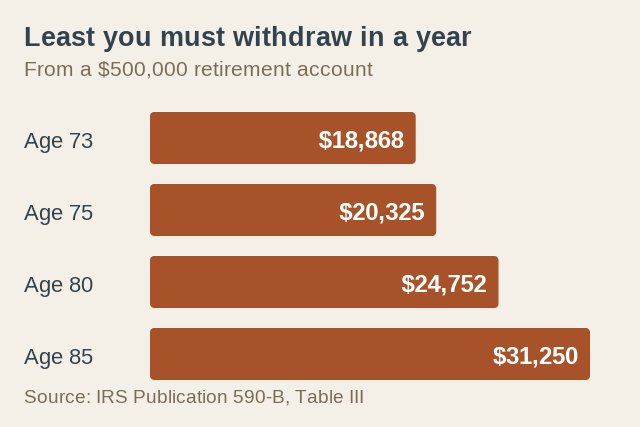
Here is part of the IRS table. The last column shows the result on a $500,000 balance.
- IRS divisor
- 26.5
- Minimum on $500,000
- $18,868
- IRS divisor
- 25.5
- Minimum on $500,000
- $19,608
- IRS divisor
- 24.6
- Minimum on $500,000
- $20,325
- IRS divisor
- 20.2
- Minimum on $500,000
- $24,752
- IRS divisor
- 16.0
- Minimum on $500,000
- $31,250
The divisor falls each year, so the share you must take rises as you age. A $500,000 balance needs $18,868 at 73 but $31,250 at 85.
This table is the standard one. It covers unmarried owners, and married owners whose spouse is not the only beneficiary or is no more than 10 years younger. If your spouse is the only beneficiary and is more than 10 years younger, a different table applies. See IRS Publication 590-B.
When it is due
- First withdrawal: by April 1 of the year after you reach your starting age. If you reach 73 in 2026, that is April 1, 2027.
- Every year after that: by December 31.
Waiting until April 1 for your first one means two withdrawals land in the same tax year. That can push you into a higher tax bracket.
What a missed withdrawal costs
The IRS can charge a 25% tax on the amount you should have taken but did not. The tax is 10% if you take the missed amount out and file within the correction window. The window is generally the end of the second year after the year of the miss.
The IRS may waive the tax if the shortfall was a reasonable error and you are fixing it. You ask by filing Form 5329 with a short letter that explains what happened.
Ways to lower the tax bill
- Give to charity from your IRA. A qualified charitable distribution can count toward your minimum without being added to your taxable income. See our guide on qualified charitable distributions and Medicare surcharges.
- Plan the withdrawal. Taking money out over the year, not in one lump, can make it easier to manage taxes and cash.
- Check other accounts. Your 401(k) withdrawal rules may differ from your IRA rules.
If you inherited an account, different rules apply. See the inherited IRA 10-year rule guide and the inherited IRA RMD calculator.
Method and Sources
The divisors and the 2026 balance rule come from IRS Publication 590-B, Table III. We divided $500,000 by each divisor and rounded to the nearest dollar. The example balance is hypothetical.
- IRS, Retirement plan and IRA required minimum distributions FAQs: deadlines, the 25% and 10% tax, the waiver, and Roth accounts.
- IRS, Publication 590-B, Distributions from Individual Retirement Arrangements: the Uniform Lifetime Table.
- IRS, Retirement topics: significant ages for retirement plan participants: starting ages by birth year.
- IRS, Instructions for Form 5329: how to report and fix a missed withdrawal.
Rules and tables can change. Confirm with the IRS or a tax professional before you act. This is general information, not tax advice.
Frequently Asked Questions
At what age do I have to take a required minimum distribution in 2026?
How do I calculate my required minimum distribution?
What happens if I miss a required minimum distribution?
Do Roth IRAs have required minimum distributions?
The 5-minute money briefing
One email per week. The biggest changes in savings, money market, checking and CD rates.
Send me the weekly SwitchWize rate briefing: the biggest changes in savings, money market, checking and CD rates. Unsubscribe in one click. We never share your address.
Answer a few questions about your situation and goals. Money Map points you to the highest-value next step across savings, mortgage, cards, and debt.
Editorial review
What changed since the last update
Was this guide helpful?
Found an inaccurate, outdated, or missing claim? Report a correction. We verify reports against the relevant source before changing a guide or ranking.