- Renting is not throwing money away; it just removes the automatic savings a mortgage forces, so renters have to build wealth on purpose.
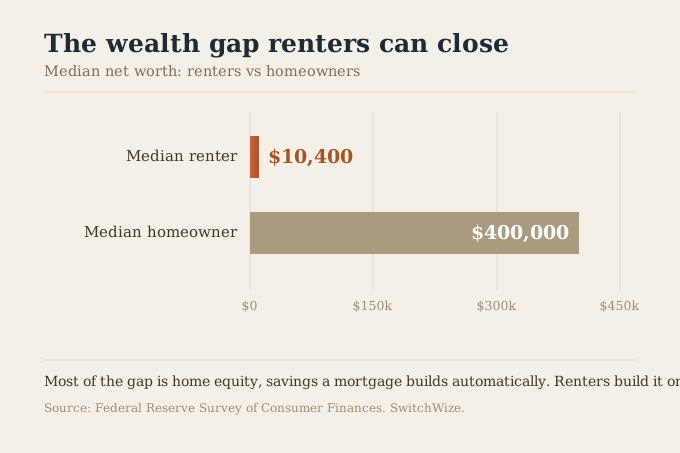
- The renter-owner wealth gap is real but mostly home equity: about $400,000 median for owners versus $10,400 for renters, largely forced savings.
- The playbook: rent smart, buy cheap renters insurance, invest the difference automatically, and build credit so buying stays an option.
The oldest line in personal finance is that renting is throwing money away. It is also wrong, or at least badly incomplete. A renter pays for a place to live; so does a homeowner, in mortgage interest, taxes, insurance, and maintenance, none of which builds equity. The real difference between the two is not waste. It is that a mortgage quietly forces a homeowner to save a little every month, while a renter is handed no such machine and must build one deliberately. Get that distinction right and renting becomes a perfectly sound financial path. Miss it and renting really can leave you behind. This playbook is how to get it right. This page is reviewed by the SwitchWize Editorial Team; the figures are sourced below with dates. The question of whether is renting throwing money away ultimately comes down to how deliberately you build wealth as a renter.
The reframe: renting isn't the mistake, not planning is
Here is the distinction the old cliché misses. Homeownership bundles two very different things: a place to live, and a forced savings plan. Every mortgage payment sends part of your money into principal, an asset you keep, and over decades that automatic saving, amplified by leverage and rising home values, builds most of the wealth gap between owners and renters. Renting gives you the place to live without the forced savings.
That is not a reason to buy; it is a reason to save on purpose. The median homeowner's net worth is around $400,000 against about $10,400 for the median renter, but that gap is not evidence that renting wastes money. It is evidence that homeowners save automatically and most renters do not. A renter who rebuilds that savings machine deliberately can reach the same place. The rest of this playbook is how.
Rent smart: the rent-versus-buy decision, honestly
The first move is to know whether renting is even the right call for you right now, and the honest answer is local and personal. Renting tends to win when you will move within a few years (buying's transaction costs take years to recoup), when home prices are high relative to rents in your city, and when you will actually invest the money you are not tying up in a house. Buying tends to win over long horizons in affordable markets, partly for the forced-savings discipline itself.
Ignore rules of thumb and run your own numbers, for your city, your timeline, and your discipline:
Compare rent with homeownership over an entered horizon using insurance, maintenance, transaction costs, opportunity cost, and terminal equity.
Use our comparison page for live rates
Use the effective rate from your local assessor or latest tax bill.
Monthly Mortgage (P&I)
$2,402
Use this result as one input in your broader Money Map, not as a one-off number.
What to do
Compare Mortgage Rates
Pre-tax estimates. For illustration only — not financial advice.
Protect what you have: renters insurance
This one is simple and non-negotiable. Renters insurance is cheap, often $15 to $25 a month, and it covers two things a landlord's policy does not: your belongings if they are stolen or destroyed, and your liability if someone is hurt in your home or you cause damage. The landlord's insurance covers the building, not your possessions or your legal exposure. For the price of a couple of coffees a week, it protects thousands of dollars of stuff and shields you from a large claim. Skipping it is a bad bet. Our renters insurance guide covers how much to carry.
Size renters insurance after belongings, deductible, liability coverage, loss-of-use needs, emergency cash, replacement-cost gap, and total-loss affordability.
Monthly Premium
$15
Use this result as one input in your broader Money Map, not as a one-off number.
What to do
Build this emergency fund plan
Pre-tax estimates. For illustration only — not financial advice.
Build wealth on purpose: invest the difference
This is the heart of the playbook, the deliberate replacement for the homeowner's forced savings. Take the money you are not spending on a down payment, maintenance, property taxes, and the interest portion of a mortgage, and invest it automatically. Set up automatic transfers into a retirement account and a brokerage so the saving happens without willpower, exactly as a mortgage payment happens without a decision each month.
A renter who invests this difference consistently can match or beat a homeowner's wealth, because the money compounds in the market instead of in a single, illiquid house. The near-term portion of that savings should sit somewhere safe and earning while it accumulates:
Build credit and keep the option to buy
Renting well does not mean renting forever, and you want the choice. Build your credit, including through rent-reporting services that add your on-time rent payments to your credit file, so a future mortgage is cheaper if you decide to buy. Keep saving toward a potential down payment as one of your investment goals, not a separate sacrifice. If and when buying becomes the better call for your life and your city, you will be ready, and our homeowner's playbook picks up from there.
The honest counterargument
Homeownership genuinely builds wealth, and it would be misleading to pretend otherwise. Leverage lets a modest down payment control a large asset, the forced savings is real and works precisely because it is not optional, and there are tax advantages and the stability of a fixed housing cost. For many households, buying is the better long-run financial move, which is why so much wealth is concentrated in home equity.
But the reverse claim, that renting is a financial dead end, is equally wrong. A disciplined renter who invests the difference, in a high-price city or with a short horizon, can come out ahead, with more flexibility and liquidity besides. The truthful conclusion is not that one always wins. It is that homeownership makes saving automatic and renting makes it optional, so the renter's whole job is to make it automatic anyway.
Methodology
The renter share and cost-burden figures are Census and Harvard Joint Center for Housing Studies data for 2024 to 2026. The net-worth comparison uses Federal Reserve Survey of Consumer Finances figures for the median homeowner versus median renter; the gap includes home equity, and narrows when equity is excluded. Renters-insurance cost is a typical national range that varies by coverage and location. Whether renting or buying wins financially depends entirely on your city, timeline, and whether you invest the difference, which is what the calculator is for. Nothing here is individualized financial advice.
How we source this. Renter and cost-burden data come from the Census and Harvard JCHS, the wealth comparison from the Federal Reserve, and insurance costs from market ranges, all cited with dates. See our methodology and editorial team. We take no payment for organic rankings.
Sources
- US Census Bureau and Harvard Joint Center for Housing Studies: renter share, household formation, and cost-burden figures.
- Federal Reserve Survey of Consumer Finances: median net worth of homeowners versus renters.
- Typical national renters-insurance cost ranges (industry data).
Figures are current as of mid-2026 and vary by market. This page is informational, not financial advice. Free to cite with attribution to SwitchWize.
Frequently Asked Questions
Is renting really throwing money away?
Why do homeowners have so much more wealth than renters?
When does renting make more financial sense than buying?
Do I need renters insurance?
How can a renter build wealth?
The 5-minute money briefing
One email per week. New rates, fed moves, and what to actually do about them.
No spam. Unsubscribe anytime.
Answer a few questions about your situation and goals. Money Map points you to the highest-value next step across savings, mortgage, cards, and debt.
Editorial review
What changed since the last update
Was this guide helpful?
Found an inaccurate, outdated, or missing claim? Report a correction. We verify reports against the relevant source before changing a guide or ranking.
