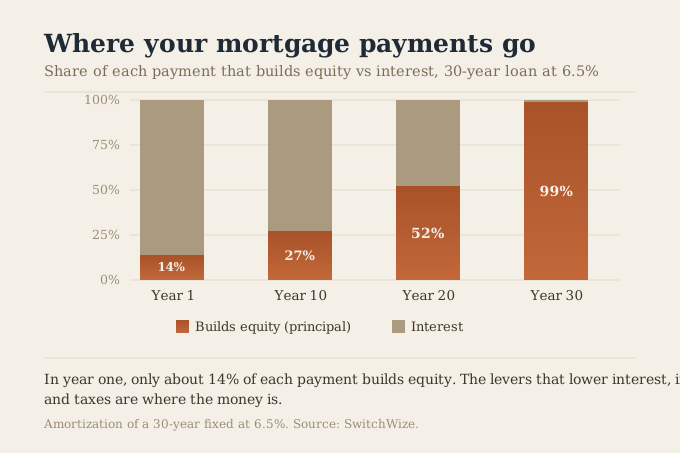
- Closing is the start of a 30-year contract that is mostly interest early: in year one of a 6.5% loan, only about 14 cents of each dollar builds equity.
- Five recurring levers win back thousands: refinance past break-even, remove PMI at 20% equity, reshop insurance every renewal, appeal property tax, and get payoff-versus-invest right.
- None of these is urgent on any single day, which is why they get skipped, and why doing them is where the money is.
Every homebuying guide ends at the closing table, as if the money decisions end there too. They do not. Closing is the moment you sign a 30-year contract that, in its early years, is mostly interest, and the terms of that contract are more negotiable after the fact than most owners realize. A mortgage is not a fixed bill you set and forget. It is a live account with several dials, and the owners who turn them, at the right moments, keep thousands of dollars that the passive owner hands over without noticing. This is the playbook for running the house you already bought. This page is reviewed by the SwitchWize Editorial Team; the figures are sourced below with dates. Understanding what to do after buying a house is where real wealth-building in homeownership begins.
The reframe: closing was the start line
Here is the fact that reframes homeownership. In the first year of a 30-year mortgage at 6.5%, only about 14 cents of every dollar you pay reduces what you owe. The other 86 cents is interest. That ratio improves slowly, reaching roughly a quarter by year ten and half by year twenty, but for most of the time you own the home, a large share of every payment is the price of borrowing, not equity you are building.
That is not a scandal; it is how amortized loans work. But it explains why the moves in this playbook matter. When the bulk of your housing payment is interest, insurance, and taxes rather than principal, the levers that lower interest, insurance, and taxes are where real money lives. Buying the house was one decision. Running it well is five.
Lever 1: Refinance, but only past break-even
Refinancing replaces your loan with a new one, usually to capture a lower rate. The mistake is treating any rate drop as a win. The real test is break-even: divide your total closing costs by the monthly payment savings, and you get the number of months it takes to recoup the cost of refinancing. Stay in the home past that point and you come out ahead; move or pay off before it and you lost money, no matter how good the rate looked.
A refinance also restarts the amortization clock, pushing you back to the interest-heavy early years, so a lower rate on a longer remaining term is not always cheaper over the life of the loan. Run the break-even honestly against how long you actually plan to stay, and see our should I refinance and break-even guides.
Separate payment break-even from five-year financing cost using entered closing costs and ending mortgage balances.
Check your statement or loan documents
Compare refinance rates on our Compare page
Enter points and all lender and third-party costs from the Loan Estimate.
Live top rate across lenders we track, used only for the likely-savings range below, not the main result.
Monthly Savings
$188
Use this result as one input in your broader Money Map, not as a one-off number.
What to do
Compare Mortgage Rates
Pre-tax estimates. For illustration only — not financial advice.
Lever 2: Kill PMI the day you qualify
If you put down less than 20%, you are probably paying private mortgage insurance, a monthly charge that protects the lender, not you. It is pure cost, and it is removable. Under the Homeowners Protection Act, you can request cancellation at 20% equity, an 80% loan-to-value ratio against your original value, and the lender must drop it automatically at 78%. Waiting for automatic removal leaves money on the table, so the move is to track your balance and request cancellation the moment you cross 20%.
There is a faster path if your home has appreciated: a new appraisal that shows 20% equity can end PMI years before the payment schedule would. In a market where your home gained value, paying for an appraisal to drop PMI is often one of the highest-return few hundred dollars you can spend. The PMI guide covers the request process.
Estimate illustrative PMI cost and separate current-value LTV from original-value HPA thresholds and servicer conditions.
Estimated loan amount
$350,000
Use this result as one input in your broader Money Map, not as a one-off number.
What to do
Compare current mortgage rates
Pre-tax estimates. For illustration only — not financial advice.
Lever 3: Reshop insurance at every renewal
Homeowners insurance is the fastest-rising controllable cost of owning a home. The average premium reached about $3,057 in 2026 and has climbed roughly 46% since 2021, about three times inflation, driven largely by extreme-weather losses, per Insurify. Insurers reprice constantly, and the carrier that was cheapest when you bought is frequently not cheapest three years later. Loyalty earns nothing.
The habit that beats this is simple: reshop at every renewal. Get fresh quotes, raise your deductible if you can absorb the larger out-of-pocket in a claim, and bundle with auto where it lowers the total. Each can save hundreds a year on a bill most owners let renew on autopilot. Our insurance reshop guide and best homeowners insurers are the starting points.
Lever 4: Appeal an inflated tax assessment
Your property-tax bill is the assessed value times the local rate, and the assessed value is an estimate that can be wrong, often high. If comparable homes near you are assessed for less, or if your assessment jumped faster than the local market, you can appeal. The process is usually a form, some comparable-sales evidence, and sometimes a brief hearing, and a successful appeal lowers not just this year's bill but the base for future years.
It is worth checking every reassessment, because the assessor is not going to volunteer that your home is overvalued. See the property-tax guide for how assessments and appeals work in your state.
Estimate nonnegative taxable value and flat-value, flat-rate property-tax arithmetic from user-entered local assumptions.
Use assessed value if known, otherwise current market value
Use the effective rate from your local assessor or latest tax bill; statutory or state-average rates may not match your property.
Many states reduce taxable value for primary residences. Enter $0 if unsure
Annual Property Tax
$4,400
Use this result as one input in your broader Money Map, not as a one-off number.
What to do
Compare Mortgage Rates
Pre-tax estimates. For illustration only — not financial advice.
Lever 5: Extra principal, investing, and HELOC discipline
Once the house runs efficiently, the surplus-cash question arrives: pay the mortgage down faster, or invest? The honest frame is that prepaying is a guaranteed, risk-free return equal to your mortgage rate. Paying down a 6.5% mortgage is like earning a guaranteed 6.5%, which beats what safe cash pays today. Compare that against what your cash earns sitting in savings:
Investing may outperform your mortgage rate over decades, but only with risk and no guarantee, so this is a guaranteed-versus-expected decision, not one flat number against another. A common sequence is to secure the emergency fund and any employer retirement match first, then weigh extra principal against investing based on your rate and temperament. If you prepay, a recast can lower your payment without a full refinance. And if you tap equity, treat a HELOC as a deliberate tool for value-adding uses, not a standing line to spend down.
Estimate payoff time and interest savings from extra principal using the current average mortgage rate as an editable starting assumption.
New Total Monthly Payment
$2,412
Use this result as one input in your broader Money Map, not as a one-off number.
What to do
Compare mortgage lenders
Pre-tax estimates. For illustration only — not financial advice.
Methodology
The amortization figures describe a standard 30-year fixed mortgage at a 6.5% rate, near the prevailing 30-year rate in mid-2026; the exact principal-versus-interest split varies with the rate and loan size, but the front-loaded shape is universal to amortized loans. The insurance figures are Insurify's 2026 projections and historical averages, which vary widely by state and property. PMI rules follow the federal Homeowners Protection Act. The payoff-versus-invest framing treats prepayment as a risk-free return equal to the mortgage rate, which is a standard way to make the comparison honest; it is a decision framework, not a recommendation. Rates in the live table are sourced from primary institutions and update continuously. Nothing here is individualized financial advice.
How we source this. Insurance data comes from Insurify's 2026 report, mortgage-rate context from our own live rate data, and PMI and tax rules from the underlying law and our maintained cluster guides, cited with dates. See our methodology and editorial team. We take no payment for organic rankings.
Sources
- Insurify, home insurance price projections (2026): average premium and multi-year increase.
- Homeowners Protection Act, for PMI cancellation at 80% and automatic termination at 78% loan-to-value.
- SwitchWize live rate data for the mid-2026 30-year mortgage rate used in the amortization example.
Figures are current as of mid-2026 and vary by state, property, and loan. This page is informational, not financial advice. Free to cite with attribution to SwitchWize.
What to Do Now
Frequently Asked Questions
What should I do with my money after buying a house?
When is refinancing actually worth it?
How do I get rid of PMI?
Should I pay off my mortgage early or invest instead?
Why should I reshop my homeowners insurance?
Act on this: today's top mortgage



Ranked by SwitchWize's composite score. We may earn a referral fee, and it never changes the ranking order.
Editorial review
What changed since the last update
Was this guide helpful?
Found an inaccurate, outdated, or missing claim? Report a correction. We verify reports against the relevant source before changing a guide or ranking.
