The short answer
- The FDIC national average money market rate is 0.64%, and the savings average is 0.39%.
- The best money market accounts pay several times the national average.
- On $10,000, an example 4.00% rate earns $336 a year more than the 0.64% average.
- Money market rates are variable and can change at any time.
The typical rate
The FDIC publishes a national average rate for each type of deposit account. In its November 16, 2026 release, the money market average was 0.64%. The savings account average was 0.39%.
This average is not what a good account pays. It is what the whole market pays, weighted toward big banks with many branches. Many of them pay close to nothing on a money market account.
The best rate today
The best money market accounts we track pay about 4.05% APY. The best high-yield savings accounts pay about 4.40% APY. Rates last verified recently.
What the gap costs you
Here is one year of interest on $10,000. The 0.64% figure is the FDIC average. The 4.00% figure is an example, not a quote.
- Rate
- 0.64%
- Interest in one year on $10,000
- $64
- Rate
- 4.00%
- Interest in one year on $10,000
- $400
- Rate
- Interest in one year on $10,000
- $336
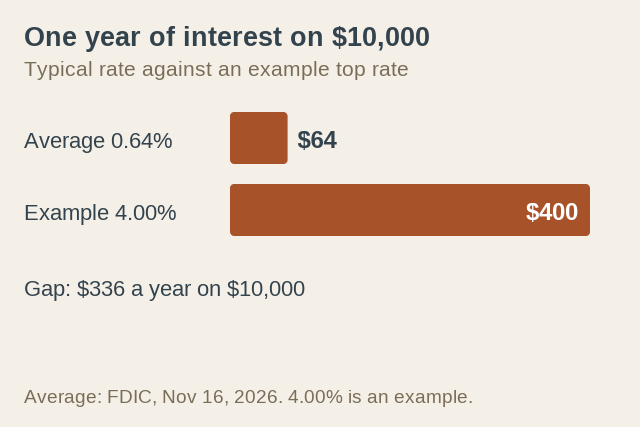
The gap grows with your balance. On $50,000 it is $1,680 a year at these example rates.
Why most accounts pay less
Three things pull the average down:
- Branch banks pay little. Big banks with many branches do not need to pay more to attract deposits.
- Tiers and minimums. Some accounts pay the top rate only above a set balance, and a much lower rate below it. See our guide to money market minimum balances.
- Inertia. Most people never check their rate after they open the account.
Before you switch
- Is the rate variable? Yes. It can fall after you open the account, so recheck every few months.
- Is there a minimum or a fee? A fee can wipe out the extra interest. Read the fine print first.
- Is it insured? At a bank, the FDIC covers up to $250,000 per depositor, per bank, per ownership type. At a credit union, the NCUA does.
If you want the highest rate on a simple account, also compare high-yield savings against money market accounts. If you hold your cash at a brokerage, see money market funds against high-yield savings. To see today's ranked list, read our best money market accounts.
Method and Sources
The 0.64% and 0.39% figures come from the FDIC national rates table, November 16, 2026 release. The FDIC averages the $10,000 and $100,000 deposit tiers for its national rate. The $64, $400 and $336 figures are simple one-year interest at the stated rates, with no compounding. The 4.00% rate is an example.
- FDIC, National Rates and Rate Caps: national average rates by account type.
- FDIC, Deposit insurance coverage: the $250,000 limit.
- Federal Reserve, Regulation D interim final rule (April 2020): the federal withdrawal limit on savings was removed.
Rates change often. Confirm current terms on the bank's own site before you open an account. This is general information, not financial advice.
Frequently Asked Questions
What is a typical interest rate on a money market account?
Why is the average so much lower than the best rates?
Is a money market account rate fixed?
Is a money market account the same as a money market fund?
The 5-minute money briefing
One email per week. The biggest changes in savings, money market, checking and CD rates.
Send me the weekly SwitchWize rate briefing: the biggest changes in savings, money market, checking and CD rates. Unsubscribe in one click. We never share your address.
Act on this: today's top savings


Ranked by SwitchWize's composite score. Some partner links may compensate SwitchWize.
Editorial review
What changed since the last update
Was this guide helpful?
Found an inaccurate, outdated, or missing claim? Report a correction. We verify reports against the relevant source before changing a guide or ranking.