- Where your next dollar should go has a defensible answer, because each destination carries a different guaranteed return, and you fund the highest-return use first.
- The sequence: starter emergency fund, full employer match, high-interest debt, HSA, IRA, finish the 401k, full emergency fund, taxable brokerage.
- It is a default, not a law; the starter fund and match come first for everyone, and the order can shift only for a documented reason like very high or very low income.
You have an extra few hundred dollars this month. Should it pay down the credit card, go into the 401k, fill an HSA, buy an index fund, or sit in savings? Most people answer this by feel, or by whatever they read last. But the question has a defensible answer, and it is not a matter of taste. Each of those destinations carries a different guaranteed return, and the right move is simply to fund the highest-value one first. Savings rates on this page were last verified recently. This money order of operations 2026 prioritizes guaranteed returns, ensuring every dollar works as hard as possible for your financial goals.
This is the complete order of operations: the sequence that sends every dollar to its best use at each moment, and the reasoning that makes each step rank where it does.
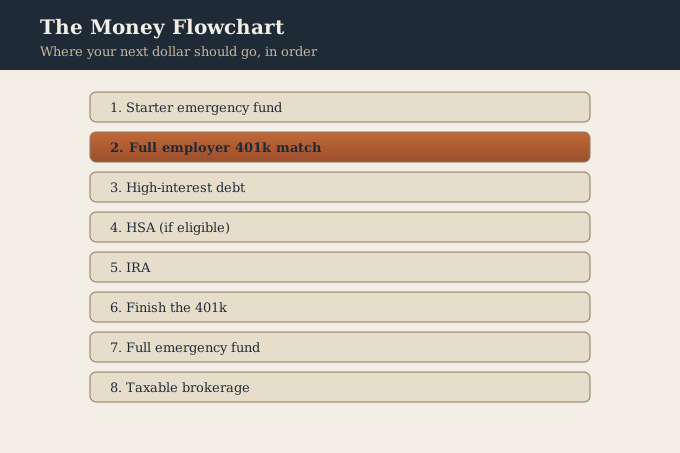
Why an order exists at all
The reason there is a right sequence is that money is not fungible across destinations in one respect: the guaranteed return differs. A dollar that captures an employer match instantly doubles. A dollar that clears a 22% credit card earns a guaranteed 22%. A dollar in a tax-advantaged account saves tax that a taxable account does not. Ranking these by their certain value, then funding from the top, is the entire idea. You are not guessing; you are sorting.
The sequence, step by step
Step 1: A starter emergency fund. Before anything else, hold a small cash buffer, often around one month of essentials, in a high-yield savings account. Without it, the first surprise becomes new debt, which unwinds everything downstream. This step is non-negotiable and comes first for everyone.
Step 2: The full employer 401k match. Contribute at least enough to capture every dollar your employer will match. A 50 to 100% match is an instant 50 to 100% return, which no debt payoff or investment can beat. Leaving match on the table is the most expensive omission in personal finance.
Step 3: High-interest debt. Now attack balances above roughly the high single digits. Paying off a debt is a guaranteed, tax-free return equal to its rate, so clearing a card near 20% beats almost any investment. This is the save-versus-payoff crossover: above your expected returns, kill the debt first.
Step 4: Max an HSA, if eligible. With a qualifying high-deductible health plan, the HSA ranks next because it is uniquely triple tax-advantaged, pre-tax in, tax-free growth, tax-free medical withdrawals. Invested rather than spent, it becomes a stealth retirement account.
Step 5: An IRA, Roth or traditional. Next, fund an IRA up to the annual limit. Whether Roth or traditional depends on whether your tax rate is higher now or in retirement, but the account belongs here either way for its tax advantage over a brokerage.
Step 6: Finish the 401k. Return to the 401k and contribute beyond the match, up to the annual limit, for continued tax-advantaged growth.
Step 7: A fully funded emergency fund. Top the cash reserve up to three to six months of essentials, so a job loss or large shock is covered without touching investments.
Step 8: A taxable brokerage. Everything after the tax-advantaged accounts are full goes into a regular brokerage account, which has no contribution limit and full flexibility.
The order at a glance
- Destination
- Starter emergency fund
- Why it ranks here
- Prevents new debt
- Destination
- Full employer match
- Why it ranks here
- Instant 50 to 100% return
- Destination
- High-interest debt
- Why it ranks here
- Guaranteed, tax-free return at the rate
- Destination
- HSA (if eligible)
- Why it ranks here
- Triple tax-advantaged
- Destination
- IRA
- Why it ranks here
- Tax-advantaged over a brokerage
- Destination
- Finish the 401k
- Why it ranks here
- More tax-advantaged growth
- Destination
- Full emergency fund
- Why it ranks here
- Covers large shocks
- Destination
- Taxable brokerage
- Why it ranks here
- Unlimited, flexible
Where the order can shift
The sequence is a strong default, not a universal law. A very high earner may lean harder on traditional pre-tax accounts to cut a high current tax rate. A very low earner may favor Roth to lock in a low rate now. Someone with no high-interest debt simply skips step three. The point is that any deviation should have a specific, documented reason, a known tax situation, a matched pension, a defined goal, not a vague feeling that one option seems nicer. Absent such a reason, the default is the default because it wins on the math.
The one habit that makes it work
The flowchart is only useful if you actually run it. The habit is simple: whenever new money appears, a raise, a bonus, a freed-up payment, ask which step you are currently on and send the money there. You do not restart at the top each time; you continue filling from wherever you stopped. Done consistently, the sequence quietly ensures that no dollar ever sits in a lower-value use while a higher one goes unfunded. That is the whole advantage, and it compounds for decades.
Sources
- Contribution limits and account rules follow current IRS guidance; see the IRS pages for retirement plans and HSAs.
- SwitchWize Research Desk synthesis of the widely used financial order-of-operations framework.
Contribution limits and eligibility are set annually and change; confirm current figures. This is general educational information, not personalized financial advice.
What to Do Now
Frequently Asked Questions
What is the financial order of operations?
Should I invest or pay off debt first?
Why does the employer match come before paying off debt?
Where does an HSA fit in the order?
Is the order of operations the same for everyone?
Answer a few questions about your situation and goals. Money Map points you to the highest-value next step across savings, mortgage, cards, and debt.
Editorial review
What changed since the last update
Was this guide helpful?
Found an inaccurate, outdated, or missing claim? Report a correction. We verify reports against the relevant source before changing a guide or ranking.
