- Equity compensation is three different tax regimes people lump together: RSUs taxed as income with a withholding gap, ISOs that can trigger alternative minimum tax on paper gains, and QSBS whose holding clock can make millions tax-free.
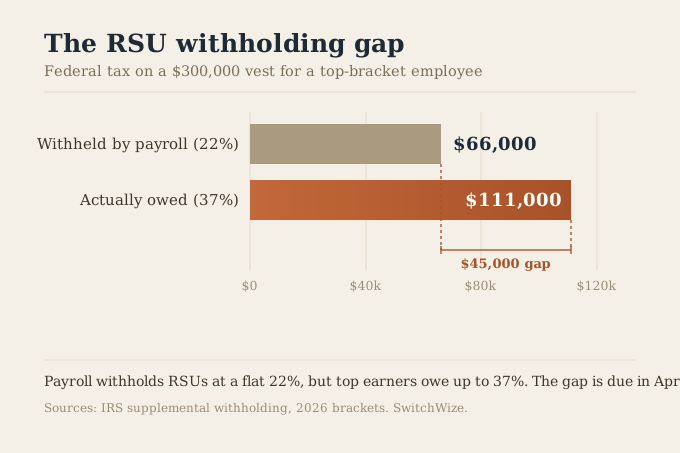
- The most common surprise is the RSU withholding gap: payroll withholds a flat 22% while a top earner owes up to 37%, so a $300,000 vest can leave a $45,000 bill in April.
- Under the 2026 OBBBA rules, QSBS now excludes 50% of gain at 3 years, 75% at 4, and 100% at 5, capped at the greater of $15 million or 10x basis, so the clock is worth real money.
Equity compensation is where smart, high-earning people make expensive tax mistakes, and the reason is deceptively simple: they think of it as one thing. It is not. An RSU, an incentive stock option, and a slice of founder stock are three different financial instruments with three entirely different tax regimes, and the traps that catch people are specific to each. The RSU owner is blindsided by a tax bill their withholding did not cover. The option holder gets ambushed by a tax on gains they never cashed. The founder loses a fortune in tax-free treatment by selling a few months too early. This playbook takes the three instruments in turn, names the trap and the timing lever in each, and updates all of it for the 2026 rules, which changed in ways that matter. This page is reviewed by the SwitchWize Editorial Team; the 2026 figures are sourced below with dates. Understanding the distinct rules for each instrument is the foundation of sound equity compensation tax planning.
The reframe: three instruments, three tax regimes, one risk
The mistake underneath every equity-comp horror story is category confusion. People apply what they heard about one instrument to a different one. So the first move is to sort your equity into its actual buckets, because the rules do not transfer:
- RSUs (restricted stock units) are taxed as ordinary income at vesting, on their full value, whether or not you sell. The trap is withholding.
- Stock options (ISOs and NSOs) are taxed when you exercise and again when you sell, and ISOs carry a separate alternative minimum tax exposure. The trap is the AMT ambush.
- Founder or very-early-employee stock may be qualified small business stock (QSBS), where a holding-period clock can make a huge amount of gain tax-free. The trap is selling too early.
Beneath all three runs a single, non-tax risk: concentration. Your income and your net worth are riding on the same company. Hold that thought; it is the through-line, and the last section returns to it.
RSUs: the withholding gap that surfaces in April
RSUs are the simplest instrument and the source of the most common surprise. When they vest, their full market value is ordinary income, exactly like salary. Your employer withholds federal tax, but only at the flat supplemental rate of 22% (rising to 37% on amounts over $1 million in a year), per IRS Publication 15 rules for supplemental wages. The problem is that anyone receiving meaningful RSUs is usually in the 32% to 37% bracket, so the 22% withholding is not enough. On a $300,000 vest taxed entirely in the 37% bracket, that is about $45,000 of federal tax that no one withheld (15 points times $300,000), before any state tax.
The fix is planning, not panic. Estimate the real tax on each vest, and close the gap with quarterly estimated payments or by asking payroll to withhold extra. And reframe the holding decision: because RSUs are already taxed at vest, keeping the vested shares is simply a choice to invest in your employer, and selling immediately carries no additional tax. Most of the time, the disciplined move is to sell at vest and diversify. Model the gap before it becomes a bill:
Estimate supplemental withholding, employee payroll tax, state tax, and an entered-rate federal reserve for an RSU vest.
Total Vest Value
$75,000
Use this result as one input in your broader Money Map, not as a one-off number.
What to do
Park Your Tax Reserve in a High-Yield Account
Pre-tax estimates. For illustration only — not financial advice.
ISOs: the alternative-minimum-tax ambush
Incentive stock options are where the tax code gets genuinely counterintuitive. When you exercise ISOs, the spread between your exercise price and the fair market value is not taxed under the regular income tax, which is the good news everyone remembers. But that same spread is added to your income for the alternative minimum tax (AMT), per Carta. The result is a trap: you can owe real cash tax on a paper gain, on shares you have not sold and that might later be worth less.
The 2026 numbers set the boundaries. The AMT exemption is $90,100 for single filers and $140,200 for married filing jointly, and under the OBBBA the exemption now phases out faster, by 50 cents per dollar of income above $500,000 (single) or $1 million (joint). The tax you pay creates an AMT credit recoverable in later years, so it is often a timing cost rather than a permanent one, but the cash crunch is real. And the reward for holding is large: a qualifying disposition, more than one year from exercise and two years from grant, turns the whole gain into long-term capital gain. The craft is exercising in amounts that stay under the AMT crossover, ideally early when the spread is small. Model the AMT before you exercise, not after:
Estimate ISO exercise cash and a simplified AMT reserve from positive spread and a user-entered tax-rate assumption.
AMT Preference Income
$60,000
Use this result as one input in your broader Money Map, not as a one-off number.
What to do
Compare brokerage accounts
Pre-tax estimates. For illustration only — not financial advice.
QSBS: the clock that can make millions tax-free
For founders and very early employees, the highest-value rule in the entire tax code may be Section 1202, qualified small business stock. It can exclude an enormous amount of gain from federal tax when you sell stock in a qualifying C corporation, and the 2026 rules under the OBBBA made it more generous for stock issued after July 4, 2025, per Baker Tilly.
Instead of an all-or-nothing five-year hold, there is now a tiered exclusion: 50% of the gain at three years, 75% at four years, and 100% at five years or more. The cap rose to the greater of $15 million or 10 times your basis per company, and the qualifying company's gross-asset ceiling rose to $75 million, both indexed for inflation from 2027. Two details carry real money: the unexcluded portion at three or four years is taxed at 28%, not the usual 15% or 20%, and the difference between a four-year and a five-year hold can be millions of dollars of tax. If you hold potentially qualifying stock, tracking the clock, and getting a tax advisor to confirm eligibility, is not optional. Estimate what the exclusion is worth to you:
Screen gain using acquisition-date, holding-period, basis, and rate assumptions under current Section 1202 tiers.
Post-July 4, 2025 stock can have tiered exclusions beginning at 3 years; older stock generally requires more than 5 years
Long-term capital gains rate plus the 3.8% Net Investment Income Tax, if applicable
Excluded Gain
$5,000,000
Use this result as one input in your broader Money Map, not as a one-off number.
What to do
Compare brokerage accounts
Pre-tax estimates. For illustration only — not financial advice.
The through-line: concentration is the real risk
Step back from the tax detail and the deeper danger comes into focus. With equity compensation, your paycheck and your savings depend on the same company. If it stumbles, you can lose your income and watch your net worth fall at the same moment, which is exactly the scenario that wrecked employees at companies that seemed invincible right up until they were not. Taxes shape the timing of diversifying, but they should not override the principle.
Financial planners commonly suggest keeping any single stock, including your employer's, to a modest share of your net worth. The tools to get there without letting emotion or a single day's price drive the decision are a scheduled, unemotional sell-down, often through a 10b5-1 plan that pre-commits your sales, and, for RSUs specifically, simply selling at vest since there is no tax reason to hold. The goal is to convert a concentrated, fragile position into a diversified, durable one, on purpose and over time.
The honest counterargument
None of this means sell everything immediately or exercise nothing. Sometimes concentration pays off spectacularly, and the people who got rich on equity did so by holding. The tax rules genuinely reward patience: a qualifying ISO disposition and a five-year QSBS hold are worth real money, and cashing out early to diversify has a cost. Private-company shares are often illiquid, so "just diversify" may not even be available until a liquidity event. And the AMT you pay on an ISO exercise is frequently recoverable as a credit, which softens the trap.
But the counterargument refines the discipline rather than replacing it. The lesson is not "never hold," it is decide deliberately, with the tax math modeled and the concentration risk sized, rather than drifting into an outcome. The people who get hurt are not the ones who chose to concentrate with eyes open; they are the ones who never made a choice at all, missed a withholding gap, tripped an AMT bill, or blew a holding-period clock. At these dollar amounts, a CPA who does equity comp and a fee-only advisor are a rounding error against what a single mistake costs.
Methodology
Figures are the 2026 amounts: the 22% supplemental withholding rate (37% above $1 million), the AMT exemptions of $90,100 (single) and $140,200 (married filing jointly) with the OBBBA phaseout of 50 cents per dollar above $500,000 and $1 million, and the QSBS tiered exclusion (50/75/100% at three, four, and five years) with the greater-of-$15-million-or-10x-basis cap and $75 million gross-asset ceiling for stock issued after July 4, 2025. The roughly $45,000 RSU example reflects the gap between 22% withholding and a 37% marginal rate on a $300,000 vest; your amount depends on your bracket, state, and other income. QSBS eligibility is technical and fact-specific. Tax rules interact and change; a CPA and a fee-only advisor are worth engaging at these amounts. Nothing here is individualized financial, tax, or legal advice.
How we source this. RSU withholding and bracket figures, AMT exemptions and the OBBBA phaseout, and the Section 1202 QSBS changes come from the IRS and tax practitioners analyzing the 2026 law, all cited with dates. See our methodology and editorial team. We take no payment for organic rankings.
Sources
- IRS Publication 15 on the 22% optional flat rate for supplemental wages and the mandatory 37% rate above $1 million.
- Carta on ISOs and the alternative minimum tax; IRS Rev. Proc. 2025-32 for the 2026 AMT exemptions and phaseout thresholds; and the One Big Beautiful Bill Act (sec. 70107) for the 50% phaseout rate.
- Baker Tilly on the OBBBA changes to Section 1202 QSBS: the tiered 50/75/100% exclusion, the $15 million or 10x cap, and the $75 million gross-asset ceiling for stock issued after July 4, 2025.
Figures are current for 2026 and set by federal rules that change. This page is informational, not financial, tax, or legal advice. Free to cite with attribution to SwitchWize.
What to Do Now
Frequently Asked Questions
Why do I owe more tax on my RSUs than my employer withheld?
What is the AMT trap with incentive stock options?
How do I get the lowest tax rate on my stock options?
What is QSBS and did the rules change for 2026?
Should I sell my company stock or hold it?
The 5-minute money briefing
One email per week. New rates, fed moves, and what to actually do about them.
No spam. Unsubscribe anytime.
Answer a few questions about your situation and goals. Money Map points you to the highest-value next step across savings, mortgage, cards, and debt.
Editorial review
What changed since the last update
Was this guide helpful?
Found an inaccurate, outdated, or missing claim? Report a correction. We verify reports against the relevant source before changing a guide or ranking.
