How to choose
What to weigh before you pick
It usually comes down to 3 things. Compare your options on each before deciding.
The all-in price, including fees that are easy to miss.
What each option actually does for your situation.
Which one matches how you will really use it.
- In 2026 both child care tax breaks grew. The employer account limit rose from $5,000 to $7,500, and the credit rate rose from 35% to as much as 50%.
- You cannot use the same care dollars for both. For two children, a $7,500 account uses up the $6,000 the credit can cover.
- At $120,000 a married couple with two children and $9,000 of care saves $626 more with the credit. At $150,000 the account is $124 ahead, and at $250,000 it is $1,174 ahead.
For a married couple with two young children and about $120,000 of income, skipping the employer's dependent care account (a dependent care FSA) and claiming the tax credit instead saves about $626 more in 2026. That runs against the usual advice that money taken from your pay before tax is always better. It holds because the credit went up this year. How much the account saves depends on your tax bracket, which is the rate your last dollars of income are taxed at.
Priya, 36, is a composite, an illustration and not a real person. Her employer's open enrollment starts next week. She and her husband Sam earn $120,000 together, and they pay about $9,000 a year for daycare and after-school care for their two children, ages 3 and 6. The benefits site now offers a dependent care account of up to $7,500. Everyone at work says to take it.
What changed in 2026
Two tax breaks help pay for child care. Both changed on January 1, 2026, under a 2025 tax law.
The first is the employer dependent care account. Your employer takes money from your pay before taxes and you use it to pay for care. Until 2025 the most was $5,000 a year. For 2026 it is $7,500, or $3,750 if you are married and file separately. The IRS lists the $7,500 limit in its guide to employer benefits.
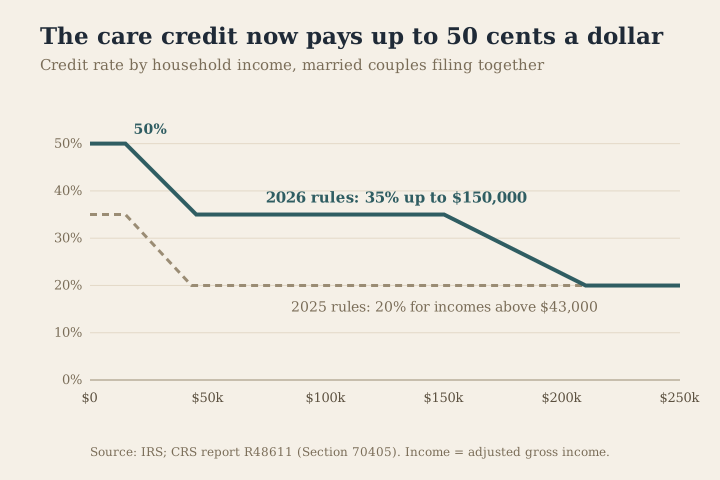
The second is the child and dependent care credit, which you claim on your tax return. It pays back a percentage of what you spend on care. That percentage is the credit rate. In 2025 the top rate was 35%, and it fell to 20% for anyone with income above $43,000. In 2026 the top rate is 50%. The rate then follows these steps:
- It falls one point for each $2,000 of income above $15,000, reaching 35% at $45,000.
- It stays at 35% until $75,000 of income, or $150,000 for married couples filing together.
- It then falls one point for each additional $2,000 ($4,000 for married couples) until it reaches 20%. For couples that point is $210,000.
The most care spending the credit covers did not change. It is $3,000 for one child and $6,000 for two or more, and the child must be under 13. The income cutoffs do not rise with inflation.
For a couple at $120,000, the old rate was 20% and the new rate is 35%. On $6,000 of care, that moves the credit from $1,200 to $2,100.
Why you cannot use both on the same dollars
This is the rule that decides everything. The IRS says that if you took money through an employer account, you must subtract it from the $3,000 or $6,000 limit before you work out the credit. The same dollar cannot count for both.
Priya's $7,500 account is more than the $6,000 limit for two children. So if she takes the full account, it uses up all $6,000 the credit can cover, and the credit is worth zero. She gets one benefit, not two.
Which one saves more
Here is the same family at three incomes. Each case is a married couple filing together with two children and $9,000 of care. The account lowers the income tax the couple pays, based on their tax bracket. It also avoids 7.65% in payroll taxes, the paycheck taxes that fund Social Security and Medicare, because the law generally leaves these benefits out of those taxes too. State tax is not counted.
- $120,000. After the $32,200 standard deduction, a flat amount every couple can subtract, taxable income is $87,800, which is in the 12% bracket. The account saves $7,500 times (12% + 7.65%), or $1,473.75. The credit is $6,000 times 35%, or $2,100. The credit wins by $626.25.
- $150,000. Taxable income is $117,800, in the 22% bracket. The account saves $7,500 times 29.65%, or $2,223.75. The credit rate is still 35%, so the credit is $2,100. The account wins by $123.75.
- $250,000. Taxable income is $217,800, in the 24% bracket. The account saves $7,500 times 31.65%, or $2,373.75. At this income the credit rate has fallen to 20%, so the credit is $1,200. The account wins by $1,173.75.
The brackets and standard deduction come from an IRS announcement of 2026 figures, Revenue Procedure 2025-32.
The break-even point is where both options save the same amount. With two children and a 35% rate, the credit is worth $2,100. The account beats that once the couple's tax bracket is 22% or higher. In the 12% bracket, the credit wins.
One child changes the picture. The credit covers at most $3,000 of care, which is worth at most $1,050 at a 35% rate. A $7,500 account still saves $1,473.75 in the 12% bracket, but only if you really spend the full $7,500 on care.
Why choosing a partial amount can cost you
Some families think about putting part of the money in the account and claiming the credit on the rest. Say Priya puts $6,000 into the account and claims the credit on the rest. The care cost left for the credit is $6,000 minus $6,000, which is zero. Her savings are $6,000 times 19.65%, or $1,179. That is less than the credit alone ($2,100) and less than the full $7,500 account ($1,473.75).
For a family like hers, the two clean choices are no account, or the full $7,500. A middle amount gives up credit dollars worth 35 cents each and gets tax savings worth about 20 cents per dollar. The full $7,500 comes out ahead only because the dollars above $6,000 do not reduce the credit, which is already zero.
What these numbers leave out
The examples are simple on purpose. A few things can change the answer:
- The credit cannot be larger than your income tax. It cannot pay you more than the income tax you owe, according to the Congressional Research Service. At $120,000 Priya and Sam owe about $10,040 in federal income tax before credits, so $2,100 fits. A family with a small tax bill could not use all of it, especially if other credits come first. Look at IRS Form 2441, the form for this credit, or ask a tax preparer.
- Using the account lowers your taxable income. That can raise your credit rate a little. These examples do not count that.
- Your plan may set a lower cap. $7,500 is the legal ceiling. Your employer decides what its plan offers, and the account may have its own rules about unused money. Read the plan documents.
- Payroll tax. We used 7.65% for Social Security and Medicare. Social Security tax stops on pay above a yearly cap, so the account saves a little less for higher earners.
- Both spouses must work. The care costs you count generally cannot be more than the lower of your two earned incomes, according to the IRS.
What to do before open enrollment
Open enrollment is the yearly sign-up window when your employer lets you pick benefits.
- Add up what you expect to pay for care in 2027 and whether it will reach $7,500. If it will not, the credit is likely the better tool.
- Find your federal tax bracket, the rate on your last dollar of income, not your average rate. If you are in the 22% bracket or higher with two children, the account probably wins. If you are in the 10% or 12% bracket, the credit probably does.
- Look at your federal income tax bill before any credits. If that bill is small, you may not be able to use the whole credit.
- Ask your employer whether the plan allows the full $7,500 and what happens to unused money.
- If you choose the credit, collect each care provider's name, address and taxpayer ID number now. Form 2441, the credit form, asks for them.
To see how a tax credit differs from a deduction, read the tax deductions versus credits guide.
What Priya did
Priya ran both numbers on a sheet at the kitchen table. The account saved $1,473.75 and the credit saved $2,100. She left the dependent care account at zero on her enrollment form. Then she asked her daycare and the after-school program for their taxpayer ID numbers, so she can claim the credit when she files in February.
Quick answers
What is the 2026 dependent care account limit? $7,500, or $3,750 if married filing separately.
What is the 2026 credit rate? Up to 50%, falling to 35% at $45,000 of income and to 20% at higher incomes.
Which saves more? For a couple with two children, the credit at $120,000, and the account at $150,000 and above.
Methodology
The 2026 changes come from sections 70404 and 70405 of the 2025 tax law (Public Law 119-21). We checked them against the Congressional Research Service summary (report R48611), the IRS page on the law and IRS Publication 15-B (2026). The 2025 credit rates, the $3,000 and $6,000 limits, the under-13 rule, the earned income rule and the rule that employer benefits reduce the limit come from IRS Publication 503 (2025), Form 2441 instructions and IRS Topic 602, read October 26, 2026. The 2026 brackets and standard deduction come from IRS Revenue Procedure 2025-32. The Social Security and Medicare tax treatment is from section 3121(a)(18) of the tax code. Every dollar figure was recalculated with a script: 7,500 times 0.1965 = 1,473.75; 7,500 times 0.2965 = 2,223.75; 7,500 times 0.3165 = 2,373.75; 6,000 times 0.35 = 2,100; 6,000 times 0.20 = 1,200. Priya and Sam are an illustration, and all examples ignore state tax. This is general information, not tax advice.
Sources
- IRS: Working Families Tax Cuts (One Big Beautiful Bill provisions)
- Congressional Research Service: Tax Provisions in P.L. 119-21 (R48611)
- IRS Publication 503: Child and Dependent Care Expenses
- IRS Publication 15-B: Employer's Tax Guide to Fringe Benefits
- IRS Topic 602: Child and Dependent Care Credit
- IRS Revenue Procedure 2025-32
- 26 U.S. Code section 3121
Frequently Asked Questions
What is the dependent care FSA limit for 2026?
Can I use a dependent care FSA and the child care credit together?
What is the child and dependent care credit rate in 2026?
Which is better, the dependent care FSA or the credit?
Can the child and dependent care credit give me a refund?
How old must my child be?
The 5-minute money briefing
One email per week. New rates, fed moves, and what to actually do about them.
No spam. Unsubscribe anytime.
Answer a few questions about your situation and goals. Money Map points you to the highest-value next step across savings, mortgage, cards, and debt.
Editorial review
What changed since the last update
Was this guide helpful?
Found an inaccurate, outdated, or missing claim? Report a correction. We verify reports against the relevant source before changing a guide or ranking.
