- Taxes feel like an April event, but April is reporting; the decisions that change your bill almost all close on December 31 or earlier.
- Run the year as a calendar with four checkpoints: file and fund prior-year accounts in Q1, pay or extend in Q2, project mid-year in Q3, and execute the real moves in Q4.
- The 2026 numbers anchor everything: 401(k) $24,500, IRA $7,500, HSA $4,400 self or $8,750 family, with OBBBA keeping the lower rates permanent and adding new deductions.
Every April, tens of millions of people sit down with a pile of forms and try to lower a number that was locked in three and a half months earlier. It does not work, because filing is not planning. Filing is reporting what already happened. By the time the deadline arrives, the 401(k) window has closed, the losses went unharvested, the Roth conversion never happened, and the FSA balance was forfeited. The people who pay less are not smarter at filling out forms. They treat taxes as a system that runs all year, with the heavy lifting done long before April. This is that system, laid out as a twelve-month calendar. This page is reviewed by the SwitchWize Editorial Team; the 2026 figures are sourced below with dates. Year-round tax planning isn't about being clever on forms; it's about making deliberate moves when windows are still open.
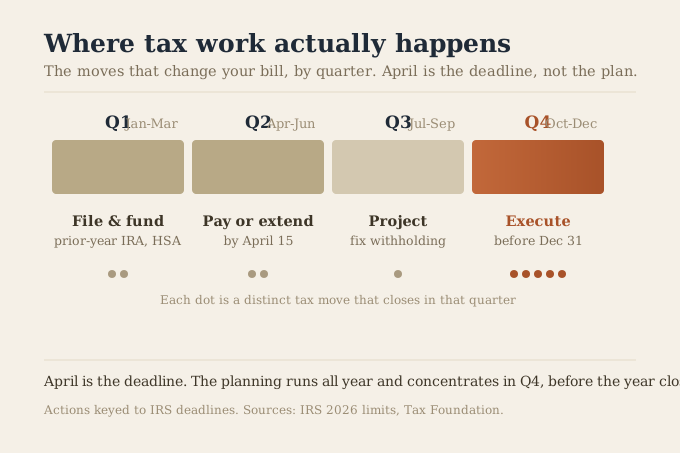
The reframe: tax is a system, not a season
Here is the single idea that reorganizes everything. Your tax bill is set by December 31, not April 15. The filing deadline is when you report the result; the tax year itself is when you shape it. Almost every move that lowers what you owe, funding tax-advantaged accounts, realizing or deferring gains and losses, converting to Roth, timing deductible expenses, has to happen inside the calendar year. Wait until you are filing and you are a scorekeeper, not a player.
That reframe turns a stressful annual event into four manageable checkpoints, one per quarter. None of them is heavy on its own. Skipping them is what makes April feel like a scramble.
Q1 (January to March): file, and fund the past
The first quarter has two jobs. The obvious one is filing your prior-year return, and filing earlier is better: it shortens the window for refund fraud and gets any refund back faster. The less obvious job is that a narrow set of moves can still touch the year you are filing for. Prior-year IRA and HSA contributions are allowed right up to the April filing deadline, so if you underfunded either last year, Q1 is your last chance to top them up and claim the deduction on the return you are about to file.
Use the filing itself as data. A large refund means you lent the government money interest-free all year and should cut your withholding; a large balance due means the opposite. Either way, Q1 is when you reset withholding so the rest of the year runs closer to even.
Q2 (April to June): pay or extend, and set your estimates
April 15 is the hard deadline, and the most expensive misunderstanding in tax lives here: an extension to file is not an extension to pay. You can push your paperwork to October 15, but any tax owed is still due in April, and underpaying accrues interest and penalties from that date. If you extend, estimate the bill and pay it now.
If you are self-employed or have significant income without withholding, Q2 is also when the quarterly system kicks in. Estimated taxes are due roughly April 15, June 15, September 15, and January 15, not once a year, and missing them triggers underpayment penalties even if you settle up in April. The cash you set aside for those payments should not sit idle while it waits.
The money earmarked for a quarterly tax payment can earn a competitive rate right up until it is due. These are current high-yield savings rates, live as of today, all at FDIC-insured banks:
Estimate remaining 2026 federal safe-harbor funding and divide it across the entered number of remaining installments.
Remaining Safe-Harbor Funding
$20,000
Use this result as one input in your broader Money Map, not as a one-off number.
What to do
Plan your tax strategy
Pre-tax estimates. For illustration only — not financial advice.
Q3 (July to September): project, do not guess
The middle of the year is the checkpoint almost everyone skips, and it is the one that makes Q4 work. By September you know enough about your income, gains, and life changes to run a mid-year tax projection: a rough estimate of where your taxable income will land and which bracket you will top out in. That single number drives every Q4 decision.
It also leaves time to fix things while fixing is still cheap. If your withholding is off, adjusting it in September spreads the correction over several paychecks instead of one painful catch-up. If a Roth conversion or a big deductible move makes sense, Q3 is when you map the room to do it, before the year-end rush when everyone else is scrambling and custodians get slow.
Q4 (October to December): where the money is actually made
This is the quarter that matters, and the reason the whole calendar exists. Nearly every high-value tax move has a hard December 31 deadline, and Q4 is when you execute against the projection you built in Q3.
- Harvest losses. Sell investments trading below their cost to realize losses that offset capital gains, and up to $3,000 of ordinary income, then reinvest while respecting the wash-sale rule. See the tax-loss harvesting guide for the mechanics.
- Convert to Roth in your bracket headroom. If your Q3 projection shows room at the top of a low bracket, converting traditional balances to Roth up to that ceiling locks in today's rate. The Roth conversion guide covers the timing.
- Max the accounts. Push your 401(k) toward the 2026 limit through the last paychecks, and finish HSA funding. These are the largest, most reliable deductions available.
- Handle the forced and the perishable. Take required minimum distributions, make qualified charitable distributions if you are giving anyway, spend down a use-it-or-lose-it FSA, and bunch deductions into this year or next depending on which clears the standard deduction.
Screen how entered investment losses may offset gains, ordinary income, and future years.
Estimated Current-Year Tax Effect
$2,870
Use this result as one input in your broader Money Map, not as a one-off number.
What to do
Compare Top Brokerage Accounts
Pre-tax estimates. For illustration only — not financial advice.
What OBBBA changed for 2026
The One Big Beautiful Bill Act, passed in 2025, is the backdrop to this year's planning. It made the lower individual rates from the 2017 Tax Cuts and Jobs Act permanent instead of letting them expire, and kept the larger standard deduction, which removes a cliff that would otherwise have raised most bills. It also added new deductions for qualifying tip income and overtime pay, an additional $6,000 deduction for filers 65 and older that phases out at higher incomes, and a higher cap on the state and local tax deduction, per the Tax Foundation.
The thresholds phase in and depend on your income, so confirm your own eligibility rather than assuming, but the practical effect for most households is a modestly lower bill and a few new levers worth checking against your situation.
Illustrate selected 2026 OBBBA deduction and credit scenarios using user-confirmed eligible amounts.
Extra Deduction vs. the Old $10,000 SALT Cap
$8,000
Use this result as one input in your broader Money Map, not as a one-off number.
What to do
Compare High-Yield Savings
Pre-tax estimates. For illustration only — not financial advice.
The 2026 numbers that anchor the year
Every move above runs against a set of limits the IRS resets annually. These are the 2026 figures:
- 2026 limit
- $24,500
- Catch-up (older savers)
- +$8,000 (age 50+)
- 2026 limit
- $7,500
- Catch-up (older savers)
- +$1,100 (age 50+)
- 2026 limit
- $4,400
- Catch-up (older savers)
- +$1,000 (age 55+)
- 2026 limit
- $8,750
- Catch-up (older savers)
- +$1,000 (age 55+)
- 2026 limit
- $3,400
- Catch-up (older savers)
- rollover up to $680
Exact bracket thresholds and the standard deduction adjust for inflation each year; see our 2026 federal tax brackets for the current figures.
Methodology
This playbook organizes standard tax-planning actions into a calendar keyed to their real deadlines; the quarters are a framework, not a legal schedule, and the specific dates (April 15, the estimated-tax due dates, and the December 31 cutoff) follow IRS deadlines that can shift by a day when they fall on weekends or holidays. The 2026 contribution limits are the IRS's published figures. The OBBBA summary describes the direction of the law's individual provisions; because several phase in by income, we point to the specific thresholds rather than restating them, and we link the maintained bracket article for exact numbers so this page does not drift as inflation adjustments land. Nothing here is individualized tax advice; a complex situation warrants a professional.
How we source this. Contribution limits and deadlines come from the IRS directly; the OBBBA summary is drawn from the Tax Foundation's analysis, cited below with dates. See our methodology and editorial team. We take no payment for organic rankings.
Sources
- IRS, 401(k) limit increases to $24,500 for 2026, IRA limit increases to $7,500, and published HSA and FSA limits for 2026.
- Tax Foundation, The One Big Beautiful Bill Act tax changes.
- IRS, estimated taxes and filing deadlines.
Figures are current for the 2026 tax year and subject to IRS inflation adjustments. This page is informational, not tax advice. Free to cite with attribution to SwitchWize.
What to Do Now
Frequently Asked Questions
When should I start tax planning for the year?
What are the 2026 contribution limits?
Is a tax extension also an extension to pay?
What tax moves must be done by December 31?
What did the One Big Beautiful Bill Act change for 2026 taxes?
Answer a few questions about your situation and goals. Money Map points you to the highest-value next step across savings, mortgage, cards, and debt.
Editorial review
What changed since the last update
Was this guide helpful?
Found an inaccurate, outdated, or missing claim? Report a correction. We verify reports against the relevant source before changing a guide or ranking.
