- Federal student debt cancelled under an income-driven repayment plan is taxable income again for cancellations on or after January 1, 2026. The 2021 exemption expired on December 31, 2025, and the 2025 tax law renewed it only for cancellations due to death or disability.
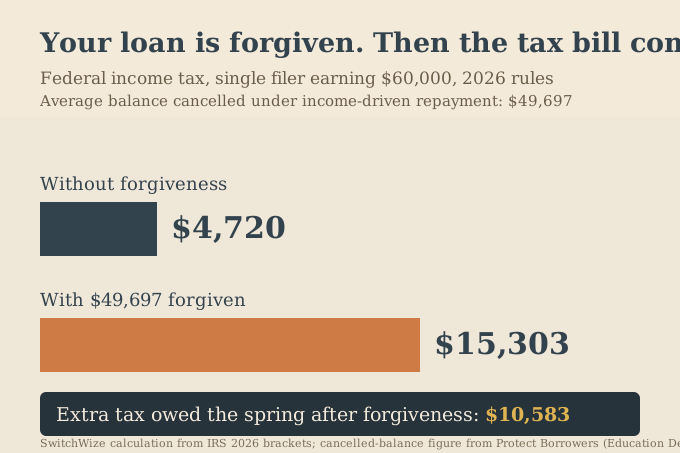
- The average balance cancelled under these plans is $49,697. Added to a single filer's $60,000 wages, it raises the 2026 federal income tax from $4,720 to $15,303, an extra $10,583. SwitchWize calculated that from the IRS 2026 brackets, and Protect Borrowers reaches the same number.
- The insolvency exclusion is the one rule that can cut the bill. If your debts exceed your assets the day before cancellation, you can exclude that much of the cancelled balance using IRS Form 982. It requires a list of everything you own and owe, so the time to make that list is before the cancellation, not after.
Lorena made her first income-driven student loan payment in 2001, the summer after she finished college in San Antonio. She moved to the Income-Based Repayment plan when it opened in 2009, and the earlier payments counted. The payments were small because her pay was small. The balance was not. Interest grew faster than the payments shrank it. The $38,000 she borrowed became $49,697 by the time her 25-year count ran out this year. The letter from her loan servicer said the rest of the balance was cancelled. She read it twice and went out to dinner.
What the letter did not say is what happens next January. A second piece of paper, IRS Form 1099-C, will report the cancelled $49,697 as income she received in 2026. She earns $60,000 at a dental office. For tax purposes, she earned $109,697 this year. Her federal income tax goes from $4,720 to $15,303. The loan is gone. A $10,583 bill takes its place.
What changed on January 1, 2026
From 2021 through 2025, a federal law made every cancelled federal student loan tax-free. That law, part of the American Rescue Plan Act, had an end date written into it: December 31, 2025. Congress rewrote the student loan tax rules again in July 2025, in the One Big Beautiful Bill Act. It kept a permanent exemption only for loans cancelled (the law calls it a discharge) because the borrower died or became permanently disabled. Balances cancelled after 20 to 25 years of income-driven payments were left out. The current text of the tax code, section 108(f), now covers death and disability only. The notes attached to that section confirm the old exemption ended for cancellations after December 31, 2025.
Protect Borrowers, a nonprofit that advocates for student debt relief, put numbers on the result in a report released October 7. Using Education Department data and 2026 IRS rules, it estimates that 1.9 million to 3.2 million borrowers will reach cancellation by 2036. Each of them would owe tax on it. That is 15% to 25% of the 12.8 million people enrolled in income-driven plans as of March 2026. Most people who have earned cancellation so far made less than $50,000 a year in 2022, about $60,000 in today's dollars. Half had no bank savings outside a retirement account.
How a cancelled balance becomes a tax bill
The tax code treats a debt you no longer have to pay as money you received. The IRS calls it cancellation of debt income. A lender that cancels $600 or more of a debt files Form 1099-C with the IRS and sends you a copy. Whether or not the form arrives, the IRS says you must report the cancelled amount as income.
From there the math is ordinary. Lorena's wages are $60,000. Add $49,697 of cancelled debt and her income for 2026 is $109,697. Subtract the 2026 standard deduction of $16,100 and her taxable income is $93,597. The first $12,400 is taxed at 10%, or $1,240. The next $38,000, up to $50,400, is taxed at 12%, or $4,560. The remaining $43,197 is taxed at 22%, or $9,503. Total: $15,303.
Without the cancellation, her taxable income would have been $41,400, because she could also deduct $2,500 of student loan interest. Her tax would have been $4,720. The cancellation costs her that deduction too, because the deduction goes away once income passes $100,000. The difference is $10,583. Her total federal income tax, $15,303, is about one dollar of every four she earned this year.
Families with children lose even more. Two tax credits for working families, the Earned Income Tax Credit and the Child Tax Credit, shrink or disappear as income rises. Adding $49,697 of paper income pushes a working family out of both. Take Protect Borrowers' numbers for a married couple with two children earning $40,000. A refund of $8,854 in a normal year becomes a bill of $1,704, a swing of $10,558. Their tax bill is 11 times what it would have been.
"Treating such cancelled debt as taxable income will hit many borrowers with an unprecedented tax bomb and force them to replace their debt to the U.S. Department of Education with debt to the Internal Revenue Service." (Protect Borrowers, October 2026)
How the tax break came and went
Income-driven repayment began on July 1, 1994, when the Education Department launched its first plan with cancellation after 25 years of payments. From that day, the cancelled balance was taxable, like any other cancelled debt. The first borrowers reached the 25-year mark in July 2019, according to the National Consumer Law Center. The group filed a public records request that month to find out whether the promised cancellations were happening at all.
Congress carved out the first exceptions in 2017, when the Tax Cuts and Jobs Act made death and disability discharges tax-free through 2025. In March 2021 the American Rescue Plan Act went much further and exempted all cancelled federal student debt through the same end date. The timing mattered. Between 2022 and 2025 the Education Department recounted payments for millions of borrowers whose servicers had tracked them badly. About 1.5 million people earned cancellation under income-driven plans in the ten years through 2025. Much of that happened inside the tax-free window.
Enrollment in these plans has also nearly doubled, from 6.8 million borrowers at the end of 2017 to 12.8 million in March 2026. So more people are headed for cancellation, and cancellation is now taxed. The first cancellations under the new rule are being processed now.
What the bill looks like at three incomes
Protect Borrowers modeled nine households, three incomes by three family types, each receiving the $49,697 average cancellation. Every one of them owes at least $5,964 more. The highest single-filer figure, $11,641 at $80,000 of wages, comes from the tax brackets alone, with no credits involved. The highest family figure, $10,558 at $40,000 of wages, comes mostly from credits that disappear.
This is the opposite of how taxes usually work. A higher earner pays more dollars, but a lower earner loses a bigger share. The single filer at $40,000 ends up paying $10,525 in federal income tax, more than a quarter of pay. That is before Social Security, Medicare, or any state tax.
The insolvency rule can cut the bill
There is one exception written into the tax code that does not depend on Congress acting. You are insolvent when your total debts are larger than the total value of everything you own. That is the IRS definition. If that is true right before a debt is cancelled, you can leave the cancelled amount out of your income. The most you can leave out is the gap between what you owe and what you own. The claim goes on IRS Form 982, line 2, with a worksheet in IRS Publication 4681. Assets include things you cannot easily spend, such as retirement accounts. Debts include the student loan itself, right up to the moment it disappears.
Here is how it would work for Lorena. The day before her cancellation she owes $49,697 on the loan, $6,000 on her car, and $2,400 on a credit card: $58,097 in all. She owns a car worth $9,000, $1,200 in checking, and $14,000 in a 401(k): $24,200. She is insolvent by $33,897. She can exclude that much of the $49,697. Only $15,800 is taxed. Her income for the year becomes $75,800, low enough to keep the $2,500 interest deduction, and her federal tax comes to $7,296. The extra cost of the cancellation drops from $10,583 to $2,576.
Protect Borrowers treats this rule as a weak defense. Few borrowers know it exists. Free tax-preparation programs have historically not handled cancelled-debt cases. If the IRS questions the claim, you may have to pay for appraisals and a professional preparer. Still, many borrowers own a modest car, a thin checking account, and little else. For them the worksheet is a page of addition, and it is worth thousands of dollars.
What the projection leaves out
The 1.9 million to 3.2 million figure is a projection. It assumes 15% to 25% of today's enrollees reach cancellation within ten years. The real number could land outside that range. It could be lower in the near term. Cancellation under three of the plans, ICR, PAYE and SAVE, is paused after a federal appeals court ruling. The Education Department is processing cancellations only under the Income-Based Repayment plan for now, as Bankrate and The College Investor have reported. A borrower whose payments count toward Income-Based Repayment can still get there. Many will simply get there later than their payment count suggests.
The tax is also smaller than the debt it follows. Lorena owes $10,583 more in tax and no longer owes $49,697. She still comes out $39,114 ahead. The problem is timing and cash. The loan vanished on paper. The tax is due in real dollars, in one spring, from a household that the report's own data says has almost no savings. The IRS offers payment plans of up to 72 months on Form 9465. That would spread Lorena's $10,583 to about $147 a month before interest and penalties, roughly what she was already paying on the loan.
State taxes are not in any of these numbers. Protect Borrowers modeled federal tax only and notes that states vary. Some copy the federal definition of income automatically, some update it by vote, and some write their own. A borrower in a state with no income tax, like Lorena in Texas, owes only the federal amount. Elsewhere the bill can be larger.
What Lorena does when the 1099-C arrives
The night the form comes, Lorena opens Publication 4681 to the insolvency worksheet. She does what she should have done the week the cancellation letter arrived. She lists what she owned and owed on the day before the balance disappeared. The loan goes on the debt side. The 401(k) goes on the asset side, even though she cannot touch it. The gap comes to $33,897, and her federal bill falls from $15,303 to $7,296. She sets up a payment plan for the rest. The $150 a month keeps flowing, this time to the IRS instead of the servicer, for about a year and a half. Then, for the first time since 2001, the monthly payment stops.
Sources
- Protect Borrowers, "Fleeced at the Finish Line: The Tax Bomb Coming for IDR Borrowers", October 2026, and the accompanying press release, October 7, 2026: $49,697 average cancellation (Education Department "Approved Debt Relief by State" data, January 15, 2025); 12.8 million enrolled in income-driven plans (Federal Student Aid IDR portfolio, March 2026), up from 6.8 million in 2017; 1.9 million to 3.2 million projected cancellations 2026 to 2036 (15% to 25% of enrollees); income and savings profile of 2022 recipients; Figures 2 to 4 (tax outcomes by income and household, including lost Earned Income Tax Credit and Child Tax Credit); about 1.5 million cancellations 2015 to 2025; methodology (standard deduction, up to $2,500 student loan interest deduction, no insolvency assumed). Retrieved and read in full October 13, 2026.
- 26 U.S.C. 108(f), current text and amendment notes via Cornell Legal Information Institute: paragraph (5) now covers death and disability discharges; the prior paragraph (5), the "special rule for discharges in 2021 through 2025," was replaced by Public Law 119-21 for discharges after December 31, 2025. American Rescue Plan Act of 2021, section 9675, created the 2021 to 2025 exemption.
- IRS, news release IR-2025-103 and Revenue Procedure 2025-32: 2026 standard deduction $16,100 single, $24,150 head of household, $32,200 joint; 2026 brackets for single filers, 10% to $12,400, 12% to $50,400, 22% to $105,700. Revenue Procedure 2025-32, section 4.29: for 2026 the $2,500 student loan interest deduction begins to phase out above $85,000 of modified adjusted gross income for single filers and is gone at $100,000 ($175,000 and $205,000 for joint returns).
- IRS, Publication 4681, Canceled Debts, Foreclosures, Repossessions, and Abandonments: definition of insolvency, the Insolvency Worksheet, the rule that excluded debt is capped at the amount of insolvency, Form 982 line 2, and the statement that cancelled debt must be reported as income with or without a Form 1099-C. IRS, "What if I am insolvent?" and About Form 1099-C: the $600 filing threshold.
- National Consumer Law Center, press release, July 1, 2019: income-contingent repayment launched July 1, 1994, with cancellation after 25 years; first cohort eligible July 2019.
- Bankrate, "IDR student loan forgiveness becomes taxable in 2026" (Mark Kantrowitz): list of discharge types that remain tax-free, and the pause on cancellation under ICR, PAYE and SAVE after the Eighth Circuit ruling. The College Investor's reporting on the Education Department resuming Income-Based Repayment discharges in batches.
- Lorena's figures are SwitchWize's own calculation from the IRS 2026 brackets and deductions above; the $4,720 and $15,303 results match Protect Borrowers' Figure 3 single-filer row to the dollar. Her insolvency example uses assets and debts SwitchWize chose to illustrate the worksheet; they are not from any survey.
What to Do Now
Lorena is a composite character; the tax rules, brackets, and Protect Borrowers figures cited are real. Figures were verified on October 13, 2026, against the report, the tax code, and IRS publications. This article is educational information, not tax advice for your situation. If you claim insolvency, have a tax professional check the return.
Quick answers
Is student loan forgiveness taxable in 2026? For forgiveness under an income-driven repayment plan (IBR, ICR, PAYE, SAVE or the new RAP), yes. The federal tax exemption that covered all cancelled federal student debt from 2021 through 2025 expired on December 31, 2025. Public Service Loan Forgiveness, Teacher Loan Forgiveness, closed-school discharges, and death or disability discharges stay tax-free under separate rules.
How much tax will I owe on forgiven student loans? The cancelled balance is added to your other income for the year. On the average $49,697 cancelled balance, a single filer earning $60,000 would owe about $15,303 in federal income tax instead of $4,720, an extra $10,583. Parents can be hit harder. The added income can wipe out two credits for working families, the Earned Income Tax Credit and part of the Child Tax Credit.
How does the insolvency exclusion work for forgiven student loans? You are insolvent if, right before the cancellation, everything you owe adds up to more than everything you own, including retirement accounts. You can exclude cancelled debt from income up to that amount, using IRS Form 982 and the worksheet in IRS Publication 4681. If you owe $58,097 and own $24,200 of assets, you can exclude $33,897 of a $49,697 cancellation and pay tax only on the remaining $15,800.
Will I get a form from the Education Department for forgiven loans? Lenders that cancel $600 or more of a debt file IRS Form 1099-C. That form reports the cancelled amount to the IRS, and you get a copy. The Protect Borrowers report assumes cancelled federal student debt will be reported that way. The IRS says you must report cancelled debt as income even if no form arrives. Expect the tax to be due with your return the spring after the cancellation.
Frequently Asked Questions
Is student loan forgiveness taxable in 2026?
How much tax will I owe on forgiven student loans?
How does the insolvency exclusion work for forgiven student loans?
Will I get a form from the Education Department for forgiven loans?
The 5-minute money briefing
One email per week. New rates, fed moves, and what to actually do about them.
No spam. Unsubscribe anytime.
Act on this: today's top loans



Ranked by SwitchWize's composite score. SwitchWize currently has no compensated product links.
Editorial review
What changed since the last update
Was this guide helpful?
Found an inaccurate, outdated, or missing claim? Report a correction. We verify reports against the relevant source before changing a guide or ranking.