- Americans owe about $1.86 trillion in student loans, and a record 9.5 million federal borrowers, more than one in five, are now in default as payments resumed.
- The repayment system is changing: SAVE has ended and the new Repayment Assistance Plan (RAP) arrived in July 2026, with payments of 1% to 10% of income and forgiveness after 30 years.
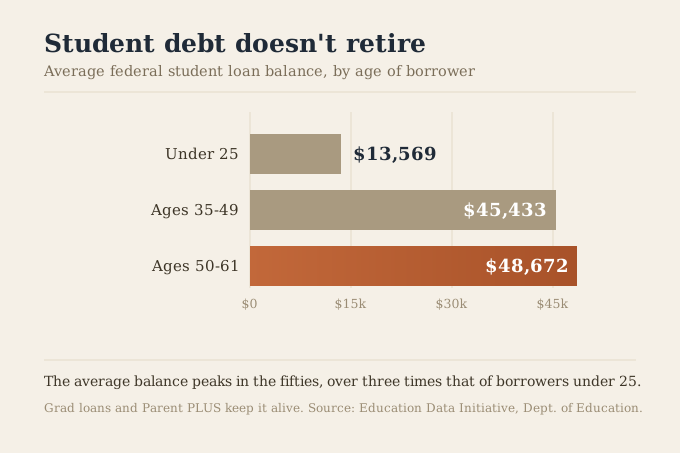
- The surprise in the data: student debt peaks in your fifties, not your twenties, so it is increasingly a lifelong burden.
Student debt in America has crossed $1.86 trillion, but the total is the least interesting number in this report. Two things define the moment. The pandemic-era payment pause has fully ended, and a record share of borrowers cannot keep up: more than one in five federal borrowers is in default. At the same time, the repayment system is being rebuilt beneath them, with the SAVE plan ended and a new plan in its place. And underneath both stories sits a fact that contradicts the stereotype of the broke young graduate. This report lays out the numbers and what changed. This page is reviewed by the SwitchWize Editorial Team; the figures are sourced below with dates. Below, we break down the key student loan debt statistics 2026 and explain what they mean for borrowers today.
The numbers
Four figures define the landscape:
- The debt. Americans owe about $1.86 trillion in student loans, roughly $1.7 trillion of it federal, per Federal Reserve and Education Data figures.
- The borrowers. About 42.6 million people hold federal student loans.
- The default record. A record 9.5 million federal borrowers were in default as of March 2026, more than one in five.
- The delinquency. Balances 90 or more days past due reached about 10.3% of student debt in early 2026, per New York Fed data.
The through-line is stress. The total has grown for years, but the resumption of payments after the pandemic pause has exposed how many borrowers cannot sustain them, which is why the repayment changes below matter so much right now.
- Value
- ~$1.86 trillion
- Source
- Federal Reserve / Education Data
- Value
- ~42.6 million
- Source
- Dept. of Education
- Value
- ~9.5 million
- Source
- Dept. of Education
- Value
- ~10.3%
- Source
- New York Fed
- Value
- ~$48,672
- Source
- Education Data
The debt that does not retire
The stereotype is the young graduate buried in loans. The data tells a different story. The average federal balance is highest for borrowers aged 50 to 61, at about $48,672, more than three times the roughly $13,569 owed by those 24 and under. Debt does not shrink with age; on average it grows.
Three forces explain it. Graduate and professional loans are far larger than undergraduate ones and are taken later. Parent PLUS loans let parents borrow, often heavily, for their children's education, adding student debt in midlife. And income-driven repayment stretches balances over 20 to 30 years, so a loan taken at 25 can still be outstanding at 50. The consequence is that student debt increasingly follows people toward retirement, competing with the savings they should be building, and it reframes the whole issue from a youth problem into a lifelong one.
The safety net just changed
For 43 million borrowers, the most consequential news is structural. The SAVE plan, which spent months on hold in the courts, has ended, so anyone enrolled in it must choose a new plan. In its place, a new Repayment Assistance Plan (RAP) became available July 1, 2026.
RAP works differently. Payments are set on a sliding scale from 1% to 10% of income, rising with earnings, with a reduction for dependents and a floor of $10 a month. Crucially, unpaid interest is waived, so a balance no longer grows when the payment does not cover interest, and the government adds up to $50 toward principal when a payment barely dents it. Any remaining balance is forgiven after 30 years, longer than the 20 to 25 years under older plans. Whether RAP or the revised IBR plan is better depends on your income and family size, so it is worth running both:
Estimate a RAP payment scenario, compare it with clearly labeled generic and legacy-plan references, model the Sept. 30 auto-pay rate discount, check for a growing-balance warning sign, check PSLF fit, and identify the next paperwork step.
Line 11 of your Form 1040 (married filing jointly uses combined AGI)
Each dependent claimed on your tax return cuts the payment by $50/mo
Used to compare RAP against the Standard 10-year plan
Your weighted-average federal loan rate
Used only for rough IBR and PAYE/ICR reference payments. Confirm exact plan math with StudentAid.gov.
PSLF generally requires 120 qualifying monthly payments while meeting program rules.
Choose 1 if you work for a qualifying government or nonprofit employer.
Servicers began sending these notices July 1, 2026, with a 90-day window to choose. Miss it and you are auto-enrolled in Standard or Tiered Standard. Check your notice for your exact deadline.
Choose 1 if a consolidation loan includes Parent PLUS debt; RAP eligibility can differ.
Direct Loans enrolled in auto-pay by September 30, 2026 get a 1-percentage-point rate reduction (the existing 0.25% plus a new 0.75% add-on) that runs through June 30, 2028.
Your Estimated RAP Monthly Payment
$275
Use this result as one input in your broader Money Map, not as a one-off number.
What to do
Start a Student Loan Reset
Pre-tax estimates. For illustration only — not financial advice.
The default crisis, and how to avoid it
The resumption of payments has produced the worst default numbers on record: 9.5 million federal borrowers in default, more than one in five. Default generally occurs after about 270 days of nonpayment, and its consequences are severe: wrecked credit, the full balance coming due, and potentially wage garnishment and seizure of tax refunds. Collection on defaulted loans is currently suspended, but that is temporary and no substitute for a plan.
The escape is almost always to act before default. Enrolling in an income-driven plan can drop a payment to as little as $10 a month, which beats every consequence of defaulting. If you are behind, the priority is to get into a plan you can afford now.
Estimate fixed-payment student-loan payoff with zero-rate, non-amortizing, and final-payment safeguards.
Use our comparison page for live rates
Months to Pay Off (with extra)
124.0
Use this result as one input in your broader Money Map, not as a one-off number.
What to do
Explore student loan options
Pre-tax estimates. For illustration only — not financial advice.
The honest counterargument
Not every borrower is in crisis. Many carry modest, manageable balances and repay on schedule, a college degree still raises lifetime earnings substantially on average, and the new plans, for all the disruption, include genuine relief like the interest waiver and eventual forgiveness. It would be wrong to paint all 43 million borrowers as drowning.
But the record default numbers are not noise. More than one in five federal borrowers in default, at the same moment the repayment system is being rebuilt, means a large minority faces real risk, especially those who do not realize their plan is changing or who fall behind without enrolling in an affordable option. The aggregate degree still pays; the distribution is what this report is about, and the tail of it is in genuine trouble.
Methodology
Total and federal debt figures combine Federal Reserve consumer-credit data with Department of Education and Education Data Initiative reporting; by-age averages are Education Data Initiative figures. Default and delinquency counts are Department of Education and New York Fed data for early 2026. RAP terms reflect the plan as enacted, which opened July 1, 2026; specific payment amounts depend on income and family size. A machine-readable version of the headline figures is published at /data/student-debt.json. Nothing here is individualized financial advice.
How we source this. Debt totals come from the Federal Reserve and Department of Education, by-age figures from the Education Data Initiative, delinquency from the New York Fed, and RAP terms from the enacted law, all cited with dates. See our methodology and editorial team. We take no payment for organic rankings.
Sources
- Federal Reserve and New York Fed Household Debt and Credit: total balances and delinquency.
- US Department of Education and Education Data Initiative: federal borrower counts, default totals, and average balance by age.
- The Repayment Assistance Plan (RAP) as enacted, effective July 1, 2026: payment formula and forgiveness terms.
Figures are current as of mid-2026 and change with policy. This page is informational, not financial advice. Free to cite with attribution to SwitchWize.
What to Do Now
Frequently Asked Questions
How much student loan debt do Americans have in 2026?
Is student debt only a young person's problem?
What is happening to student loan repayment plans in 2026?
How many borrowers are in default, and what happens in default?
Should I refinance my federal student loans?
The 5-minute money briefing
One email per week. New rates, fed moves, and what to actually do about them.
No spam. Unsubscribe anytime.
Act on this: today's top loans



Ranked by SwitchWize's composite score. We may earn a referral fee, and it never changes the ranking order.
Editorial review
What changed since the last update
Was this guide helpful?
Found an inaccurate, outdated, or missing claim? Report a correction. We verify reports against the relevant source before changing a guide or ranking.
