Quick answer
A Roth conversion can reduce an eligible senior deduction, raising taxable income by more than the conversion. Calculate incremental tax, possible Medicare effects and expected future savings separately.
Daniel and Maria are both 67. They are considering moving $10,000 from a pretax IRA into a Roth IRA before year-end.
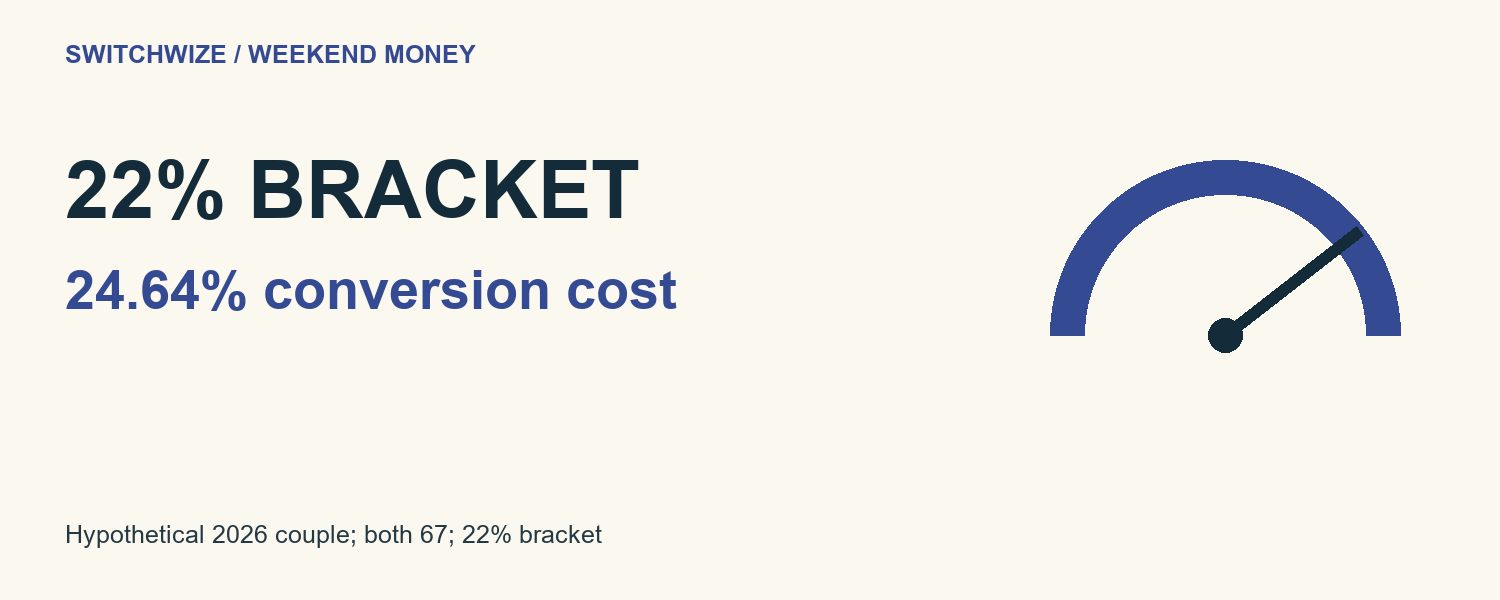
They are in the 22% federal bracket. Their first estimate of the bill is $2,200.
Under the assumptions in our example, the additional federal tax is $2,464. The conversion is not crossing into the next bracket. Instead, it reduces two deductions they otherwise would receive.
Daniel and Maria are fictional. Their example uses 2026 married-filing-jointly rules, $150,000 of other adjusted gross income consisting entirely of ordinary taxable income, the standard deduction and the age-related deductions. There is no Social Security, investment income, state tax, credit or Medicare cost in the calculation. The converted IRA money is entirely pretax, and they pay the tax with separate cash.
This simplified household exposes a feature that a bracket-only calculation misses.
The next $10,000 can create $11,200 of taxable income
Eligible people aged 65 or older can claim an additional deduction of up to $6,000 each under current law for 2025–2028. For married couples filing jointly, the deduction starts shrinking above $150,000 of modified adjusted gross income. This is AGI with certain excluded income added back. Daniel and Maria have no such income, so the two amounts are equal.
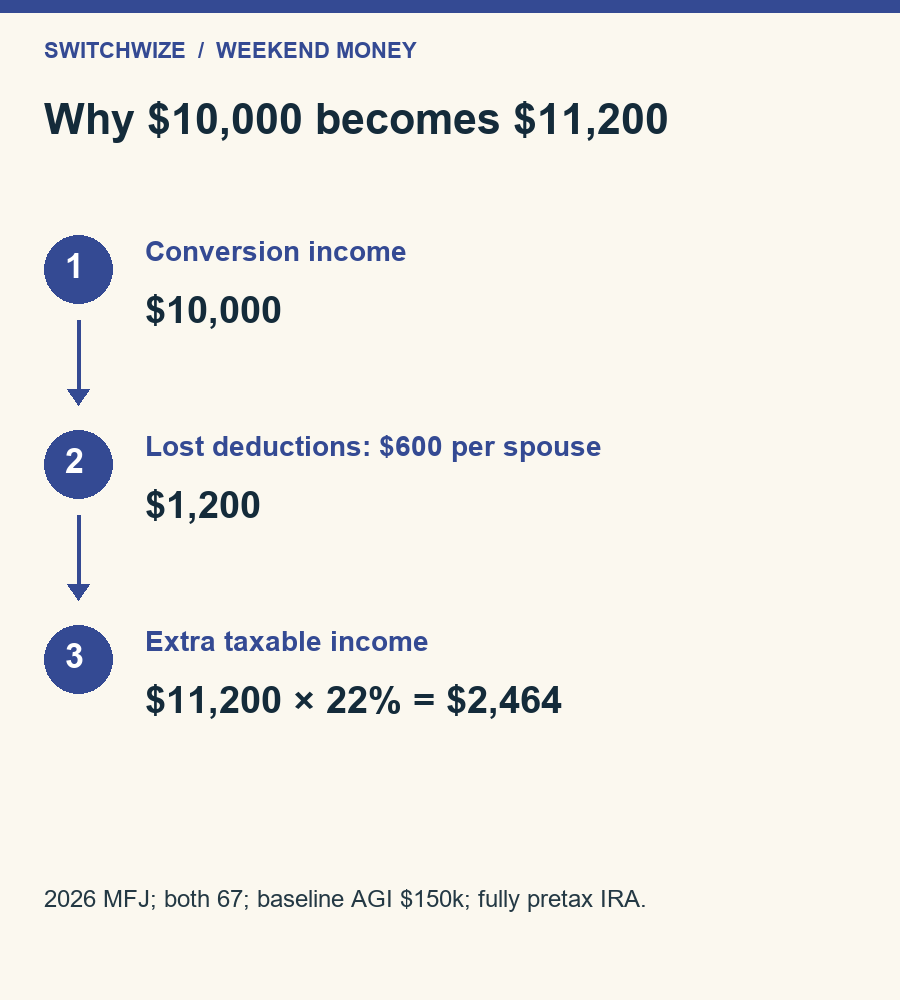
The $6,000 amount is reduced by 6% of income above that threshold for each qualifying person. With two eligible spouses, a $10,000 increase reduces each deduction by $600. Together, the couple loses $1,200 in deductions.
Their conversion adds $10,000 of income. The smaller deductions add another $1,200 to taxable income. At 22%, the extra $11,200 produces $2,464 of federal tax.
The effective federal tax on this conversion is 24.64%, even though every extra taxable dollar in this example remains in the 22% bracket.
A calculator that adds the conversion and leaves the deductions unchanged understates the bill by $264.
The same conversion can have three different costs
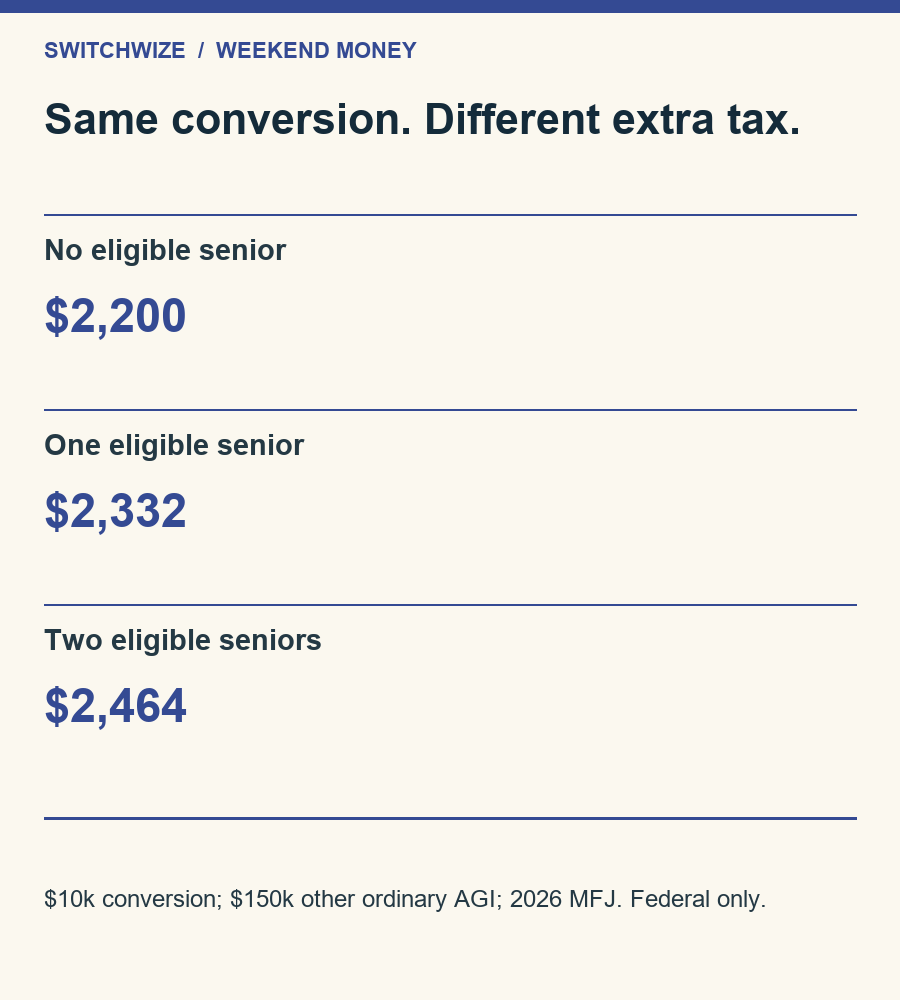
Compare three hypothetical joint-filing households with $150,000 of ordinary adjusted gross income before a $10,000 conversion.
If neither spouse qualifies for the senior deduction, the modeled extra federal tax is $2,200. If one qualifies, it is $2,332. If both qualify, it is $2,464.
The calculation includes each household’s applicable additional standard deduction for age. In all three, the extra taxable income remains in the 22% bracket.
This is not a penalty for turning 65. The eligible households start with deductions that reduce their total tax. The comparison concerns the additional cost of the next conversion, not which household pays more tax overall.
It also does not mean every senior faces a 24.64% conversion rate. Income below the phaseout, a different bracket, only one eligible spouse or an already exhausted deduction changes the answer.
Medicare uses a different calculation and a different year
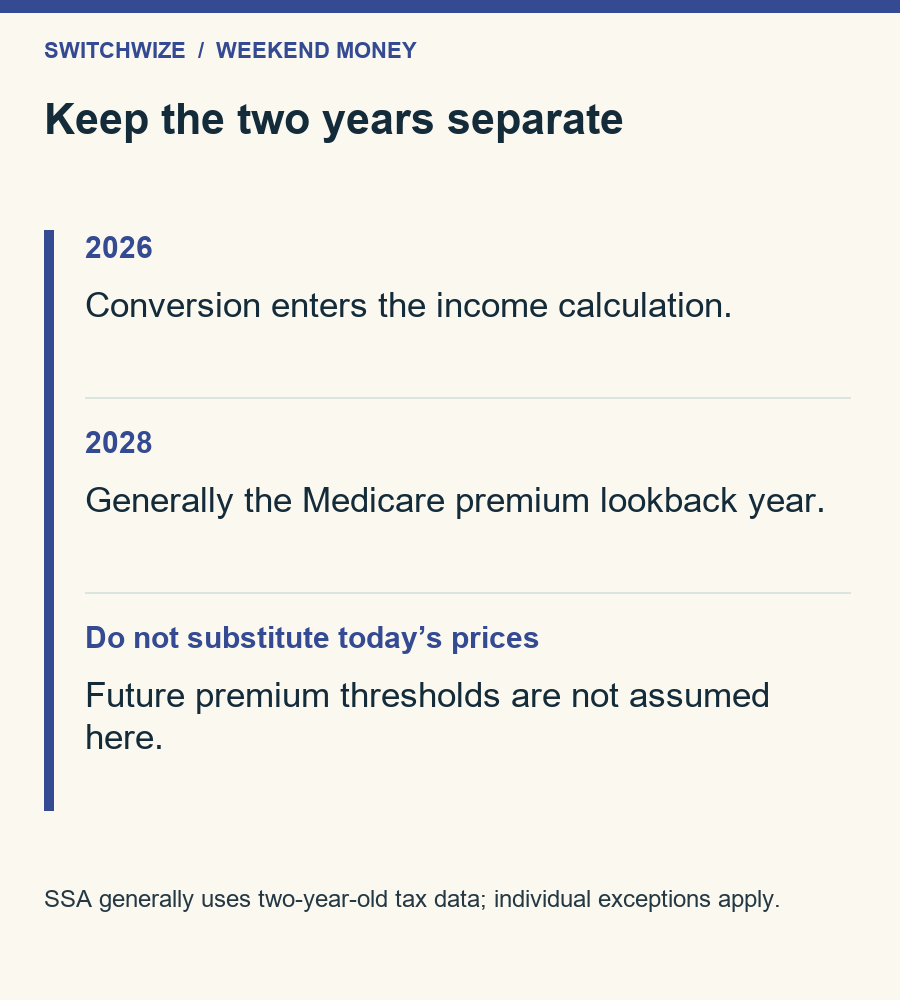
A Roth conversion can also affect income-related Medicare premiums. Social Security generally uses tax information from two years earlier to set those adjustments.
That creates a timing question. A 2026 conversion can generally enter the income calculation used for 2028 premiums. Today’s premium table is not a verified price list for 2028, and we have not added an invented future premium to Daniel and Maria’s tax bill.
The senior deduction and Medicare are different mechanisms. A deduction that lowers taxable income does not automatically lower the income measure Medicare uses. Check the applicable modified-income definition for each calculation.
For an actual household, a conversion analysis should show the federal tax now and identify any future premium year that may be affected. It should also distinguish a standard premium from an income-related increase and account for whether one or both spouses are enrolled.
A higher current cost can still be worth paying
The extra $264 does not settle the decision.
A conversion can reduce future pretax balances and required withdrawals. Qualified Roth distributions receive favorable tax treatment, and Roth IRAs do not impose lifetime required minimum distributions on their original owners. Qualification and distribution rules still matter; moving money into a Roth does not make every immediate withdrawal tax-free.
The family may expect higher future rates, large required distributions or a surviving spouse facing different filing thresholds. Any of those could support paying more now.
The opposite is possible. Someone expecting lower taxable income later, needing cash for near-term spending or using IRA money to pay the conversion tax may reasonably prefer less conversion. Future tax rates and investment returns are assumptions, not facts we can recover from a current bracket table.
The temporary deduction adds another timing consideration: it currently runs through 2028. Waiting might avoid its phaseout cost, but could also forgo other benefits. No single deadline makes the full answer automatic.
Calculate the next increment, then compare the future
Start with the household’s actual projected return before a conversion. Recalculate with another $5,000 or $10,000. Include changing deductions, credits, taxable Social Security where relevant, state rules and any applicable premium effects.
Then ask what that conversion is expected to avoid in later years. Use a consistent investment horizon and include the cash used to pay today’s tax. Compare multiple future tax assumptions, not just the one that makes conversion look best.
Daniel and Maria’s first estimate was a bracket multiplied by a transfer. Their second estimate includes a deduction that shrinks when income rises. Before moving the money, their adviser should be able to show what creates the difference—and what future saving is expected to justify it.
Sources
Current senior-deduction statute · IRS senior guidance · IRS 2026 brackets and age deductions · SSA Medicare income rules · IRS IRA distribution rules
Illustrative federal calculation for 2026. The $2,464 is incremental federal income tax, not total tax or a lifetime cost estimate. Modified income equals AGI in this example. Medicare, state tax, Social Security and other interactions are not included in the displayed numbers. No future premium thresholds or investment returns are assumed. No individual conversion recommendation is made.