
Quick answer
A scam-induced IRA withdrawal and a theft-loss deduction are separate tax questions. Preserve the transaction records and examine the actual facts before assuming that a stolen distribution is tax-free.
Imagine a caller telling you that your retirement account is in danger. You withdraw the money and transfer it to the account they provide. Then you discover that the person helping you was the thief.
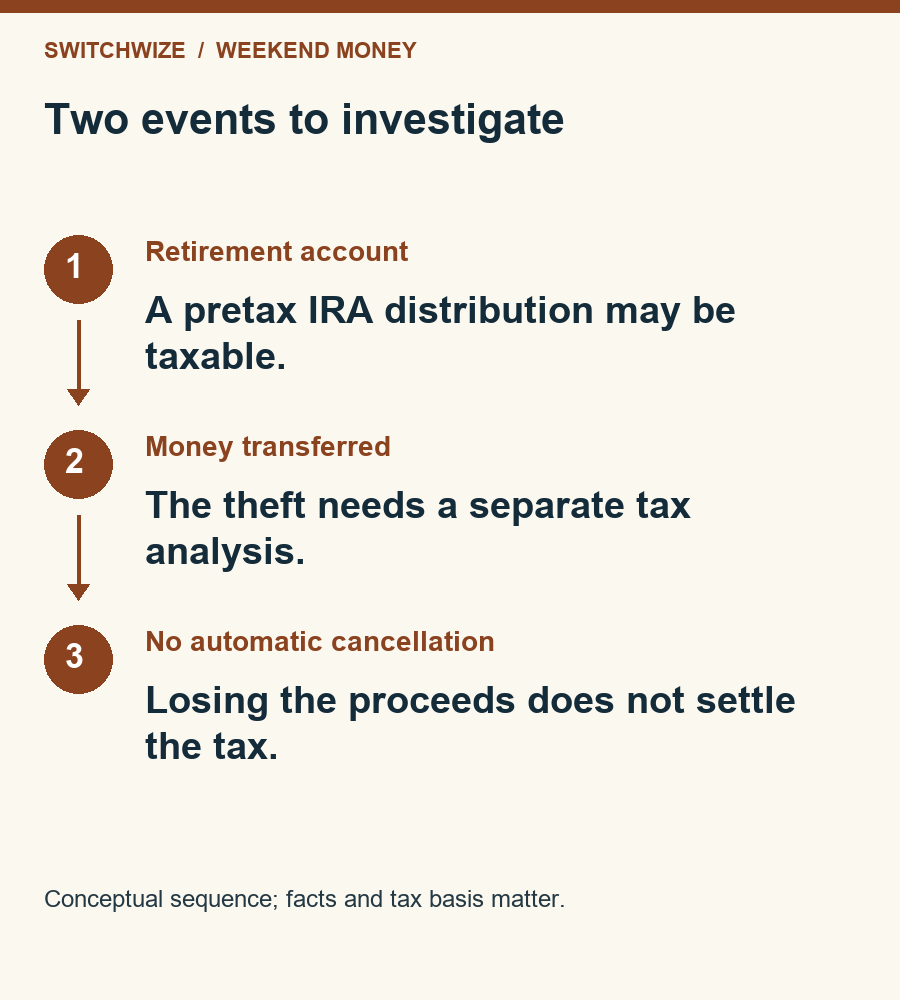
The next problem can be painfully real: a withdrawal from a pretax IRA does not automatically stop being taxable because someone stole the proceeds.
The loss and the distribution are separate tax questions. A deduction may help in some cases. In others, it may be unavailable, delayed or different from what the victim expects.
The family’s first task is to stop further losses. Its second is to preserve enough evidence to understand both problems.
The withdrawal and the theft are separate events
Consider a hypothetical 71-year-old retiree named Ellen. At a scammer’s direction, she requests a $100,000 distribution from an IRA funded entirely with pretax money. She then sends the proceeds outside the retirement account.
The distribution is one event. The transfer and theft are another. Ellen cannot assume that the second event cancels the first.
This is different from a criminal accessing an account and making an unauthorized withdrawal. The legal facts, reporting and remedies can differ. An account statement alone may not establish what Ellen authorized, what she believed or where the money went.
Save copies of messages and transfer instructions before access is lost. Other records matter too: withdrawal forms, messages, transfer instructions, account statements and the explanation the scammer used. The tax analysis should follow the actual sequence, not a label such as “hacked” or “investment fraud.”
IRS Chief Counsel examined scam scenarios involving retirement and nonretirement funds in a memorandum released in March 2025. It recognized that a taxable IRA distribution could precede a separately deductible theft loss. But it did not grant every victim a deduction.
Two victims can suffer the same loss and receive different tax treatment
In the memorandum’s 2024 examples, three victims’ losses qualified as transactions entered into for profit. Two other victims’ losses were personal and did not qualify under the rules applied there.
For example, a victim who sends money to a fake investment expecting a return has a different purpose from someone paying a fake ransom for a relative. An investment purpose alone does not establish every requirement for a deduction. The distinction depends on the purpose and facts of the transaction. Even an account-protection story could require closer examination of the investment purpose; the scammer’s chosen label did not settle the answer.
The memorandum is advice about specified facts, not a blanket exemption or binding precedent for every taxpayer. Current law must also be checked. The personal-loss restriction did not simply disappear after 2025: Section 165 continues to restrict personal casualty losses, with disaster-related provisions and an exception involving personal casualty gains. Profit-related theft losses require their own analysis.
Our conclusion is straightforward: “I lost the money” is the beginning of the tax inquiry, not its answer.
A deduction is not a refund of the stolen amount
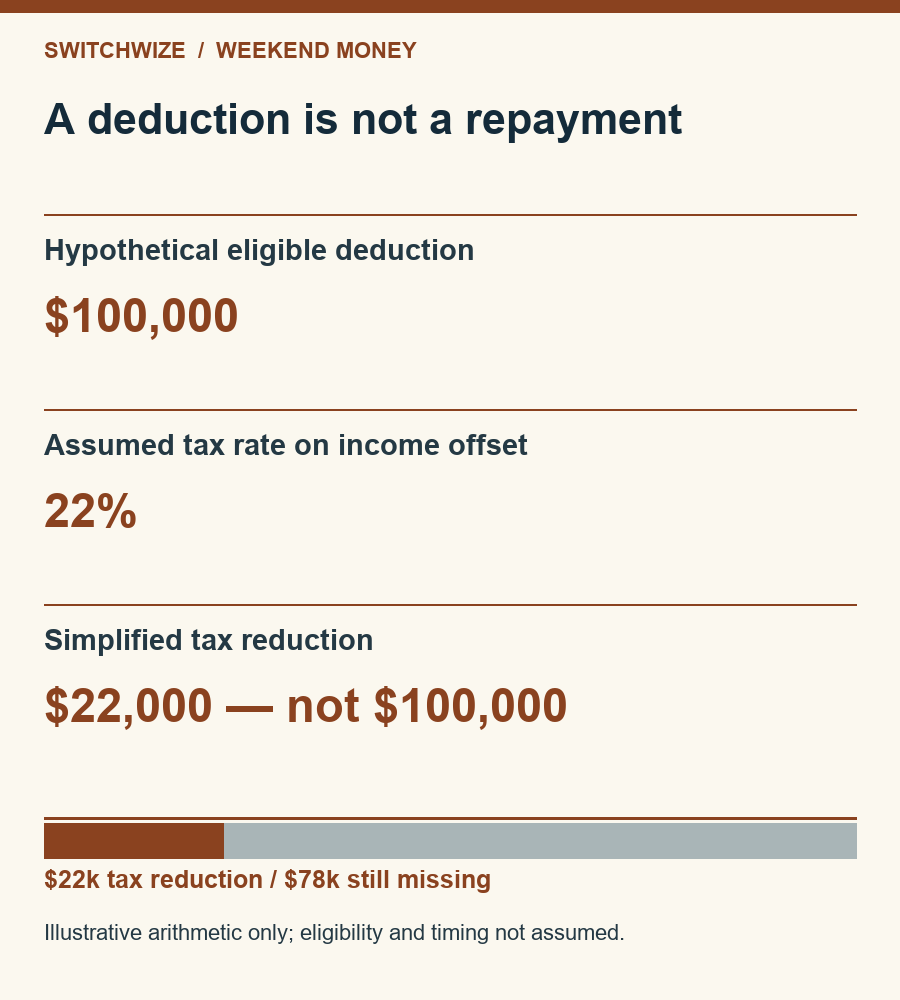
Suppose a victim can properly deduct $100,000. That does not mean the government returns $100,000.
In a deliberately simplified illustration, a deduction offsetting income otherwise taxed at 22% reduces federal tax by $22,000. The victim is still missing the other $78,000. Actual benefits depend on the applicable rules, income, deductions, timing and recoveries; this arithmetic is not Ellen’s tax calculation.
Timing can matter too. A reasonable prospect of recovery can affect when a theft loss is treated as sustained. Do not abandon a recovery claim to chase a tax deduction. Coordinate the recovery and tax questions with the relevant professionals, including a CPA or tax attorney, and preserve the evidence supporting each.
A victim who receives money back later may face additional reporting questions. A claim against a bank, a criminal investigation and a deduction are separate processes; progress on one does not establish success on another.
AI makes a familiar voice weaker evidence
The FBI warns that criminals use generated text, images, video and cloned voices to make fraud more believable. That warning establishes a capability and documented threat. It does not establish that AI caused a particular family’s loss, or that all elder fraud uses it.
The practical response is to change verification. A familiar voice should not be enough to authorize an unfamiliar money movement.
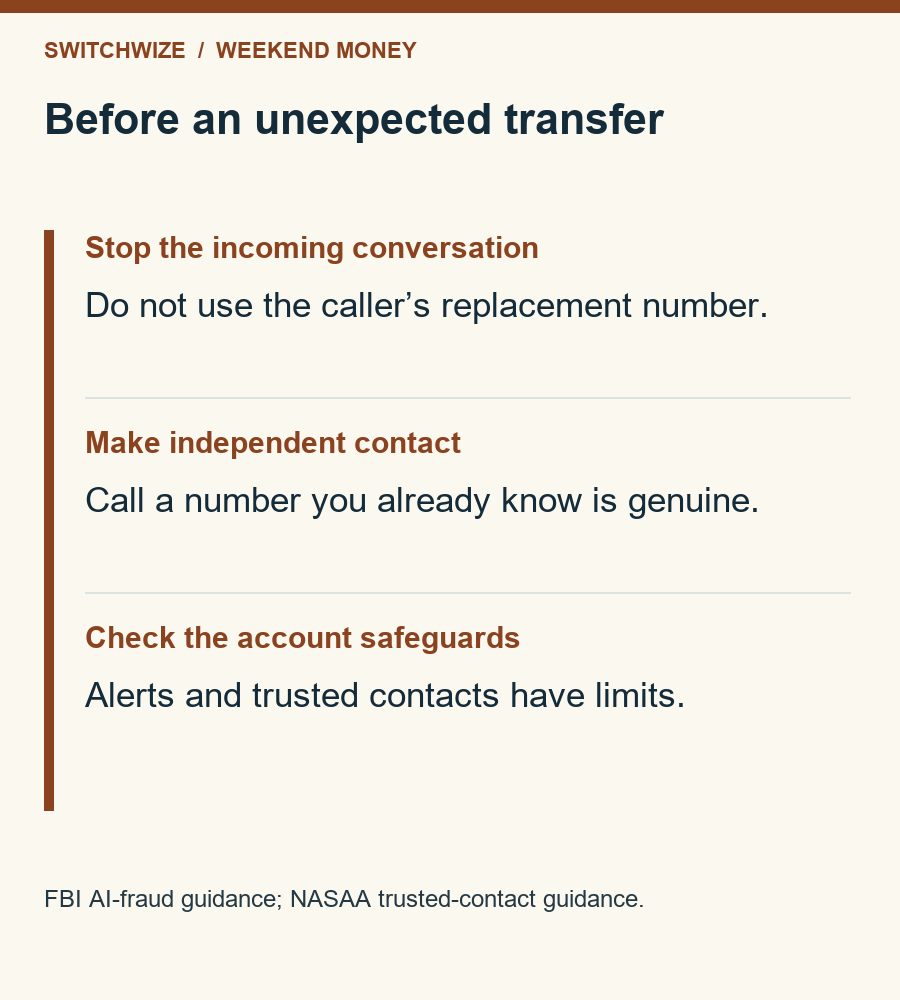
End the incoming conversation. Contact the person or institution through a number independently known to you. Do not use a replacement number supplied by the caller. For a family emergency, reach the relative or another family member through a separate channel.
A family verification phrase can help, but it should not be the only safeguard. A compromised conversation or account can expose it. Independent contact and a pause before a major withdrawal address different parts of the risk.
Build the protection before anyone needs it
Ask each financial institution what alerts, transaction limits and fraud-review procedures it offers. Name an appropriate trusted contact where available. That contact can help a firm reach someone when concerns arise; the designation does not give the person authority to trade or take control of the account.
A power of attorney is different and requires its own legal consideration. Neither arrangement guarantees that a transfer will be stopped. Families should understand what each institution can actually do, rather than assume a name on a form creates a universal second signature.
If a scam has happened, contact the institution’s fraud department immediately, request an appropriate recall or freeze where possible, report through official channels and preserve the records. Recovery is not guaranteed. Be wary of anyone demanding another payment to retrieve the first one.
Before the next large retirement withdrawal, agree on a family rule: an unexpected request to “protect” money gets an independent callback before any transfer. Once retirement funds leave the account, the family may have both a theft and a tax problem to solve.
Sources
IRS scam-loss memorandum, 2024 facts · Current Section 165 · Taxpayer Advocate guidance · FBI AI-fraud warning · Trusted-contact limits
U.S. federal context, researched November 13, 2026. Ellen and the numerical example are hypothetical. No victim interview or individual tax determination was performed. State law, account facts, tax basis, recovery prospects and the year of loss can change the result. A deduction is not promised.