- Most health FSA plans take back money you have not spent by the end of the plan year. The IRS limit for 2026 is $3,400, and a plan may allow a $680 carryover or a grace period of up to 2 1/2 months, but not both.
- An FSA usually still pays even if you lose some. In the 22% federal bracket, $3,400 saves about $1,008 in tax. Losing $200 of it still leaves you about $808 ahead of paying with after-tax pay.
- The 2027 limit has not been announced. The amount you choose at open enrollment matters more than any year-end rush.
If your health FSA plan follows the usual rule, any money left after the plan year ends is gone. For most people that date is December 31, which is 67 days from today. The IRS describes health FSAs as "generally use-it-or-lose-it" plans in its Publication 969.
Maya, 38, opened her FSA balance online this morning. She is a composite, an illustration and not a real person. Last November she chose to set aside $3,400, taken from her pay in 26 equal pieces of about $131. The page says $740 is left. She has not been to the dentist this year, and her glasses are four years old.
What the IRS rule says
A health FSA is an account your employer sets up. You choose an amount during open enrollment, and it comes out of each paycheck before income tax and payroll tax. You then use the account to pay back medical costs: copays, dental work, glasses, and over-the-counter medicine.
Publication 969 sets out three things that matter in the fall:
- Money left at the end of the plan year generally cannot move to the next year.
- A plan may add a grace period of up to 2 1/2 months after the plan year ends. For a calendar-year plan, that runs to mid-March.
- As an alternative, a plan may let you carry over a set amount. For plan years that begin in 2026, the most is $680.
A plan can pick the grace period or the carryover. It cannot offer both, and it can offer neither. Your employer decides, so the answer for Maya is in her plan documents, not in the IRS rule.
How the limit and carryover have changed
The carryover is newer than most people think. Before 2013, the only exception was a grace period. In Notice 2013-71 the IRS let plans offer a carryover of up to $500 instead. At that time, the yearly limit was $2,500 before inflation adjustments.
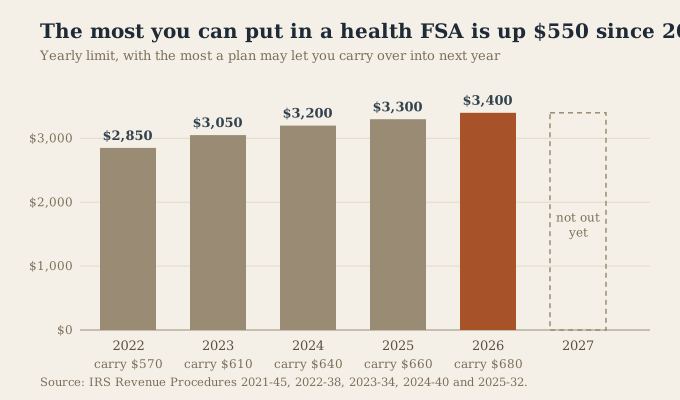
Both numbers have crept up since. The IRS now sets the carryover at 20% of the yearly limit, and that has held in each of the last five years. Across the revenue procedures for 2022 through 2026, the limit went from $2,850 to $3,400, and the carryover from $570 to $680.
That makes the 2026 limit $550, or 19.3%, higher than 2022. The 2027 limit has not been announced as of October 25, 2026. We could not find an official figure, and the estimates we saw disagree, so we are not using one.
Why the money goes away
Publication 969 says you must be able to get the full yearly amount back at any point in the plan year, no matter how much has come out of your pay so far. Maya could have claimed all $3,400 in January, after one paycheck. The employer fronts the money early.
The other side of that deal is the forfeiture rule. If the worker has not used the money by the end of the plan year, it generally does not carry forward. The carryover and the grace period are small, optional exceptions to that rule, not the rule itself.
Does an FSA still pay if you lose some?
Usually, yes. Take Maya with these assumptions: a 22% federal tax bracket and 7.65% in Social Security and Medicare tax, with state tax left out. Together that is 29.65%.
- Her $3,400 election lowers her taxes by $3,400 × 0.2965, which is $1,008.10.
- So the account costs her $3,400 − $1,008.10, or $2,391.90, in take-home pay.
- Say she spends only $3,200 of it. Paying that care with after-tax pay would take $3,200 from her. Using the FSA took $2,391.90. She is ahead by $808.10.
Losing $200 is not free. Each $100 she forfeits is $70.35 of take-home pay she gave up for nothing. But it does not erase the gain on the other $3,200.
The year-end rush has a limit too. It cannot fix a choice made last November. If Maya buys $740 of things she does not need, she ends up with items she does not want. If she had chosen $2,700 last year, there would be nothing to scramble for. The FSA rewards a good estimate more than a busy December.
What counts before December 31
The expense has to be incurred during the plan year. Publication 969 says the account pays back expenses incurred "during the period of coverage" and cannot pay in advance for future care. Buying next year's contact lenses in December is the kind of purchase that does not count. Check how your plan dates a claim.
Covered costs include copays, deductibles, dental and vision care, and over-the-counter medicine, with or without a prescription. Many plans also set a deadline for filing claims after the year ends. Your plan documents give the date.
For a quick list, ask your plan administrator for the eligible expense list. A dentist visit, new glasses, and a refill of the allergy medicine Maya buys every month could use up her $740.
What to do before you choose a 2027 amount
Open enrollment for most employers runs in November. Before choosing, do three things:
- Add up the medical costs you paid in 2026 that you would also pay in 2027: prescriptions, dental work you know you need, vision.
- Ask whether your plan offers a carryover, a grace period, or neither. If it offers neither, choose closer to what you are sure to spend.
- Check the 2027 limit once the IRS announces it. If you also have a health savings account, read how an HSA and an FSA differ, because you generally cannot fund both.
If your plan has a $680 carryover and you finish with $740 left, you still lose $60. The carryover softens a mistake. It does not remove one.
What Maya did
Maya booked the dentist for the second week of November and ordered new glasses the same day. Her plan has a grace period, so a late claim would still count until mid-March, but she did not want to rely on it. Then she opened her enrollment form for 2027 and typed $3,000, an amount she could list item by item: two dental visits, glasses, and her monthly allergy medicine.
Quick answers
What happens to unused FSA money? It is generally lost at the end of the plan year, unless your plan allows a carryover of up to $680 or a grace period of up to 2 1/2 months.
What is the 2026 limit? $3,400.
Is it still worth it? Usually. In the 22% bracket, a $3,400 election saves about $1,008, and losing $200 of it still leaves about $808 of gain.
Methodology
Limits and carryover amounts come from the IRS revenue procedures named in the chart: 2021-45 (2022), 2022-38 (2023), 2023-34 (2024), 2024-40 (2025) and 2025-32 (2026), each read on October 25, 2026. The rules on grace period, carryover, forfeiture, over-the-counter medicine and the full-year availability of the election come from IRS Publication 969. The $500 carryover in 2013 comes from IRS Notice 2013-71. The tax example uses a 22% federal bracket plus 7.65% Social Security and Medicare tax, and ignores state tax. Maya's figures are an illustration. The 2027 health FSA limit had not been announced when this was written.
Sources
Frequently Asked Questions
What happens to unused health FSA money at the end of the year?
What is the health FSA contribution limit for 2026?
Do I have to pay for care by December 31 or receive it by then?
Can I buy over-the-counter medicine with FSA money?
Is a health FSA worth it if I might lose some of the money?
The 5-minute money briefing
One email per week. New rates, fed moves, and what to actually do about them.
No spam. Unsubscribe anytime.
Answer a few questions about your situation and goals. Money Map points you to the highest-value next step across savings, mortgage, cards, and debt.
Editorial review
What changed since the last update
Was this guide helpful?
Found an inaccurate, outdated, or missing claim? Report a correction. We verify reports against the relevant source before changing a guide or ranking.
