
The short answer: Banks report different approval policies by borrower category. See what the Fed survey says and why unused credit is not a guaranteed emergency reserve.
The Fed's new survey shows different treatment for stronger and weaker applicants. A new card offer also tells you little about how secure your existing limit is.
By Jay Rege · November 4, 2026
One household gets another credit-card invitation. Another discovers that the card it already has will cover less of the next emergency.
Those experiences can coexist. The Federal Reserve's survey released November 2 found that banks had become more willing over the past year to approve prime and super-prime card applicants, and less willing to approve subprime applicants. These answers describe bank policies, not a count of accepted and rejected applications.
The distinction matters as households plan holiday spending. An advertisement for credit is not evidence that borrowing has become easier for everyone. And the unused amount on a card is money the bank may let you borrow, not cash you have set aside.
The same survey shows two different lending decisions
The Fed asked banks about changes over the past quarter and, in special questions, the past year. These are different windows.
For the quarter, overall card lending standards and most terms were broadly unchanged. Exceptions included tighter credit limits and less flexibility for borrowers below credit-score thresholds. For the year, the approval-policy answers differed by borrower category.
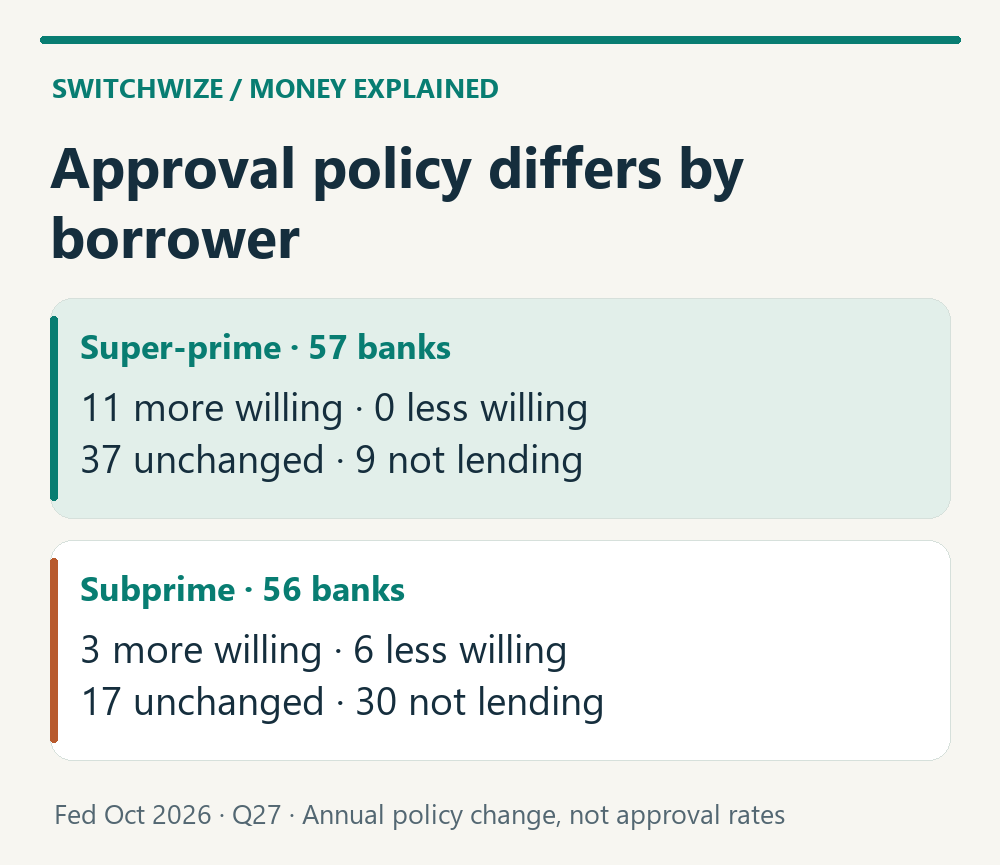
The bank counts show how policy changed, rather than how many people were rejected. For super-prime applicants, 11 of 57 responding banks reported greater willingness to approve, 37 reported no change and nine did not lend to that category. None reported less willingness. The prime category also had 11 reporting greater willingness, 37 unchanged and nine not lending.
For subprime applicants, 56 banks answered: three banks reported greater willingness, six less willingness, 17 no change and 30 did not lend to that category. The survey does not say that those 30 had just stopped serving these borrowers.
Banks used their own risk definitions; the questionnaire supplied score ranges as examples. The figures do not let us tell a reader that a particular score guarantees approval. They also are not weighted here by each bank's number of customers.
Your unused limit can shrink without new spending
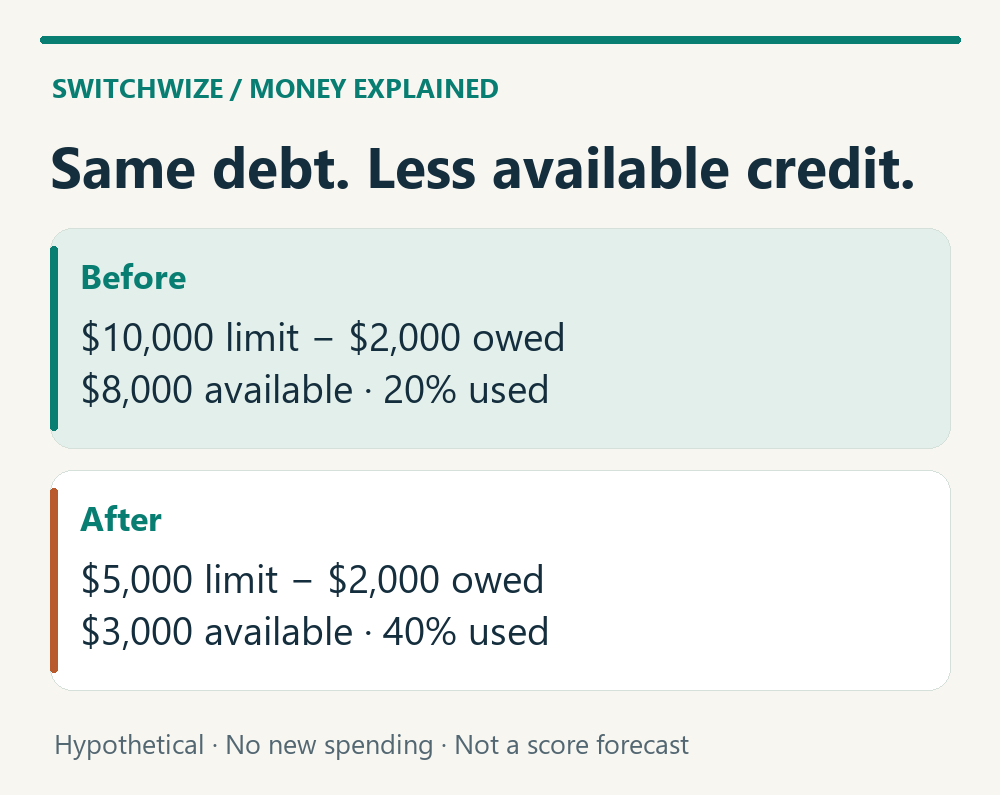
Consider a hypothetical card with a $10,000 limit and a $2,000 balance. It has $8,000 of unused credit. If the bank lowers the limit to $5,000, the unused amount falls to $3,000.
The borrower has not bought anything else. But the balance now uses 40% of that card's limit instead of 20%. That is arithmetic, not a prediction of a specific credit-score change. Other accounts, the scoring model and the information reported also matter.
A $4,000 emergency that previously fit within the line no longer does. The example does not predict a cut, but it shows the weakness of relying on unused credit as the only emergency reserve.
The CFPB says issuers can generally reduce a limit, including to a point where no additional credit remains. The OCC explains that a bank need not give advance notice before reducing the line. Separate notice protections apply, with exceptions. A reduction based on individual creditworthiness generally requires an adverse-action notice; an action connected to current delinquency or default, or affecting all or substantially all of a class of accounts, can fall outside that requirement. Even a required notice does not guarantee time to borrow the old amount.
A bank's offer and your need may be moving apart
The Fed says banks most frequently attributed stronger card-loan demand over the year to customers' spending needs in response to changes in prices. That is bankers' explanation of demand. It is not a survey proving why every household borrowed.
Still, the combination is important. Some households may seek more credit just as banks become less flexible about the borrowers they consider riskier. A generous offer aimed at a stronger applicant does not resolve that problem.
There is a reasonable explanation for caution: lenders need to assess whether a borrower can repay. Easier lending is not automatically a benefit if it leaves someone with payments they cannot afford. Conversely, a broad category cannot tell a bank everything about an individual household.
The useful test for consumers is the offer they actually receive: the available amount, interest rate, fees and repayment burden. A large rewards headline does not answer those questions. The CFPB notes that issuers consider credit history and income in setting limits, along with other relevant factors.
Read the notice before making the next application
If your limit falls, start with the bank's explanation. Check whether the income information it holds is accurate, review your credit reports for mistakes, and ask whether the decision can be reconsidered. Updating information or requesting review does not guarantee restoration; ask whether a requested increase would require a credit inquiry.
If an application is denied, the notice can identify specific reasons or explain how to request them. When a consumer report influenced the decision, it also provides information about obtaining and disputing that report. Do not assume a second application will solve the first lender's concern.
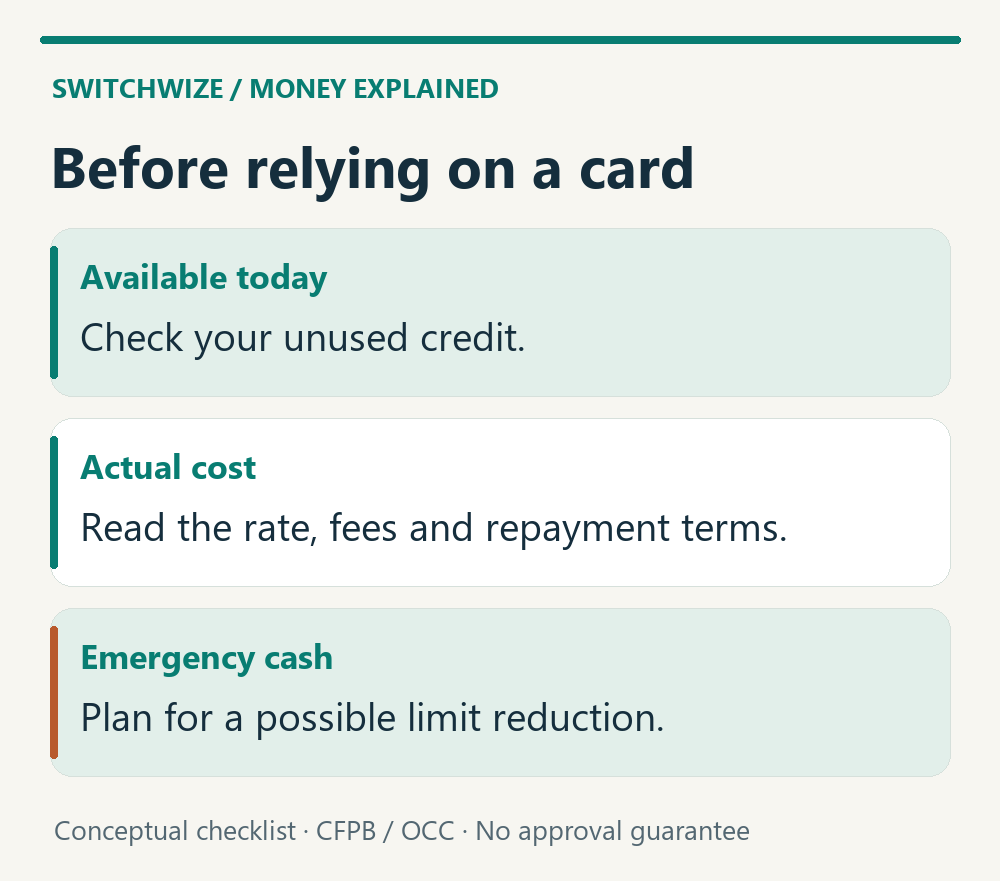
For an emergency plan, list the bills that must be paid and the cash you can access. Then list credit separately. If a limit were cut, what could still cover the first month of essentials? The answer may expose a shortfall worth addressing before an unexpected bill arrives.
The next useful number is not how many offers came in the mail. It is how much of your emergency plan would remain available if a bank changed its mind.
Sources
Federal Reserve: October 2026 survey; Fed: response counts, question 27; CFPB: lower credit limits; OCC: advance notice exceptions; Regulation B: adverse action and exceptions; CFPB: how limits are set; CFPB: denied application rights.
Checked November 4, 2026. U.S. credit cards. Survey counts are our transcription of the Fed's table, with each denominator retained. Annual approval-policy questions and quarterly lending questions are distinct; neither predicts an individual's approval. Limit examples are hypothetical and exclude payments, fees and interest changes. This is sourced analysis, not household interviews.