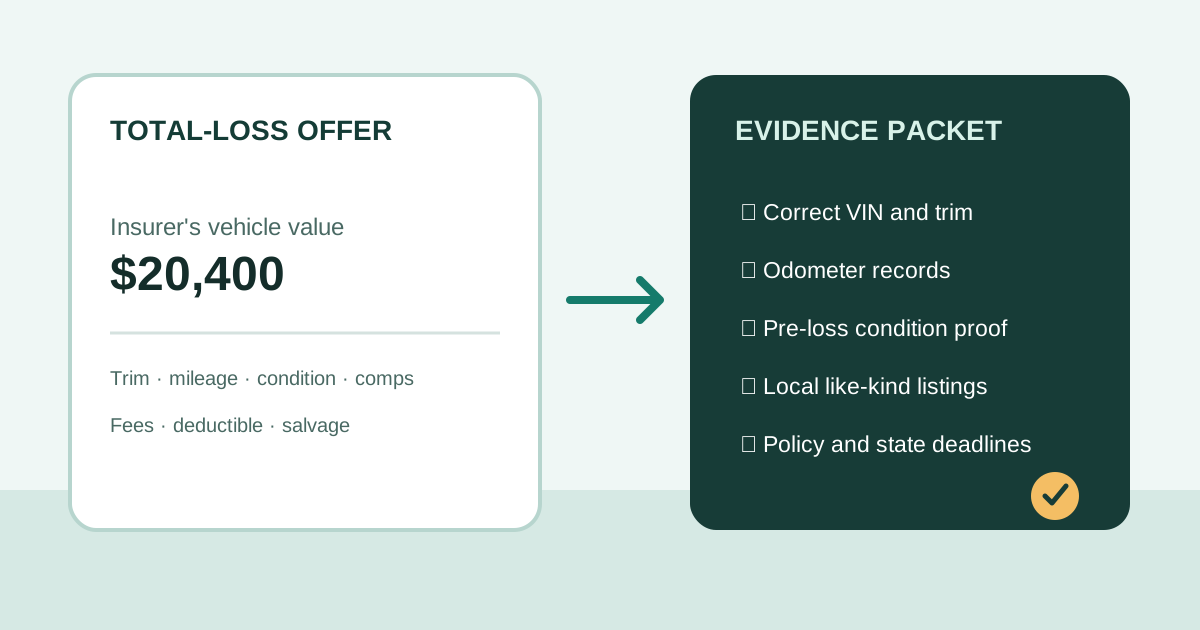
- The loan payoff, replacement-car budget, original purchase price, and a pricing-site estimate do not by themselves establish actual cash value (ACV).
- The strongest challenge is a documented correction to the insurer's report: wrong trim/options, mileage, condition, geography, date, or poorly matched comparables.
- Your policy and state determine the valuation method, taxes and fees, appraisal rights, and deadlines. Calendar each date from the policy and written notices.
- A claim dispute and a loan shortfall are separate. Check GAP or a debt waiver while keeping the lender informed about payments.
The trap: a settlement number looks final before you see how it was built
The adjuster says the car is a total loss and offers $18,900. You search online, find the same model listed for $23,000, and conclude the insurer is shorting you $4,100. Or the opposite: a glossy valuation report lists six vehicles and a precise-looking $18,900, so you assume there is nothing to question.
Both reactions skip the important evidence. A total-loss offer is usually an estimate of what the covered vehicle was worth immediately before the loss, subject to your policy and state law. It is not automatically the cost of a new replacement, your purchase price, the balance on your loan, or the asking price of a single online listing. But the insurer's report can still be wrong: the trim may be misidentified, a factory package omitted, mileage overstated, condition deductions unsupported, or the comparison cars outside the market where your car was normally garaged.
The task is to find and explain those errors. A strong written dispute is narrower than “I disagree.” It identifies the disputed input, shows reliable evidence of the correct input, explains how it changes the pre-loss market comparison, and asks the adjuster to recalculate or explain the method.
Do not let a general checklist substitute for your policy. First-party collision/comprehensive claims, claims against another driver's insurer, state valuation rules, and contract appraisal clauses can follow different procedures.
What the number is, and what it is not
Actual cash value (ACV) is commonly tied to the vehicle's value immediately before the crash or theft, but the legal definition and calculation method depend on the policy and state. The National Association of Insurance Commissioners (NAIC) says an insurer looks at what used cars like yours are going for in the area and reminds consumers that a pricing guide is not necessarily controlling. The California Department of Insurance describes ACV as fair market value unless the policy defines it differently and says a total-loss settlement must reflect a comparable vehicle of like kind and quality under California's rules.
Read the declarations page and the physical-damage coverage language. An agreed-value, stated-amount, replacement-cost, new-car replacement, or specialized-vehicle endorsement can change the contractual measure. Ordinary collision coverage is not automatically a replacement-cost promise. If another driver's insurer is paying, you may not be a party to that insurer's policy; your rights can instead depend on state liability law and the facts of fault. If you use your own collision coverage while liability is unresolved, your deductible and subrogation process may apply under your contract.
Keep three numbers separate:
- Vehicle value: the ACV or other measure under the applicable policy/rule.
- Net claim payment: vehicle value plus any covered taxes or fees, less a deductible and any permitted salvage deduction.
- Loan or lease payoff: what the lender says is due. A payoff higher than the claim amount creates a possible shortfall, not automatic proof that ACV is wrong. GAP insurance or a lender/dealer debt waiver may address some or all of that difference under its own terms.
What to check in the valuation report
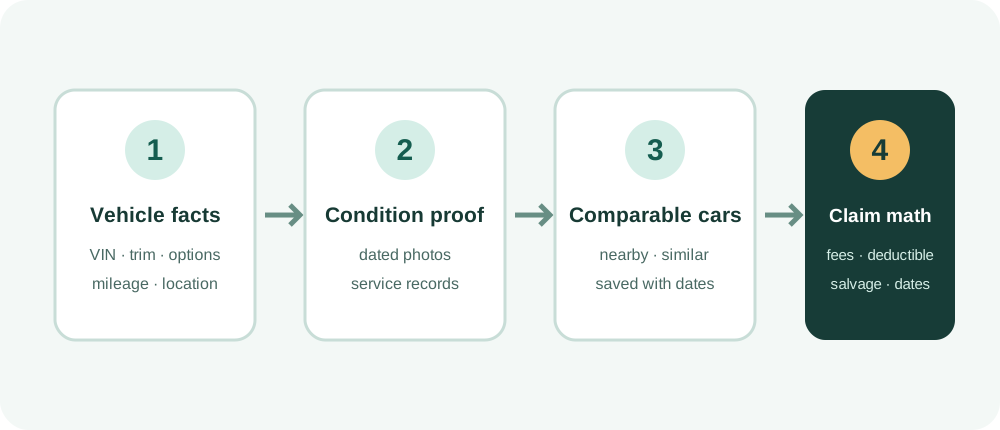
- Vehicle: VIN, miles, trim and equipment.
- Condition: Pre-loss photos, service records and any stated deductions.
- Comparables: Similar local cars available around the loss date.
- Settlement: Itemized taxes, fees, deductions and deadlines.
Audit the valuation report before arguing the total
Ask for the complete valuation report and any claim-file material the insurer can provide. If the header says CCC ONE Market Valuation Report, request the full report with its comparables and adjustment pages, along with the insurer’s settlement breakdown. Do this in writing and keep the date, delivery proof, and every attachment. The report should let you see what vehicle information the insurer used, which comparables it selected, how it adjusted them, what condition deductions it applied, and how the offer was converted into a net payment.
Verify the vehicle identity and equipment
Check the VIN, model year, make, model, body style, trim, drivetrain, engine, factory option packages, and installed equipment against your purchase documents, window sticker, VIN decode, dealer service record, or manufacturer build sheet. A base trim is not a fair proxy for a premium package. An all-wheel-drive version is not the same as a front-wheel-drive one. Correct a factual mismatch with a document, not just a screenshot of a different car.
Separate factory-installed equipment from later additions. A roof rack, adaptive-suspension package, or factory towing package may affect how closely a comparison matches. Custom audio or wheels may not return their full purchase cost in market value. Provide receipts and photos, but do not assume every dollar spent on an upgrade adds a dollar to ACV.
Check mileage and pre-loss condition
Compare the report's odometer reading with service records, inspection documents, oil-change invoices, registration records, and dated photos. For condition, use evidence that existed before the loss: maintenance records, tire receipts, inspection reports, and photos. If the report describes ordinary wear as significant damage, ask what inspection supports that deduction. A recent repair does not always increase market value by its full cost; it can, however, help disprove an inaccurate assumption that a major component was failing or damaged before the crash.
Don't conceal prior unrepaired damage. Document it accurately and distinguish it from damage caused by the covered event. The dispute is about value immediately before the loss, so a genuine pre-existing condition issue can matter in either direction.
Test each comparable, not just the headline average
For every comparable vehicle, record the URL or source, VIN if available, dealer or seller, distance from the vehicle's garaging location, listing date, asking price, model year, trim, drivetrain, options, mileage, and known condition/history. Save a dated PDF or screenshot before a listing disappears. Prefer several close matches over one unusually expensive outlier.
Ask whether each vehicle could reasonably substitute for yours: same generation and trim, similar equipment, mileage, condition, and local market. A car several states away, sold months before the loss, branded as salvage, or configured with a different drivetrain may provide weak evidence. A dealer asking price is not the same as a completed sale, and may include negotiation room, dealer add-ons, or fees. Explain those limits instead of presenting the highest listing as the answer.
If the insurer uses a third-party valuation database, request the underlying comparable list and adjustment schedule. A report can look rigorous while relying on a wrong trim or a broad, unexplained condition deduction. Ask the adjuster to identify the source for each adjustment and to correct specific errors. State regulations sometimes prescribe valuation sources or methods; they do not necessarily require one commercial guide everywhere.
If the report lists a projected sold price or negotiation deduction, ask for the basis and the amount applied to each car. Separate those market adjustments from trim, mileage, and condition adjustments. Ask whether the same difference was counted twice. In the worksheet, subtract a documented adjustment from the comparable’s price when that comparable is better than your car. Add an adjustment when the comparable is worse. If you lack support for a dollar adjustment, enter zero or choose a better match.
The net check can be low even when ACV is close
Review the settlement math line by line. Depending on state law and policy, a first-party payment may add sales tax, title, licensing, or transfer fees to the vehicle value. A deductible may be subtracted under your own collision or comprehensive coverage. If you keep the salvage vehicle, an insurer may subtract salvage value and the state may impose title or inspection steps. The rules differ; do not assume taxes are always included or excluded.
Compare the insurer's gross vehicle valuation to your evidence before comparing the final check to your loan statement. Otherwise, you can mistake a deductible or payoff gap for an ACV error. Conversely, if the vehicle value is reasonable but a state-required fee is missing, challenge that line item separately.
Rental coverage has its own contract limits. The NAIC notes that many insurers end rental coverage after a settlement offer, but the policy and state rules determine what applies. Ask the adjuster, in writing, what event ends payment and whether the offer is conditional or final. Do not assume that disputing value automatically extends a rental, storage, or towing benefit.
Step-by-step: build a dispute that an adjuster can act on
- Confirm the claim lane. Write down whether you are using your own collision/comprehensive coverage or making a third-party property-damage claim. Ask who has accepted liability, what coverage is being applied, and whether the offer is final, conditional, or subject to a release.
- Get the documents. Request the full valuation report, comparable list, adjustment details, condition assessment, title/salvage calculation, fee breakdown, and the policy's appraisal language if this is your own policy.
- Calendar every deadline. Note the loss date, report date, offer date, payment date, policy notice period, state right-of-recourse period, and any release deadline. Do not assume a phone call pauses a written deadline.
- Correct facts first. Send proof for VIN/trim/options, mileage, pre-loss condition, and garaging location. State exactly which report field is wrong and attach the corroborating record.
- Build a comparable-vehicle packet. Use multiple well-matched vehicles available near your market around the loss date. Include complete details and a short reason each is comparable. Identify mismatches in the insurer's list rather than merely attaching a pile of search results.
- Ask for recalculation in writing. State the specific ACV or line-item correction you seek and why. Ask the insurer to respond to each disputed comparable and adjustment, and to explain any remaining difference.
- Escalate in the right order. Request a supervisor review. If the disagreement is strictly about amount and your own policy contains an appraisal clause, read its mechanics and consider whether the cost and process make sense. Ask your state insurance department about valuation rules, complaint routes, and deadlines. A complaint is not a substitute for preserving contractual or court deadlines.
- Keep loan, salvage, and claim paperwork separate. Contact the lender about payment status and payoff. Start a GAP or waiver claim if relevant. Before signing a release, assigning title, or retaining salvage, understand the exact effect on the dispute and any state inspection/title requirements.
Ask in writing whether you can receive any undisputed payment while you continue to challenge the valuation. Before signing a release or endorsing a check marked as full and final, verify what rights the wording would waive under your policy and state law.
A short written request
Please review the valuation for claim [number] and send me the corrected itemized report. On page [number], the report lists [incorrect fact]. The attached [record] shows [correct fact]. I also attached [number] local comparables with listing dates and equipment. Please explain any difference in mileage, condition, options or market adjustments, and show how you calculated the taxes, fees and deductions. Please confirm my deadline to use any appraisal or state recourse procedure.
Case study: correcting a $2,300 undervaluation
Assume Jordan's 2022 compact SUV is totaled in Ohio on September 18, 2026. Jordan's own collision insurer gives a pre-deductible vehicle value of $20,400, based on a report that lists the vehicle as the base trim with 41,000 miles. Jordan's service records and VIN build sheet show the premium trim, factory driver-assistance package, and 34,800 miles. The report also deducts $650 for “below average” condition without describing a specific pre-loss defect.
Jordan saves three dealer listings within 60 miles posted within two weeks of the loss. All are the same generation and premium trim, with comparable equipment and clean histories. Their asking prices are $23,900, $24,300, and $24,600. They have 31,000–37,000 miles. Jordan does not claim these asking prices equal ACV. Instead, Jordan sends the listings and asks the insurer to correct trim and mileage, explain the condition adjustment, and show how those comparables and any market adjustments were treated.
To show how the worksheet works, its preloaded adjustments are −$1,400, −$1,600 and −$1,700 on those three asking prices. They produce $22,500, $22,700 and $22,900, with a middle value of $22,700. These are illustrative inputs, separate from the insurer’s trim and condition corrections below. Use your own supported adjustments.
The initial offer would produce a $19,900 check after the $500 deductible and before any sales-tax payment. After review, suppose the insurer agrees its wrong trim and mileage inputs understated value by $1,650 and removes $650 of unsupported condition deductions. The revised ACV becomes $22,700, a $2,300 increase. With a $500 deductible, the cash settlement before any tax payment is $22,200.
Ohio lets insurers pay applicable sales tax with the cash settlement. For later reimbursement, Ohio Administrative Code 3901-1-54(H)(7)(f) generally requires buying a replacement within 30 days after receiving the cash settlement and documenting the purchase and tax paid within 33 days after receipt. The cap is the tax on a vehicle valued at the cash settlement amount. Assume $1,100 qualifies. Different rules apply if the insurer offers a replacement vehicle under (H)(6)(c), which includes applicable taxes, license fees and title-transfer fees.
Jordan owes $24,050. The $22,200 check leaves a $1,850 gap if it all goes to the lender. A later $1,100 reimbursement reduces that gap to $750 only if the lender receives and credits it. Jordan checks the GAP contract and asks the lender how each payment will be applied. For a comparable-car dispute, Ohio’s separate notice addresses any right to renegotiate if a comparable isn’t available within 35 days of receiving the settlement.
- Initial offer
- $19,900 before tax
- $4,150 loan gap
- Corrected, before tax
- $22,200
- $1,850 loan gap
- Corrected, with tax
- $23,300 total
- $750 gap if all proceeds reach the lender
This example illustrates a method, not a promised result. The comparable adjustment, recoverable fees, deductible, appraisal right, and GAP terms are not universal. A different state, policy, liability posture, or vehicle market can produce a different answer.
State rules can change the route
There is no single U.S. deadline or valuation formula that safely applies to every claim.
California. The rule in 10 CCR § 2695.8(c) includes a specific procedure in which a first-party insured who cannot buy a comparable vehicle for the gross settlement amount can notify the insurer “within thirty-five (35) calendar days after the insured receives the claim payment or final settlement offer”, prompting the insurer to reopen the file under the regulation. The insurer can be exempt from taking action under this subsection if the final-offer documents identified a comparable actually available at that price when the offer was made. Check for the seller’s phone number with area code or street address, plus the vehicle’s VIN, a licensed dealer’s stock or order number, or its license plate. California’s cash-settlement rule separately addresses applicable taxes and transfer fees, including a sales-tax adjustment if you retain salvage.
New York. 11 NYCRR § 216.7(c)(4) sets a separate right-of-recourse procedure for the specified valuation methods, including a 35-day period from mailing the settlement check to write that a comparable vehicle cannot be found.
Washington. WAC 284-30-391 spells out permissible valuation approaches and comparable-vehicle standards. Use the rule for your claim type and confirm which version applies to your loss.
The policy's appraisal clause is another separate route. Some clauses let either party demand appraisal over the amount of loss, with each selecting an appraiser and an umpire resolving remaining differences. Others have different wording, cost allocation, deadlines, or scope. A valuation dispute may not be the same as a dispute over coverage, fault, exclusions, or the policy's interpretation. Read the full clause; if the amount is large or a release/limitations deadline is near, consider a licensed public adjuster or attorney who handles auto total-loss claims in your state.
If you contact the state insurance department, include the claim number, insurer, loss date, offer and response dates, disputed report pages, your evidence packet, and the exact relief requested. Ask whether the agency handles first-party and third-party claims alike and what complaint does, or does not, do to other deadlines. Keep copies of every submission.
The short version
Challenge the evidence behind the offer, not only the dollar figure. Correct the vehicle identity, mileage, condition and local comparable set; check the calculation of taxes, fees, deductible and salvage; and use the precise policy or state process with its own deadline. Treat the loan payoff and GAP claim as separate workstreams. The calculator models separately confirmed taxes and fees for each scenario. Its default offer excludes tax, and its comparable scenario assumes the revised Ohio example's separate tax payment qualifies. The calculator organizes the comparison, but it cannot determine the legally correct ACV or replace your policy, claim file, and state rules.
Total-loss offer and comparable check
Compare your report's ACV with a median of your own adjusted local listings, then separate estimated payment from any loan gap.
Your local comparables
Enter each listing price and your documented adjustment for differences. The calculator does not prescribe adjustment amounts or decide whether a listing is comparable.
Adjusted comp median
$22,700
Range: $22,500–$22,900
Difference vs. report ACV
+$2,300
Evidence comparison only
Estimated net at offer
$19,900
Offer ACV plus entered offer fees, minus deductible and salvage
Estimated net at comp median
$23,300
Median ACV plus scenario fees, minus the same deductible and salvage
Tax and fee difference vs. offer: +$1,100
Estimated loan gap at comp median
$750
At offer: $4,150. Assumes modeled proceeds reach the lender, before any GAP or waiver.
This is a sensitivity worksheet, not an ACV appraisal, insurer obligation, legal deadline check, or GAP determination. Listing prices and adjustments may not reflect completed sales or a legally accepted valuation method. Verify each input against your report, policy, state rules, and claim facts.
Common questions
Can I make the insurer pay the amount I still owe on my totaled car?
Usually the vehicle claim is measured under the policy or applicable state rules, not by your loan payoff. If the loan balance exceeds the settlement, check any GAP insurance or debt-waiver contract separately; the remaining balance may still be due.
Does Kelley Blue Book set the value of my totaled car?
No single pricing guide automatically controls every total-loss claim. The insurer's method depends on the policy and state rules. Compare the valuation report's specific vehicles and adjustments with well-matched vehicles available in your local market as of the loss date.
Can I invoke the appraisal clause if I disagree with ACV?
Possibly. Read the exact appraisal provision in your policy: it controls who may invoke it, notice and timing, appraiser and umpire selection, cost allocation, and the scope of the process. Do not assume the clause applies to a third-party claim or every dispute.
How long do I have to dispute a total-loss offer?
There is no single nationwide deadline. Your policy, state law, and claim type can set different periods. For example, California and New York describe specific 35-day procedures in some first-party total-loss situations; those are not general deadlines for every state or every type of dispute.
Connect the lesson
Turn the article into a next step.
SwitchWize takeaway
Find your number, not the market's.
Run a Money Map to see how your cash, debt, and rates stack up against the best available options.
Start Money Map →