Direct answer: Yes. A gain taxed at the federal 0% long-term capital-gains rate generally still increases adjusted gross income and Marketplace modified adjusted gross income. That can reduce or eliminate the Premium Tax Credit (PTC). The “true cost” depends on your filing household, taxable income, tax year, plan premiums, eligibility, and any state tax. Calculate the capital-gains tax and the PTC separately, then compare the combined change.
The trap: “zero tax” does not mean “zero income”
An early retiree sees room in the 0% long-term capital-gains bracket and decides to sell appreciated shares. The federal tax estimator shows no capital-gains tax. It is tempting to call the sale free.
But a Marketplace subsidy follows a different income measure. A realized gain generally flows through Schedule D to Form 1040 and into adjusted gross income (AGI), whether the gain is taxed at 0%, 15%, or 20%. The Internal Revenue Code includes gains from dealings in property in gross income, subject to exceptions and special rules. 26 U.S.C. § 61(a)(3); see also the Instructions for Schedule D. For the Premium Tax Credit, modified AGI starts with AGI and adds certain untaxed amounts, including tax-exempt interest and the nontaxable portion of Social Security benefits. A 0%-rate gain is not one of the ACA MAGI add-backs because it is already in AGI. 26 U.S.C. § 36B(d)(2)(B).
That means two separate calculations are happening at once:
- Federal capital-gains tax: Where does taxable income land after long-term gains and qualified dividends stack on top of ordinary taxable income?
- ACA premium credit: Where does household MAGI land as a percentage of the applicable poverty guideline, and what is the required household contribution toward a benchmark plan?
The tax rate on a gain answers the first question. It does not answer the second.
Key warning: A gain can have a 0% federal long-term capital-gains rate and still reduce your Premium Tax Credit as household income rises—or push household income over an eligibility limit and eliminate the remaining credit.
This is why “harvest all the gains in the 0% bracket” can be poor advice for someone buying Marketplace coverage. The decision has to include the value of the credit that changes when the gain is realized.
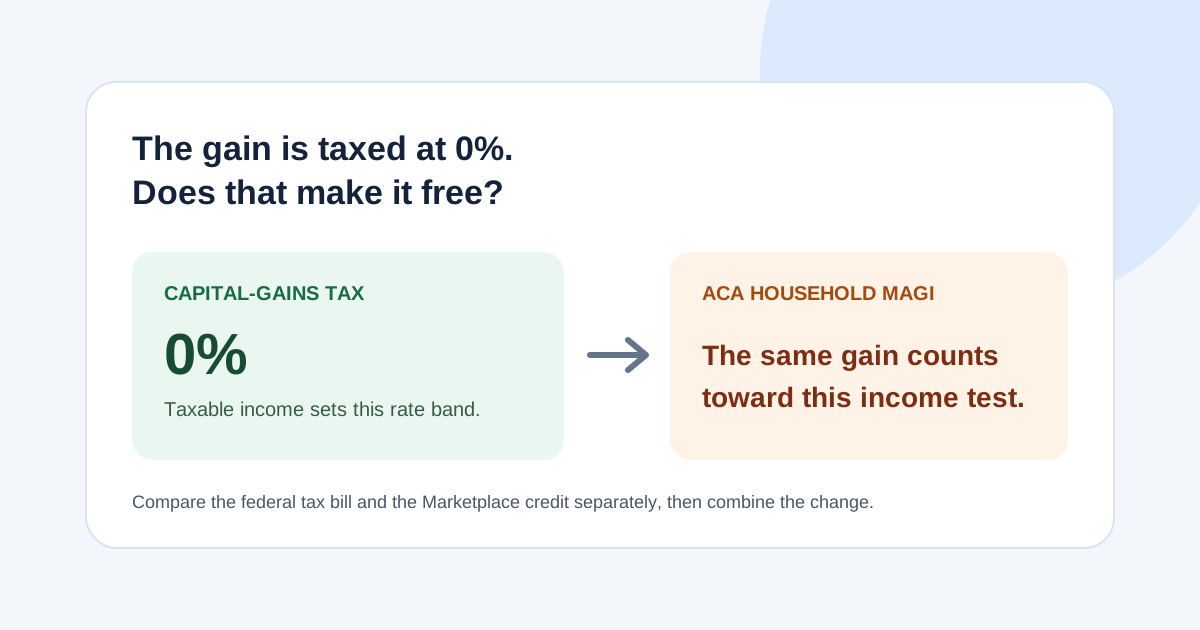
The 0% rate and the Marketplace credit use different income calculations.
The rules: taxable income and ACA MAGI are different numbers
How the 0% capital-gains band works
Long-term capital gains and qualified dividends use preferential tax rates. For most taxpayers, the 0% band is determined by taxable income, after deductions, and long-term gains stack above ordinary taxable income. The threshold depends on filing status and tax year. This structure comes from 26 U.S.C. § 1(h), including the adjusted-net-capital-gain rules and inflation-adjusted maximum amounts. Short-term gains are generally taxed as ordinary income instead.
For tax year 2026, the IRS inflation-adjusted maximum taxable-income amounts for the 0% capital-gains rate are $49,450 for single and married-filing-separately filers, $66,200 for head-of-household filers, and $98,900 for married couples filing jointly. These are thresholds, not a separate allowance on top of all other taxable income. If ordinary taxable income and qualified dividends already use part of the band, less room remains for additional long-term gains. IRS Revenue Procedure 2025-45 publishes the 2026 amounts.
The 0% rate is also not universal. It generally applies to eligible net capital gain, subject to the statutory rules. Collectibles gain, unrecaptured section 1250 gain, short-term gains, and special situations can be taxed differently. Net losses can offset gains, and the ordering rules matter. The IRS explains the basic rate structure in Topic No. 409 and the Schedule D instructions.
How Marketplace MAGI works
For the PTC, household income is not simply taxable income. Start with AGI, then add specified excluded income. The statute defines ACA modified AGI as AGI plus foreign income excluded under section 911, tax-exempt interest, and nontaxable Social Security benefits. Household income also includes certain required-to-file dependents' modified AGI. 26 U.S.C. § 36B(d)(2). The IRS explains the calculation and worksheets in Publication 974 and the Instructions for Form 8962.
The calculation is tied to your tax family and your coverage family. The tax family is based on your tax return. The coverage family includes the members enrolled in qualifying Marketplace coverage for the relevant months. The benchmark is generally the second-lowest-cost Silver plan (SLCSP) that applies to the coverage family, not necessarily the plan you selected. Your actual premium matters too because a credit cannot exceed the eligible enrollment premiums.
For 2026 coverage, the statute uses the most recently published poverty guideline on the first day of the regular enrollment period for the coverage year. 26 U.S.C. § 36B(d)(3)(B). For 2026 coverage, that is the 2025 guideline for your family size and state grouping. For a one-person household in the contiguous states and Washington, D.C., that is $15,650; 400% is $62,600. Alaska and Hawaii use higher guidelines. HealthCare.gov’s poverty-level table shows the prior and current figures.
Under the statute and current IRS guidance, temporary expanded eligibility above 400% of the poverty guideline applied for tax years 2021 through 2025. For 2026, the general statutory upper limit has returned: household income above 400% of the guideline generally means no PTC. 26 U.S.C. § 36B(c)(1)(A), (E). IRS information also says excess advance credits generally must be repaid in full for tax years after 2025. Check the current IRS PTC overview before relying on a year-specific result.
The required contribution percentage
For 2026, the applicable percentage used to calculate expected household contributions rises across income bands and reaches 9.96% from 300% through 400% of the poverty guideline. The exact table is in Revenue Procedure 2025-25. A simplified annual illustration is:
Estimated PTC = the smaller of (eligible plan premium) or (applicable SLCSP premium − required household contribution).
The required contribution is based on household income and the applicable percentage. Form 8962's current instructions convert household income to a whole-number percentage of the poverty guideline by dropping digits after the decimal before choosing the applicable percentage. The calculator follows that step, but annualizes the rest of the formula. Actual Form 8962 calculations use monthly amounts, applicable premiums, coverage months, rounding, and eligibility details; this annualized formula is a planning estimate, not a substitute for the form.
The Marketplace may apply advance premium tax credits (APTC) during the year using your income estimate. At tax time, Form 8962 reconciles advance credits with the PTC allowed from actual household income and coverage facts. If gains push final income higher than the estimate, the advance credit can exceed the final credit. For tax years after 2025, current IRS guidance says there is no repayment cap. Update your Marketplace application when your income estimate changes and keep enough cash to handle reconciliation.
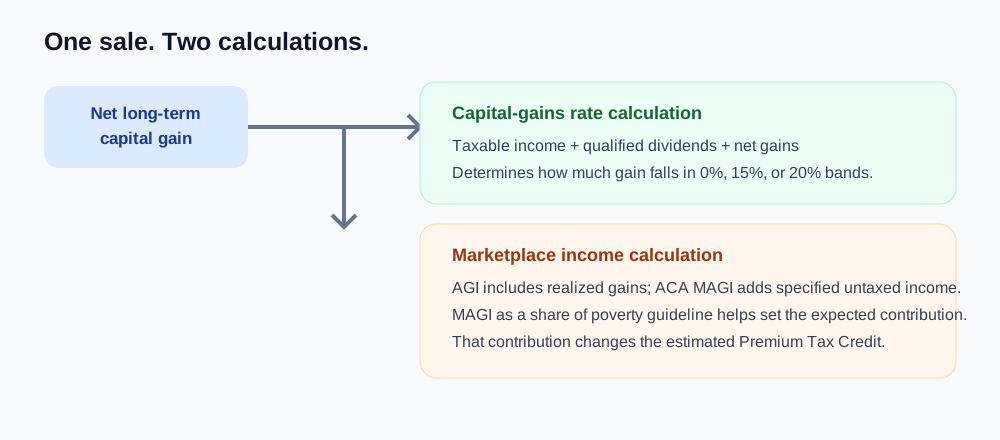
A gain’s federal tax rate does not determine whether it changes the premium credit.
Worked example: a gain at 0% can cost more than the federal tax saved
Consider a hypothetical single person in a contiguous state with Marketplace coverage for all of 2026. Assume:
- Taxable income before the new gain, including other qualified dividends and net gains: $37,000.
- Additional eligible long-term gain: $12,000.
- Household ACA MAGI before the sale: $51,000.
- Applicable 2025 poverty guideline for one person: $15,650.
- Annual SLCSP benchmark premium for the coverage family: $15,600.
- Annual premium for the person’s chosen eligible plan: at least $15,600.
- No other income changes, no state income tax, no Net Investment Income Tax, no employer or government coverage that disqualifies the person, and no special capital-gain category.
Step 1: estimate capital-gains tax
The 2026 single-filer 0% capital-gains ceiling is $49,450 of taxable income. Starting at $37,000 leaves $12,450 of room. The full $12,000 gain brings taxable income to $49,000, below that threshold. Under these simplified assumptions, the incremental federal long-term capital-gains tax is $0.
Step 2: estimate the Marketplace credit before the sale
Before selling, $51,000 ÷ $15,650 is 325.88% (about 325.9%). Form 8962 drops the fractional digits for its applicable-percentage lookup, so the lookup percentage is 325%. The 2026 applicable percentage is 9.96% throughout the 300%–400% band. The estimated annual required contribution is:
$51,000 × 9.96% = $5,079.60
Against a hypothetical $15,600 SLCSP benchmark, the estimated annual credit is $10,520.40, assuming the person is otherwise eligible and their chosen plan premium is at least that high.
Step 3: add the gain to ACA MAGI
After the $12,000 sale, estimated MAGI rises to $63,000. That is $63,000 ÷ $15,650 = 402.56% (about 402.6%) of the guideline. The current Form 8962 worksheet first checks whether household income exceeds 400% of the guideline; if it does, the form instructions say to enter 401 on line 5. The 2026 form instructions were not yet available when this estimate was prepared, so confirm the form when issued. Under the current 2026 eligibility rule, $63,000 is above the $62,600 threshold, so the person would generally have no PTC.
The sale triggered no federal capital-gains tax in this example, but it reduced the estimated annual credit by $10,520.40. Relative to the $12,000 gain, that credit reduction is about 87.7%. This percentage is not a tax rate and is not a universal result; it is the estimated premium assistance lost in this particular hypothetical.
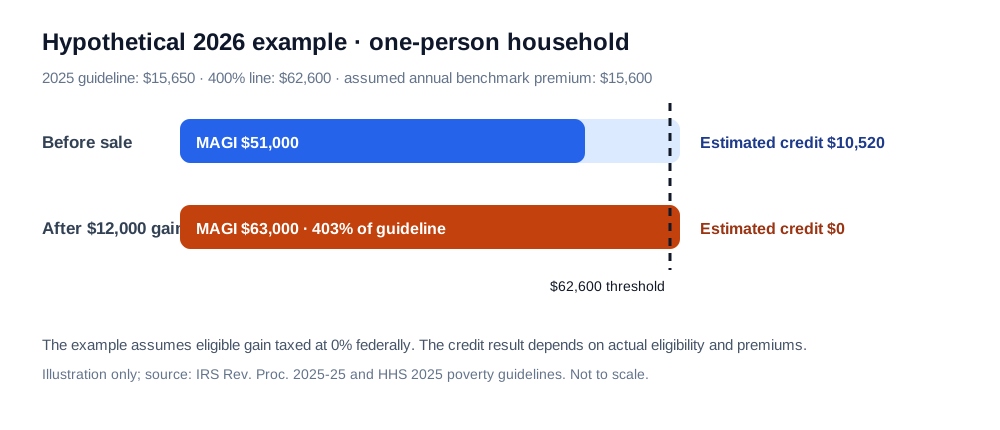
Illustrative annual estimate based on the assumptions above. The bars are not to scale.
If the person had instead realized $11,500, MAGI would be $62,500, just below the limit. That does not mean the decision is automatically safe: a year-end distribution, bank interest, short-term gain, Roth conversion, or higher actual income could cross the line. A buffer is prudent when the credit changes sharply at an eligibility threshold.
Step-by-step: plan a gain without confusing the two limits
- Choose the tax year and coverage year. For calendar-year coverage, they usually share the same household income year, but the relevant poverty guideline is commonly from the prior year. Confirm the year-specific table before projecting.
- Build a complete income estimate. Start with expected wages, pension and retirement distributions, interest, dividends, short-term gains, long-term gains, business income, and other AGI items. Add tax-exempt interest, nontaxable Social Security, and foreign income excluded under section 911 when calculating ACA MAGI.
- Estimate taxable income separately. Apply deductions and account for qualified dividends and all net capital gains. Determine the remaining 0% band from the correct filing status and year. Do not use ACA MAGI as a substitute for taxable income.
- Estimate the credit using Marketplace facts. Identify the relevant tax household, coverage family, months enrolled, SLCSP premium, and the premium for the plan actually selected. Review other coverage eligibility and filing-status rules.
- Model at least three sale amounts. Compare no sale, a planned sale, and a conservative sale. Include the credit reduction and any tax on the portion above the 0% capital-gains band.
- Leave room for uncertainty. Interest and dividends accrue; mutual funds can distribute gains; business income can change; and the Marketplace’s estimate can differ from final tax-return MAGI. A plan that works only if every estimate is exact is fragile.
- Update the Marketplace estimate and set aside cash. If the sale changes projected income materially, update your application. Keep records showing basis, proceeds, fees, holding period, losses, and the date of sale. Preserve the Form 1095-A and use Form 8962 when filing.
- Recheck with a tax professional for complicated cases. This is especially important for married filing separately (which generally blocks the PTC unless a limited exception applies), dependents with income, foreign-income exclusions, QSEHRA or employer coverage, shared policies, unusual capital gains, and states with their own insurance or tax rules.
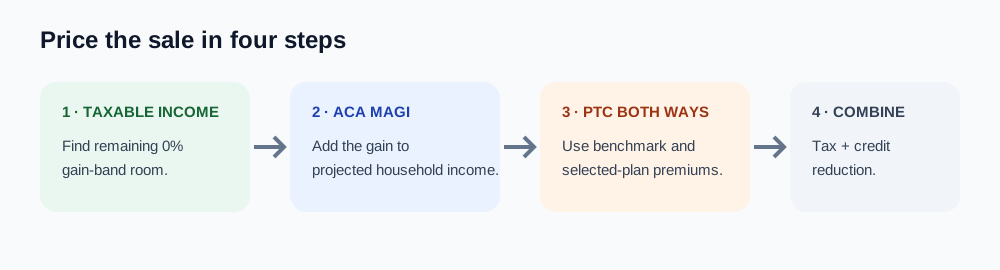
Use the same tax year for the sale and the Marketplace income estimate.
What this estimate leaves out
The example and calculator isolate one interaction. They do not calculate the entire federal return, state income tax, NIIT, the tax treatment of every type of capital gain, Medicaid eligibility, employer-coverage affordability, special household allocations, repayment rules for shared policies, or all exceptions for income below the poverty guideline. They also assume the benchmark and chosen plan premiums and coverage months are entered accurately.
The PTC is based on the final tax-return household and monthly coverage information. A household’s advance credit may be different from the annual credit estimate. The statute calculates the credit month by month using the applicable SLCSP and enrollment premiums. 26 U.S.C. § 36B(b)(1)–(3). The correct result may require Form 1095-A and Form 8962, not simply an income percentage. IRS Publication 974 explains additional cases and worksheets.
The policy can change. The example uses tax year 2026 and 2026 Marketplace coverage because the IRS has published the 2026 capital-gains thresholds and PTC applicable percentages, and HHS has published the poverty guideline used for this coverage year. Before a future-year sale, replace all three year-specific inputs. The 2027 PTC table is already available in Revenue Procedure 2026-26, but the applicable poverty guideline and the 2027 capital-gains thresholds must also be confirmed for that year.
The decision is the combined result
There is no universal “safe” amount of gain for an ACA household. A gain that falls inside the federal 0% capital-gains band may still raise ACA MAGI. The practical decision is whether the value of selling now—rebalancing, diversification, liquidity, or another goal—outweighs the tax and premium-credit effects under your actual coverage facts.
Use the 0% bracket as one input, not the answer. Estimate the gain’s federal tax, recompute Marketplace income, recalculate the credit, and keep a margin below any eligibility threshold. The result is a more honest measure of what “0%” means for your household.
If you are planning for 2027 coverage, see the separate 2027 ACA subsidy cliff guide; this article and calculator use 2026 tax and coverage-year inputs.
Calculator: estimate the combined effect
Estimate the ACA cost of a capital gain
Compare a no-sale estimate with one additional long-term gain. Uses 2026 federal capital-gains thresholds, 2025 poverty guidelines, and the IRS 2026 Premium Tax Credit percentages.
Capital-gains estimate
2026 zero-rate ceiling for single: $49,450
Marketplace credit estimate
400% income line: $62,600
This simplified annual model assumes eligible long-term gain, one coverage year, accurate premiums, and otherwise-qualified Marketplace coverage. It does not calculate state tax, NIIT, short-term or special-rate gains, monthly Form 8962 rules, employer-coverage tests, Medicaid, household allocations, dependents' separate income, or all below-poverty exceptions. Married filing separately generally disqualifies a taxpayer from the PTC; this tool does not model the limited exceptions. Actual PTC uses your tax family, coverage family, 1095-A, and Form 8962. Update all year-specific inputs when rules or guidelines change.
The combined-cost percentage is an estimate of lost credit plus incremental federal capital-gains tax divided by the proposed gain; it is not a statutory tax rate.
Sources and scope
- Internal Revenue Code § 1(h), preferential rates on net capital gain.
- Internal Revenue Code § 61(a)(3), gross income from property dealings.
- Internal Revenue Code § 36B, Premium Tax Credit.
- IRS Revenue Procedure 2025-45, 2026 capital-gains thresholds.
- IRS Revenue Procedure 2025-25, 2026 applicable percentage table.
- IRS Instructions for Schedule D and Instructions for Form 8962.
- IRS Publication 974, Premium Tax Credit worksheets and household income rules.
- HHS ASPE 2025 Poverty Guidelines, used for 2026 Marketplace coverage.
The example and calculator are annual estimates for a hypothetical household. They do not determine tax liability, Marketplace eligibility, or advance-credit reconciliation. The 2026 Form 8962 instructions were not available when this estimate was prepared; recheck the official form before relying on the four-decimal applicable-percentage interpolation. Rules and thresholds can change.
Frequently Asked Questions
Do 0% capital gains count as income for ACA subsidies?
Can a 0% capital gain make me lose the ACA premium tax credit?
Is ACA MAGI the same as taxable income?
What should I do after reading The 0% Capital-Gains Rate Can Still Raise Your ACA Premium?
The 5-minute money briefing
One email per week. New rates, fed moves, and what to actually do about them.
No spam. Unsubscribe anytime.
Answer a few questions about your situation and goals. Money Map points you to the highest-value next step across savings, mortgage, cards, and debt.
Editorial review
What changed since the last update
Was this guide helpful?
Found an inaccurate, outdated, or missing claim? Report a correction. We verify reports against the relevant source before changing a guide or ranking.
