- Insurers asked for a median 14% price increase on 2027 ACA marketplace plans, according to a Peterson-KFF analysis of 77 insurers across 16 states and DC. That number is a request, not a price.
- States that finished reviewing 2027 requests approved final increases anywhere from 2.2% (Vermont) to 24.4% (New Mexico). New York's regulator cut insurers' ask by more than two-thirds. Oregon's regulator approved MORE than insurers originally asked for, citing bigger-than-expected losses.
- No national number tells you your own price. Your state's final order, visible on HealthCare.gov or your state exchange starting November 1, 2026, is the only number that applies to your plan.
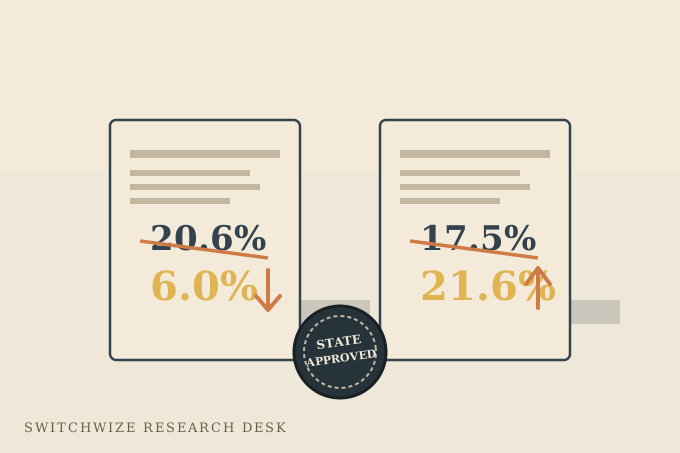
Corinne filed her own insurer's 2027 rate request the way she files most paperwork: she didn't. She just read the headline in September. Insurers nationwide were asking for a median 14% price increase on Affordable Care Act marketplace plans. She buys one every year, as a self-employed copywriter in New York. Her own insurer, she later learned, had asked the state for a 20.6% jump, worse than the national number. She started budgeting for it.
Then New York's regulator finished reviewing the request. The state cut it to 6.0%, a reduction of more than two-thirds. Her brother, four states away in Oregon, got the opposite surprise: his state's regulator approved a bigger increase, 21.6%, than insurers had even originally asked for. Two people, one national headline, two final numbers that had almost nothing to do with it or with each other.
A requested rate and a final rate are not the same number
The 14% headline skips one step. Most states require an insurer to get a regulator's formal sign-off before it can raise individual-market prices, a power most state insurance departments have held for decades under their own laws. Separately, a 2011 federal rule under the Affordable Care Act requires an insurer to publicly justify a big enough increase. That rule doesn't cap prices. It only forces an explanation, and it works alongside whatever power the state already has, not instead of it. The practical result for 2027: when an insurer files for a 20% increase, that filing is the opening position in a review, not the final bill. A state actuary checks the insurer's math. The insurer sometimes revises its own number mid-review. Then the state issues a final order, which can land lower than the ask, about the same, or, as Oregon shows, higher.
That whole process, insurers filing a number, a regulator checking it, and a final order replacing it, is called rate review. It's not a new power states invented in 2026. It's the same authority that has applied to marketplace plans since the ACA's early years. What's new is how far apart the requested and the final numbers have landed this cycle, in both directions, across the handful of states that have finished their review so far.
Eight states have finalized. The range is already enormous
As of this writing, these are the finalized 2027 individual-market increases, with what insurers originally requested alongside each one.
- Insurers requested
- about 5.2%
- Regulator approved
- 2.2%
- What changed
- Cut
- Insurers requested
- 7.8%
- Regulator approved
- 3.9%
- What changed
- Cut
- Insurers requested
- 20.6%
- Regulator approved
- 6.0%
- What changed
- Cut by 14.6 points
- Insurers requested
- 16.2%
- Regulator approved
- 11.3%
- What changed
- Cut by 4.9 points
- Insurers requested
- 13.7% (June filing)
- Regulator approved
- 14.6%
- What changed
- Approved above the filed average
- Insurers requested
- 17.14%
- Regulator approved
- 15.97%
- What changed
- Cut by 1.17 points
- Insurers requested
- 20.2%
- Regulator approved
- 17.2%
- What changed
- Cut by 3.0 points
- Insurers requested
- 17.5%
- Regulator approved
- 21.6%
- What changed
- Approved 4.1 points above the ask
- Insurers requested
- up to 29.1% (largest insurer's ask)
- Regulator approved
- 24.4%
- What changed
- Cut, but still the highest finalized rate found
Two things jump out. First, the spread: a household in Vermont is looking at a finalized increase about a tenth the size of one in New Mexico, before either of them applies for a subsidy. Second, the direction isn't uniform. Pennsylvania's regulator also denied $94.7 million in increases it called unjustified outright, on top of trimming the approved average. Oregon's regulator did the reverse twice over. It floated a cut to 16% in July. Then it reversed itself in August and finalized at 21.6%. The regulator cited a steeper drop in individual-market enrollment and bigger insurer losses than the spring filings had shown. Maryland's approved 14.6% landed exactly at the top of the range insurers themselves had filed for in June, when carrier-level requests ran from 12% to 14.6%.
New York shows the same split happening inside one state. CDPHP asked for just 1.4% and got no increase at all. UnitedHealthcare of New York asked for 52.1% and was approved for 8.1%. Anthem HP (formerly Empire HealthPlus) asked for an 11.3% increase and instead got a 3.1% cut, a lower price than it charges today. A regulator's pen can move a single insurer's number by more than 60 percentage points from its own request.
Why so many requests cited the same underlying cause
Insurers didn't arrive at these numbers randomly. Peterson-KFF attributes roughly 4 of the national median's 14 requested percentage points to one specific cause: the expiration of the enhanced premium tax credits that had made ACA plans cheaper for millions of people from 2021 through 2025. When a subsidy that size disappears, the people who drop coverage first tend to be the ones who were barely buying it to begin with, often the healthiest people in the pool. KFF's Cynthia Cox put it plainly: "It's likely that the people who dropped their coverage were also the healthier people."
Risk pool is the plain term for this: the group of people whose medical bills get averaged together to set everyone's price. When healthier people leave a risk pool and sicker people stay, the average cost per remaining person goes up. Insurers then price next year's plans for the pool they expect to have, not the one they had this year. That's the reason behind nearly every filing this cycle, not any single state's politics. Maryland and Oregon both named it directly in their own filings. Rising demand for specialty medications and GLP-1 weight-loss drugs added further pressure in multiple states; Vermont's regulator called drug costs, especially for weight-loss medications, the "primary driver" of both of its insurers' increases.
Oregon's case adds a second layer most states didn't have to use: reinsurance. That's a state-run fund that pays insurers back for part of the cost of their most expensive individual claims, so an insurer doesn't have to build those costs into everyone else's premium alone. Oregon's reinsurance program lowered the state's final 2027 rate by 10.7 percentage points, including a full point from an extra $15 million the state added to the fund for 2027. Strip that credit away and the underlying cost pressure driving Oregon's filing was running above 32%, a number no household there ever sees on a bill, because the state absorbed part of it first.
Your insurer wrote the first number. Your state wrote the one that counts.
What this doesn't tell you yet
Only a handful of states have finished review as of this writing, out of the roughly 40 that run an ACA marketplace with state-level rate authority. A state that hasn't finalized yet could land anywhere in, or outside, the 2.2%-to-24.4% range above; nothing here predicts it. And even a favorable state average hides real variation underneath it, the way New York's 6.0% average sat between a 3.1% cut for one insurer and an 8.1% increase for another. A low state number is good news about your state's regulator, not a guarantee about your specific plan.
State rate review doesn't do everything, either. It didn't stop prices from rising almost everywhere. Even the cheapest finalized state, Vermont, is still raising prices on top of premiums regulators there have called the highest in the nation. And the same subsidy expiration pushing prices up is separately pushing people off the subsidy cliff entirely once their income crosses 400% of the poverty line, a different problem covered in SwitchWize's guide to the 2027 ACA subsidy cliff. A lower final rate from your own state and a shrinking tax credit are two separate things, and for some households they'll both land the same year.
What Corinne is actually doing before November 1
Corinne stopped budgeting off the national headline the week New York's final order came out. She still doesn't know her exact 2027 premium, because the state's 6.0% average describes a weighted mix of plans, not her specific one, the same gap that let Anthem's customers get a cut while UnitedHealthcare's customers got an 8.1% increase in the same state. What she does know now is where to look: her state exchange, NY State of Health, on or after November 1, when her plan's real number replaces every estimate she's been working from since September. Her brother in Oregon is doing the same thing, for a very different reason, in a state where the number went the other way.
Sources
- Peterson-KFF Health System Tracker, via KFF Health News, "Priced Out: ACA Premium Increases": median 14% requested increase across 77 insurers in 16 states and DC; roughly 4 points attributed to subsidy expiration; Cynthia Cox quote. Retrieved October 12, 2026.
- New York State Department of Financial Services, press release pr20260904, September 4, 2026: individual market cut from 20.6% to 6.0% requested, $324 million in projected savings; small group cut from 23.7% to 8.0%; 58% of QHP enrollees receive federal premium tax credits. Individual-market enrollee count (~224,000) and per-insurer approved rates corroborated via InsuranceNewsNet and the Daily Gazette's reporting on the same DFS announcement.
- Oregon Division of Financial Regulation, final 2027 rate order announcement, August 18, 2026: individual market finalized at 21.6%, small group at 15.5%, reinsurance effect of 10.7 points. Original 17.5% May request and July 16% interim proposal corroborated via Becker's Payer reporting on DFR's filings.
- Connecticut Insurance Department, 2027 rate decision announcement, September 11, 2026: individual cut from 16.2% to 11.3%, small group from 17.8% to 15.1%.
- Pennsylvania Insurance Department, "Pennsylvania Releases ACA 2027 Health Insurance Rates", September 18, 2026: individual cut from 17.14% to 15.97%, small group from 11.49% to 10.28%, $94.7 million in denied unjustified increases, 14 individual filers.
- Green Mountain Care Board (Vermont), 2027 rate decisions, August 18, 2026, as reported by WCAX and Becker's Payer: BlueCross BlueShield of Vermont approved at 2.2% individual; MVP Health Plan approved at 3.9% individual (from a 7.8% request).
- Delaware Department of Insurance, 2027 marketplace rate announcement, as reported by InsuranceNewsNet: Highmark BCBS approved at 17.2% (from 20.2% requested); AmeriHealth Caritas finalized at 13.94% after actuarial review (from a 13.9% request).
- New Mexico Office of Superintendent of Insurance, press release pr-2026-09-01, September 1, 2026: individual market approved at 24.4%; BlueCross BlueShield of New Mexico, the largest carrier, had requested 29.1%.
- Maryland Insurance Administration decision, as reported by Maryland Matters, September 25, 2026: individual market approved at 14.6%, above the 13.7% average filed in June (carrier requests ranged 12% to 14.6%).
- Cigna's planned exit from ACA marketplaces after the 2026 plan year (369,000 members, 11 states) and Aetna's completed exit at the end of 2025 (about 1 million enrollees, 17 states), as reported by Healthcare Dive and the Associated Press. Centene's Ambetter exit from Delaware's ACA market for 2027, as reported by InsuranceNewsNet.
- HealthCare.gov, Dates and deadlines for 2027 coverage: open enrollment begins November 1, 2026.
- The $1,446-per-enrollee figure is SwitchWize's own calculation, dividing DFS's published $324 million savings figure by DFS's published 224,000 individual-market enrollee count. It is not a figure DFS itself published.
What to Do Now
Corinne is a composite character; the state rate-review figures and dates cited are real. Figures in this piece were verified on October 12, 2026, against each state regulator's own release. Several states had not yet finalized 2027 rates as of this writing; this article covers only those that had. This article is educational information, not individualized financial or insurance advice.
Quick answers
Is the 14% median ACA rate increase for 2027 what I'll actually pay? No. That 14% figure, from a Peterson-KFF analysis of 77 insurers in 16 states and DC, is the median increase insurers requested before any state reviewed it. States that have finished reviewing 2027 requests have approved anywhere from 2.2% (Vermont) to 24.4% (New Mexico). Your own state's final number, not the national median, is what applies to you.
Can a state insurance regulator actually change the price an insurer asks for? Yes. Most states require an insurer to get a regulator's sign-off before raising prices in the individual market, a process separate from the federal government's own 2011 rate-review rule, which only requires public justification above a threshold increase. A state regulator can approve a lower number than requested, as New York, Connecticut, Pennsylvania, Delaware, and Vermont all did for 2027, or a higher one, as Oregon did.
Why did Oregon approve a bigger health insurance rate increase than insurers requested? Oregon's insurers originally asked for a 17.5% average individual-market increase in May 2026. The state's Division of Financial Regulation first proposed cutting that to 16% in July, then finalized the rate at 21.6% in August, citing a steeper-than-expected drop in individual-market enrollment and bigger insurer losses than the May filings had shown. The state's reinsurance program, a fund that covers part of the cost of the most expensive claims so other customers' prices don't have to, lowered the final number by 10.7 percentage points; without it, the underlying increase would have been above 32%.
When will I know my actual 2027 ACA premium? Open enrollment for 2027 coverage begins November 1, 2026, on HealthCare.gov and state exchanges. That is when your specific plan's finalized premium, for your age and ZIP code, becomes visible. A state's average approved increase, even a low one, does not tell you what your specific plan will charge.
Frequently Asked Questions
Is the 14% median ACA rate increase for 2027 what I'll actually pay?
Can a state insurance regulator actually change the price an insurer asks for?
Why did Oregon approve a bigger health insurance rate increase than insurers requested?
When will I know my actual 2027 ACA premium?
The 5-minute money briefing
One email per week. New rates, fed moves, and what to actually do about them.
No spam. Unsubscribe anytime.
Answer a few questions about your situation and goals. Money Map points you to the highest-value next step across savings, mortgage, cards, and debt.
Editorial review
What changed since the last update
Was this guide helpful?
Found an inaccurate, outdated, or missing claim? Report a correction. We verify reports against the relevant source before changing a guide or ranking.