Vanguard Cash Plus is worth considering if you already invest at Vanguard and want savings alongside your portfolio. It works less well as your only account for urgent bills.
Its appeal is understandable: savings and investments appear together, and eligible cash goes to participating banks. But access matters as much as interest. Before moving an emergency fund, find out when you can withdraw a new deposit.
What Cash Plus offers
Cash Plus is a brokerage account with a bank sweep. The sweep places eligible cash at participating banks; it is separate from optional money market fund investments.
Vanguard lists no opening deposit or minimum balance. It offers direct deposit, mobile check deposit and electronic payments, but no debit card or checkwriting. Each available money market fund has a $3,000 minimum. Source: Vanguard account page.
The practical benefit is fewer places to check your money. That convenience may justify choosing Cash Plus even when another account pays slightly more. Decide how much convenience is worth in dollars, rather than assuming that one familiar provider must offer your best rate.
Compare the rate you actually qualify for
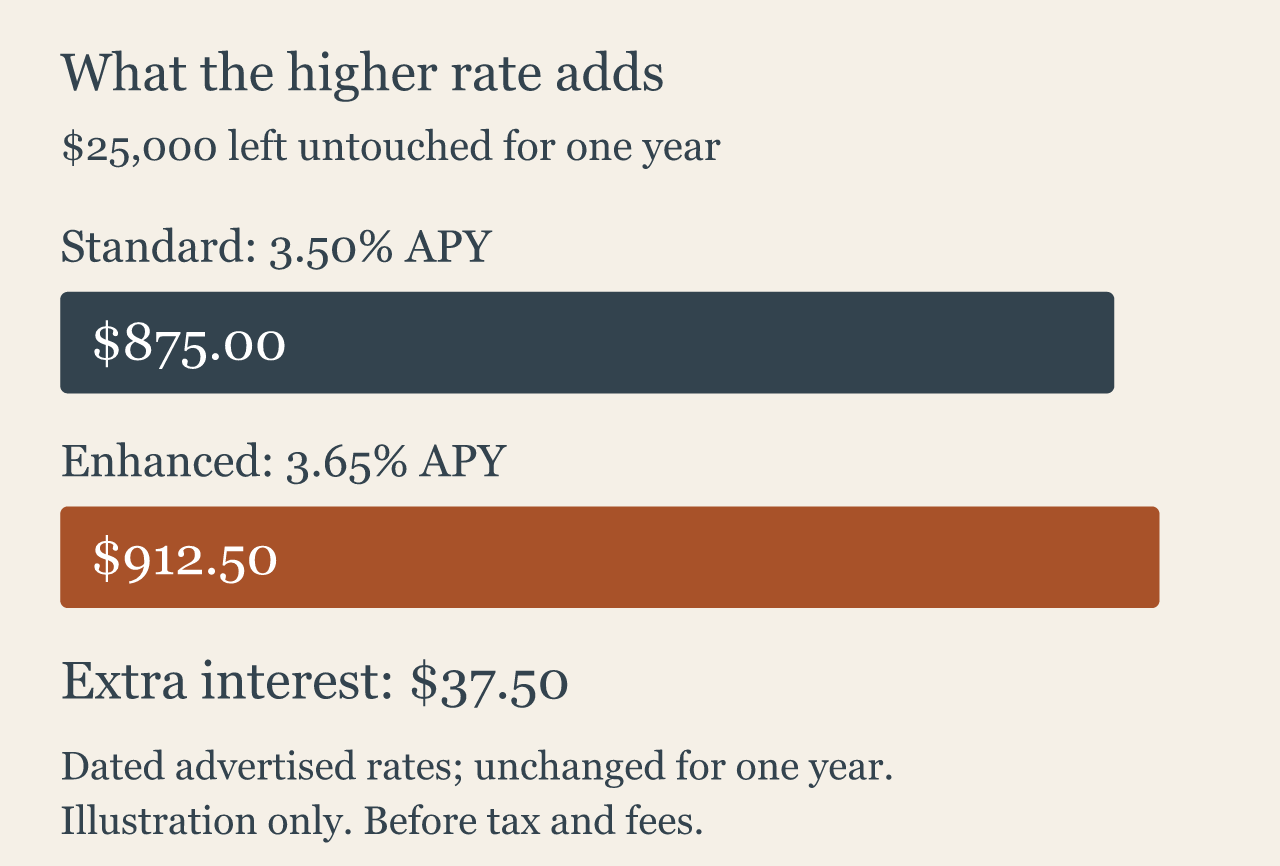
Vanguard's account page shows a 3.50% standard APY and 3.65% Enhanced APY as of November 8, 2026. APY shows the percentage your money earns over a year, including interest earned on earlier interest. These are variable rates, not a promise of future earnings.
Both rates were checked on Vanguard's live account page on November 8, 2026. Confirm your rate and eligibility before funding.
You may qualify with at least $1 million in assets that Vanguard counts toward eligibility. Other routes include specified advisory services or certain participating employer retirement plans. A joint owner's qualification can count. Eligibility updates can take time. Source: Vanguard's tier rules.
Do not assume every Vanguard retirement plan qualifies. Check your own plan and the tier shown on your account.
Consider a hypothetical $25,000 balance, left untouched for one year:
- Interest before tax and fees
- $875.00
- Interest before tax and fees
- $912.50
- Interest before tax and fees
- $37.50
The calculation is $25,000 multiplied by each APY. At an unchanged 0.15 percentage-point difference, the enhanced rate adds $150 annually per $100,000.
That is useful if you already qualify. It gives little reason, by itself, to buy advice or move a large investment portfolio. Compare the full cost and suitability of any advisory service separately.
Use the same approach when comparing savings accounts. For illustration, a rate 0.50 percentage points higher adds $125 annually on $25,000, under the same assumptions. That example is not a competing bank offer.
Check the current fee schedule
Vanguard's fee schedule, checked November 8, 2026, waives the annual account service fee for all Cash Plus accounts. Its product page still highlights free service when you receive account documents electronically. The schedule gives the broader waiver.
The same schedule lists a $10 wire-transfer fee, waived for specified clients, including those with at least $1 million in qualifying assets. Electronic bank transfers are free from Vanguard; another bank may charge. A $100 account closure and full-transfer fee may apply, with exceptions. Ordinary electronic bank transfers through the ACH network are excluded from that fee.
The annual fee waiver does not eliminate every charge. Read the charges for the transactions you expect to use, especially wires or transferring the whole account elsewhere.
New deposits may have restricted access
Vanguard describes transaction restrictions generally lasting four to five business days. New-account cash and check deposits generally face an initial restriction of up to 20 days, sometimes up to 60. During that time, cash may be returned only to its originating bank.
Transfers initiated through Vanguard have daily limits: $250,000 for deposits and $100,000 for withdrawals. Restrictions can still apply. Source: Vanguard's transaction FAQ.
This distinction matters if you are moving money before a house closing, tuition payment or emergency expense. Money available to buy an investment may not yet be available for the payment you intended.
Our recommendation: start with a small deposit. Check the available-to-withdraw balance and test a withdrawal before moving the rest. Keep upcoming bills funded elsewhere until you know the process works for you.
Insurance depends on where the money sits
The bank sweep and money market funds need separate treatment:
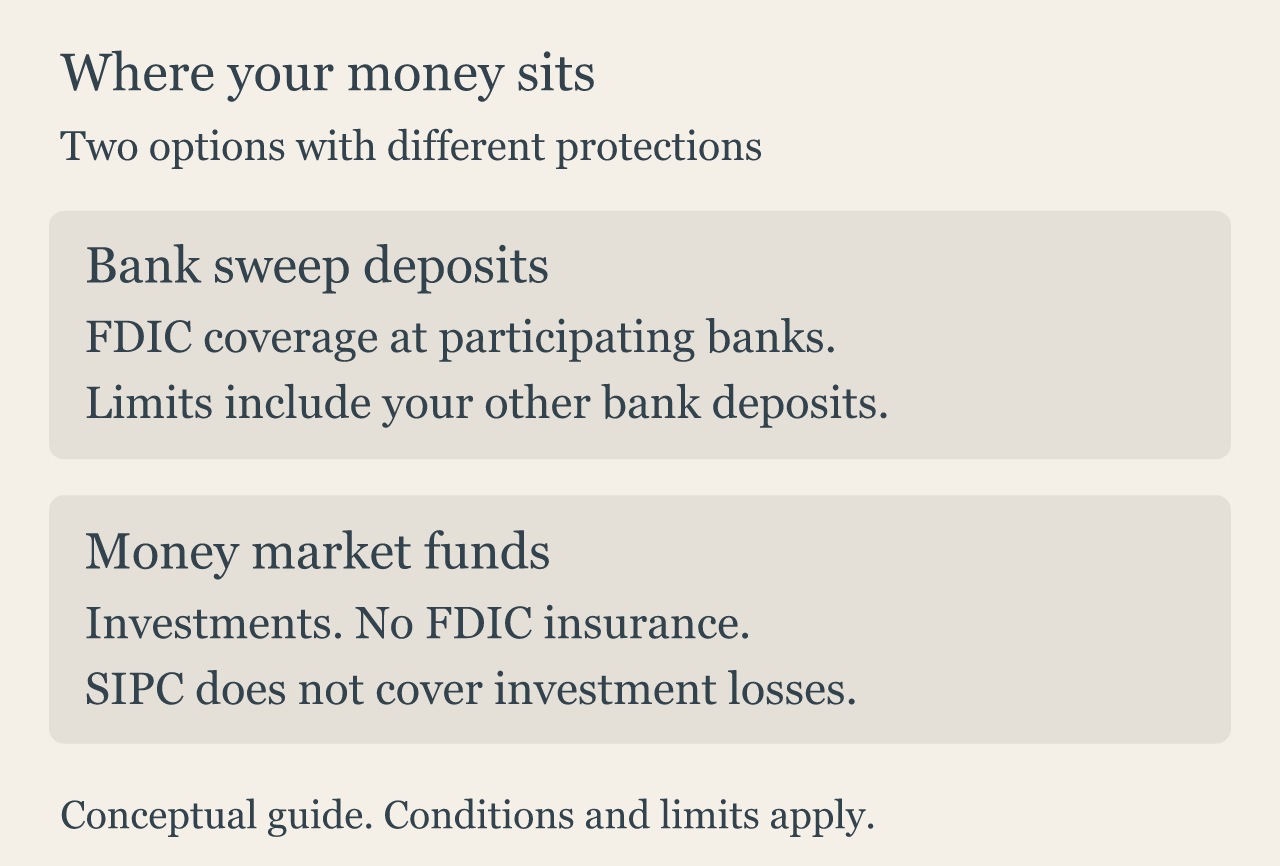
For bank deposits, the standard FDIC limit is $250,000 per depositor, per insured bank, per ownership category. An ownership category describes how an account is held, such as individually or jointly. Other deposits you hold at the same bank in the same category count toward that limit. Source: Vanguard's sweep terms, section 14.
Check the participating-bank list against accounts you hold directly or through other services. Familiar names on Vanguard's list include American Express, Citibank and Synchrony. Excluding a bank can reduce available coverage.
Do not treat the program's maximum advertised coverage as your personal insured amount. Your bank allocations, ownership category and existing deposits determine that.
Optional money market funds are securities rather than FDIC-insured deposits. SIPC helps restore missing customer assets when a member brokerage fails, subject to limits. It does not insure investment value or protect against market losses. Source: SIPC.
For a concrete example, assume you have $200,000 directly at one program bank and $100,000 swept there. With the same depositor and ownership category, the $300,000 total exceeds the standard limit by $50,000. This simplified example excludes other deposits and accrued interest.
Fund investments need a separate payment plan
Bill payments use the available bank sweep balance. Money invested in a money market fund is not necessarily available for an automatic bill payment. Source: Vanguard's payment FAQ.
Before buying a fund, check how to sell it and when proceeds become withdrawable. Compare a fund's quoted yield with a deposit APY carefully; they use different measures. A higher displayed number alone does not settle which option suits your cash.
Vanguard's sweep terms also disclose that participating banks pay it fees that affect deposit rates. That explains why the sweep's convenience does not guarantee the highest return. Source: sweep terms, section 9.
Who should choose Cash Plus?
- Our assessment
- A reasonable candidate if the rate and access rules suit you
- Our assessment
- Consider it for money beyond your immediately accessible reserve
- Our assessment
- Choose an account that provides those features
- Our assessment
- Compare current offers and account conditions first
- Our assessment
- Map coverage at each receiving bank before depositing
Cash Plus makes its strongest case as a savings companion to an existing Vanguard relationship. Its convenience deserves credit; its access restrictions deserve equal attention.
Before moving a large balance, confirm your rate tier, check bank allocations and complete a small withdrawal test. Keep money for urgent expenses in an account you have already tested.
This review analyzes published terms. We did not open an account, test customer service or measure transfer speed.
Frequently Asked Questions
Is Vanguard Cash Plus a bank account?
Does Vanguard Cash Plus charge an annual fee?
Does Cash Plus have a debit card or checks?
Can I use Cash Plus for my emergency fund?
The 5-minute money briefing
One email per week. The biggest changes in savings, money market, checking and CD rates.
Send me the weekly SwitchWize rate briefing: the biggest changes in savings, money market, checking and CD rates. Unsubscribe in one click. We never share your address.
Act on this: today's top savings



Ranked by SwitchWize's composite score. SwitchWize currently has no compensated product links.
Editorial review
What changed since the last update
Was this guide helpful?
Found an inaccurate, outdated, or missing claim? Report a correction. We verify reports against the relevant source before changing a guide or ranking.
