- The barrier to switching is friction, not cost: the fear of breaking a payment or losing history keeps people in worse accounts than they would choose today.
- The universal safe method is to run old and new in parallel, move deposits and payments one at a time, and close the old account last.
- Each product, banks, cards, insurance, brokerages, has specific traps, and a deliberate sequence avoids all of them.
Almost everyone is in at least one financial product they would not choose today: a savings account paying a fraction of the market rate, an insurer whose premium has crept up for years, a card whose fee no longer earns its keep. And almost no one switches. The reason is rarely that the math is unclear. It is that switching feels dangerous. What if a payment bounces, a deposit lands nowhere, or years of history vanish? That fear, not the cost, is what keeps people stuck. Savings rates on this page were last verified recently. This guide walks you through how to switch financial accounts without problems 2026, eliminating the fear that keeps you trapped.
The fear is legitimate but solvable. Switching goes wrong when it is done as a cold leap. Done as a controlled, parallel process, it is safe, reversible, and boring, which is exactly what you want. This is the complete method, first as a universal rule, then applied to each product.
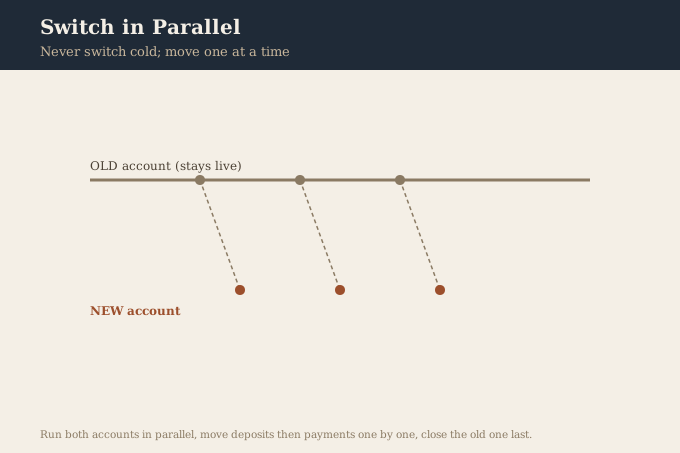
The universal rule: run in parallel
Every safe switch, of any product, follows one principle: never leave money or a payment unattached, even for a moment. In practice that means:
- Open the new account first. You now have two live accounts, not zero.
- Move incoming money before outgoing. Redirect deposits, confirm one lands.
- Move payments one at a time. Switch each automatic payment individually and verify it, most important first.
- Keep the old account live through a full cycle. It is your safety net for anything you forgot.
- Close the old account last, only after a full cycle clears with nothing still attached.
At no point in this sequence is your money without a home or a payment without a source. That is the whole trick, and it makes switching reversible at every step.
Applying it to each product
Banks. The classic case. Open and fund the new checking or savings account, redirect direct deposit and confirm a paycheck arrives, then move automatic payments one by one. Keep the old account funded for a full cycle so any forgotten charge still clears, then close it.
Credit cards. Different, because closing a card can raise your utilization and shorten your credit history. Prefer downgrading to a no-fee version, which keeps the account and its age. If you must switch cards, open the new one first, move recurring charges over, and weigh the score impact before closing anything.
Insurance. The one risk is a coverage gap. Bind the new policy with an effective date that starts before or exactly when the old one ends, never a day in between. Confirm the new coverage is active and any lienholder is listed, then cancel the old policy.
Brokerages. Use an in-kind transfer, which moves your positions and cost basis intact, rather than selling and rebuying, which can trigger taxes and lose records. The transfer takes time, so keep both accounts open until the positions arrive and reconcile.
The traps, by product
- The trap
- A payment bounces during the move
- The fix
- Parallel run, move one at a time
- The trap
- Score drops from closing
- The fix
- Downgrade instead, or close last
- The trap
- Coverage gap
- The fix
- New policy active before old ends
- The trap
- Taxes from selling
- The fix
- In-kind transfer, not sell-and-rebuy
Why the parallel period matters most
The single most important step is the one people skip: keeping the old account live through a full cycle. Almost every switching horror story comes from closing the old account too soon, before a forgotten annual charge, a quarterly bill, or a delayed deposit had a chance to surface. The old account, kept open and funded for a cycle, catches all of it harmlessly. It costs nothing to leave it open a few extra weeks, and it converts the one real risk of switching, the thing you forgot, into a non-event.
Start with one
You do not have to switch everything at once, and you should not. Pick the single product where staying put costs the most, usually a low-rate savings account, run the parallel method on that one, and let it prove how controlled the process is. Once the first switch goes cleanly, and it will, the fear that kept you in worse products loses its grip, and the rest become routine. The savings were always available. The method is what makes them reachable.
Sources
- SwitchWize Research Desk switching method, drawn from the mechanics of direct-deposit redirection, automatic-payment migration, insurance binding, and in-kind brokerage transfers.
- See also the switching friction score guide for how much friction each provider adds.
Specific timelines vary by institution; confirm each provider's process. This is general educational information, not financial advice.
What to Do Now
Frequently Asked Questions
How do I switch banks without missing a payment?
What is the safest order to switch financial accounts?
What are the risks when switching insurance?
Will switching accounts hurt my credit or lose my history?
Act on this: today's top savings



Ranked by SwitchWize's composite score. We may earn a referral fee, and it never changes the ranking order.
Editorial review
What changed since the last update
Was this guide helpful?
Found an inaccurate, outdated, or missing claim? Report a correction. We verify reports against the relevant source before changing a guide or ranking.
