- A private mortgage is a real estate loan from an investor, a fund, or the seller rather than a bank. The lender looks mostly at the property, not your tax returns.
- It costs far more: 8% to 15% interest plus 1% to 5% of the loan in fees at closing. The loan runs 6 to 36 months, and the whole balance is due at the end.
- It works for someone fixing and selling a house, someone buying a new property before the old one sells, or a self-employed buyer who will switch to a bank loan later. For a family home you plan to keep, a bank loan is cheaper and safer.
Quick answer
A private mortgage is a loan to buy or refinance property that comes from a private source instead of a bank. The lender can be an investor, a wealthy family's investment company, a fund that lends investors' money, or the person selling the house. The loan is still backed by the property, so the lender can foreclose if you stop paying. What changes is how the lender decides. A bank checks your credit score, your pay stubs and tax forms, and how your monthly debt payments compare with your income. A private lender checks the property's value and your plan to pay the loan off.
That trade has a price. A regular bank loan, which lenders call a conventional loan, has a 30-year rate near 7.40% today. A private mortgage usually charges 8% to 15%, plus fees of 1% to 5% of the loan at closing. Lenders call those fees points. Most private loans run only 6 to 36 months. Most charge interest only, so the balance never shrinks, and they end with a balloon payment: the entire balance is due on one day. A private mortgage can be the right tool for a short project. It is almost never the right tool for a home you plan to live in for years.
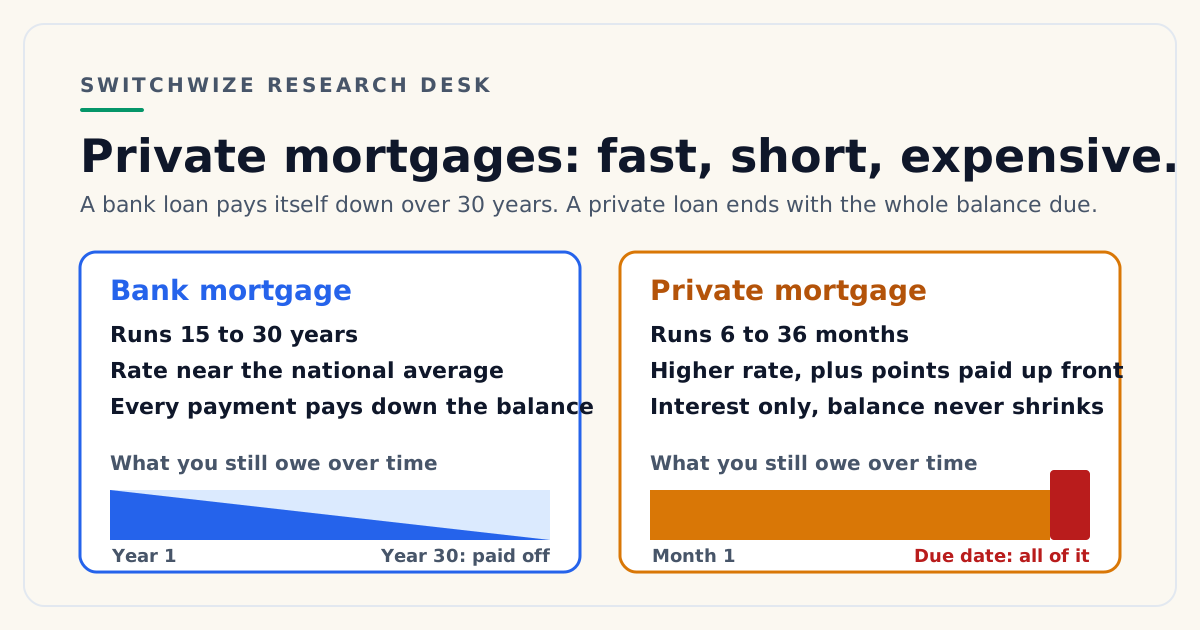
How a private mortgage works
On paper it looks like any other mortgage. You sign a loan agreement (a promissory note). The lender files a legal claim on the property (a lien). You make monthly payments. Three things are different.
The lender looks at the property first. A bank needs the loan to fit the rules of Fannie Mae or Freddie Mac, the two government-backed companies that buy most bank mortgages, so it can sell the loan later. A private lender keeps the loan, so it can set its own rules. It asks what the property is worth today, what it will be worth after any work, and how you will pay the loan off.
It closes fast. A bank mortgage takes 30 to 45 days or more. A private mortgage can close in days because the lender skips most of the paperwork a bank needs.
Everything is negotiable. The rate, the fees, the term, and the extension options are all set by contract. That can help you or hurt you. You can negotiate a better deal, and the lender can write in terms a bank could not.
Who should use one
A private mortgage fits a borrower who needs speed or flexibility more than a low rate. Three groups come up most.
House flippers and small developers. A bank will not lend on a house with no kitchen, or on a building the city has not yet approved for people to live in. A private lender will, because it values the property on what it will be worth after repairs. Money for the repairs is usually held by a third party and released in stages after an inspector confirms the work is done.
Self-employed buyers. A bank qualifies you on the income shown on your tax return. If you take legal business deductions, that number can be far below the cash you actually bring in. Some private and non-bank lenders qualify you on 12 to 24 months of bank deposits instead. Our guide to getting a mortgage when you are self-employed covers the bank route first.
Investors between properties. Some investors need to buy a new rental before the old one sells. Others need to fix up an apartment building before a bank will lend on it. Both use a private loan to cover the gap. Once the property is stable, they refinance with a bank.
When a bank loan is the better choice
If you are buying a home to live in, a bank or government-backed loan is cheaper and safer in almost every case. A regular bank loan, an FHA loan with 3.5% down, or a VA loan with nothing down all give you a fixed rate for up to 30 years. All come with federal consumer protections. Every payment pays down the balance.
A private loan does not do that. Most charge interest only, so you owe the same amount at the end as at the start. If you have no realistic way to sell or refinance within the term, you should not take one.
If your plan is "I will just refinance with a bank when the private loan comes due," ask a bank now whether it would approve you. If the answer is no today, it may still be no in 12 months. Then the whole balance is due and you have no way to pay it.
The main types of private mortgage
Seller financing. The seller acts as the bank. You sign a note with the seller and pay them monthly, and they keep a claim on the property until you pay it off. Terms are flexible. But seller financing on a home you will live in is tightly regulated by federal law, covered below.
Hard money loans. The classic private loan for flippers. The lender bases the loan on what the house will be worth after repairs, charges the highest rates in the market, and sets a term of 6 to 12 months.
Bridge loans. Short-term money to get from one property to the next, or to fix up a building until a bank will take it. Many commercial bridge loans have a rate that moves with the market, so the payment changes when the Federal Reserve moves rates.
Portfolio loans. A loan the lender keeps on its own books instead of selling. It does not have to follow Fannie Mae or Freddie Mac rules. So it can finance an unusual condo, a rural property, or a borrower with one recent credit problem and otherwise strong finances.
Bank statement loans. A non-bank loan for self-employed borrowers. Instead of tax returns, the lender adds up 12 to 24 months of business deposits and subtracts an expense allowance, often 50%. If you deposit $25,000 a month, the lender counts $12,500 as income. Your monthly debt payments, including this loan, usually cannot be more than 43% to 50% of that income.
What a private mortgage costs
Private money is expensive in three ways: the rate, the fees, and the way it is paid back.
The rate. Most private mortgages charge 8% to 15%, and risky projects pay more. Here is what that means on a $300,000 loan. A regular 30-year loan at 6.5% costs about $1,896 a month, and that payment includes paying down the balance. An interest-only private loan at 12% costs $3,000 a month, and none of it reduces what you owe. That is about $1,100 more every month, or roughly $13,200 a year, for a loan that is not shrinking.
The fees. Private lenders charge 1 to 5 points at closing. One point is 1% of the loan, so 3 points on $300,000 is $9,000 in cash on closing day. Add underwriting, document, and inspection fees for any loan that pays for repairs in stages. Because the loan is short, those up-front fees push the true yearly cost well above the stated rate. Our guide to APR versus interest rate explains why.
The way it is paid back. Most private loans charge interest only for 6 to 36 months and end with a balloon payment. On the last day, you owe the full original balance. You pay it by selling the property, refinancing with a bank, or, as a last resort, taking another private loan. The third option usually means the plan is not working.
A private lender will not fund you without a believable way to pay the loan off. If you plan to sell, bring recent sales of similar homes nearby that support your price. If you plan to refinance, show how you will qualify with a bank by then. Build in a cushion. A lender that offers a 3- or 6-month extension for a fee can save you from default if the market slows.
Private mortgage vs bank mortgage
- Bank or government-backed mortgage
- Banks, credit unions, loans sold to Fannie Mae or Freddie Mac
- Private mortgage or hard money
- Investors, family investment companies, lending funds, sellers
- Bank or government-backed mortgage
- Credit score, pay stubs, tax returns, your debt compared with your income
- Private mortgage or hard money
- Property value, your plan to pay it off, your cash reserves
- Bank or government-backed mortgage
- Near the national average, about 7.40% for a 30-year fixed
- Private mortgage or hard money
- Roughly 8% to 15% or more
- Bank or government-backed mortgage
- 15 to 30 years
- Private mortgage or hard money
- 6 to 36 months
- Bank or government-backed mortgage
- Every payment pays down the balance
- Private mortgage or hard money
- Mostly interest only, then the whole balance is due
- Bank or government-backed mortgage
- 30 to 45 days or more
- Private mortgage or hard money
- Days to a few weeks
- Bank or government-backed mortgage
- Lower, and capped by federal rules
- Private mortgage or hard money
- 1 to 5 points plus other fees
- Bank or government-backed mortgage
- Strong: federal rules on fees, disclosures, and how the loan is serviced
- Private mortgage or hard money
- Thin for investment loans; mostly whatever the contract says
- Bank or government-backed mortgage
- No
- Private mortgage or hard money
- Yes, the lender has to approve it
How to get a private mortgage
Getting a private mortgage is more like a business deal than a consumer loan application.
- Write the plan. How much you need, what you will do with the property, and exactly how and when you will pay the loan off. If you plan to sell, gather recent sales of similar homes nearby. If you plan to refinance, show how you will qualify.
- Compare lenders. The market ranges from one local investor to national funds. Check that the lender has the cash to pay for repairs on time. Ask whether it works with borrowers who hit trouble or moves fast to foreclose.
- Negotiate the terms. Points, the penalty rate on default, the term length, and an extension option are all on the table. An extension clause for a set fee is the single most useful thing to negotiate.
- Close through a third party. Expect to provide an appraisal or a broker's price opinion, proof that no one else has a claim on the property, and your LLC paperwork if you are borrowing through a company. Use an independent title or escrow company so the money is handled correctly and the lender's claim is recorded.
Private mortgage vs private mortgage insurance
These are two different things with similar names.
Private mortgage insurance (PMI) is a policy a bank requires on a regular loan when you put down less than 20%. It protects the bank if you default. On a $300,000 loan it usually costs 0.3% to 1.5% of the balance a year. That is about $75 to $375 a month, according to the CFPB. Our PMI guide covers the cost and how to cancel it.
A private mortgage does not use PMI. The lender protects itself another way. It lends only 60% to 75% of the property's value, charges a higher rate, and can foreclose quickly.
What happens if you miss payments or cannot pay it off
Private lenders move faster and give less slack than a bank. They are short-term lenders with expensive money, and they do not have to offer the payment plans and pauses a bank has to offer.
The rate jumps. Most notes have a default rate. A 10% loan can jump to 18% to 24% the day you miss a payment or miss the final balloon payment. State law sets the ceiling. Late fees, often up to 10% of the payment, are added at the same time.
Foreclosure starts. How fast depends on your state.
- Some states, such as New York and Florida, require a court case. Foreclosure there can take a year or more.
- Some states, such as Texas and Nevada, allow foreclosure without a court. The lender sends a default notice and waits the required time. It can then sell the property at auction in about 60 to 120 days.
If the auction brings in more than you owe plus fees and penalty interest, you get the difference. In practice, penalty interest eats most of that money before the sale.
Deals short of foreclosure. Many lenders prefer to avoid the cost and delay of foreclosure. Common deals:
- You hand the lender the property and the debt is canceled.
- The lender sells your loan to another investor.
- You pay less than you owe, if you can bring in new money fast.
- The lender pays you a small amount to leave the property clean and on time.
Two myths about private lenders
"They do not check credit." They do. A high score is not required, and a borrower in the low 600s can be approved on a strong property. But lenders pull credit to find an open bankruptcy, a recent foreclosure, or unpaid federal taxes, which the government can collect before the lender does.
"They do not appraise." They do. If you default, the property is all the lender has. So valuing it is the main part of the review. Expect a full appraisal, a broker's price opinion, or a computer estimate.
For big commercial buildings, lenders also use a test called debt yield. They divide the rent left after expenses by the loan amount. If a building clears $1,200,000 a year and the loan is $12,000,000, the debt yield is 10%. Most private commercial lenders want 8% to 11%. That rule caps the loan no matter what the building is worth. A building that clears $1,200,000 a year might be worth $21.8 million. A lender that wants a 9% debt yield will still lend at most about $13.3 million, about 61% of that value.
Are private mortgage lenders regulated?
Yes, by state and federal law. Private lenders have to follow real rules.
State interest caps. Every state caps the interest a lender can charge. These are called usury laws. The cap depends on the state and on whether the borrower is a person or a company. New Jersey shows how detailed this gets. For a written loan to a person, the cap is 16%, and a lender who goes over it loses all the interest. Loans of $50,000 or more are mostly exempt, unless the loan is the main mortgage on a home. Charging a person more than 30% a year is a crime. For a company, the crime line is 50%. Lenders write their default rates and late fees carefully to stay under these lines.
Dodd-Frank. This is the federal law that matters most for seller financing and private loans on a home the buyer will live in. Anyone who regularly makes home loans needs a mortgage loan originator license. Congress made two narrow exceptions for occasional seller financing:
- One home a year for a person. Someone who did not build the home can seller-finance one home every 12 months without a license. Three rules apply: the rate is fixed, or fixed for at least 5 years; no balloon payment in the first 5 years; and the seller honestly believes the buyer can repay.
- Three homes a year for a company or trust. The same rules apply. The loan must also pay itself down fully, with no balloon at all. The seller must check the buyer's income and debts and keep a record.
A lender who ignores these rules faces real consequences. Borrowers can sue for damages, and courts have let borrowers cancel the loan entirely.
More questions
Can I get a private mortgage for my primary home? Sometimes, but it is rarely a good idea. The cost is high, the term is short, and the lender is not required to offer the protections a bank must. Try a conventional, FHA, or VA loan first.
How much down payment does a private lender want? Usually 25% to 40%. Private lenders lend 60% to 75% of the property's value and want you to have real money at risk.
Can I pay a private mortgage off early? Often yes, but check the note. Some private loans charge a fee for paying early or require a minimum number of months of interest.
How much money do I need to be a private lender? Funding one loan yourself takes $100,000 to $500,000 or more per property, plus the legal paperwork and the ability to handle a default. Funds that lend investors' money to borrowers often start at $25,000 to $100,000. Your money is locked up for a year or more, and pulling out early can cost a fee.
What to Do Now
Sources
- Consumer Financial Protection Bureau, Understand the different kinds of loans available
- Consumer Financial Protection Bureau, What is private mortgage insurance?
- Federal Reserve Board, Comments on the Dodd-Frank Act related to seller financing (Regulation Z, Docket R-1417)
- Consumer Financial Protection Bureau, Regulation Z, 12 CFR 1026.36(a)(4) and (a)(5), seller financer exclusions from the loan originator definition
- New Jersey Statutes, Title 31, Interest and Usury, 31:1-1; N.J.S.A. 2C:21-19 (criminal usury)
- Freddie Mac, Understanding common types of mortgage loans
- Mortgage payment figures in this article use a standard amortization formula at the stated rates and are examples, not quotes.
Frequently Asked Questions
What is a private mortgage?
Is a private mortgage the same as private mortgage insurance (PMI)?
How much does a private mortgage cost?
Do private mortgage lenders check your credit?
Do private mortgage lenders require an appraisal?
What happens if I cannot repay a private mortgage when it comes due?
The 5-minute money briefing
One email per week. New rates, fed moves, and what to actually do about them.
No spam. Unsubscribe anytime.
Act on this: today's top mortgage



Ranked by SwitchWize's composite score. SwitchWize currently has no compensated product links.
Editorial review
What changed since the last update
Was this guide helpful?
Found an inaccurate, outdated, or missing claim? Report a correction. We verify reports against the relevant source before changing a guide or ranking.