Quick answer: Paying off a mortgage from a pretax IRA may require a larger withdrawal to cover the added income tax. Compare taxes, accessible reserves and future withdrawals rather than mortgage interest alone.
The amount you owe the bank is only part of the calculation. If the payoff comes from a pretax IRA, first work out how much must leave the account.
By Jay Rege · November 14, 2026
Mark and Susan want one less bill in retirement. Their mortgage balance is $150,000. Their IRA has more than enough to cover it.
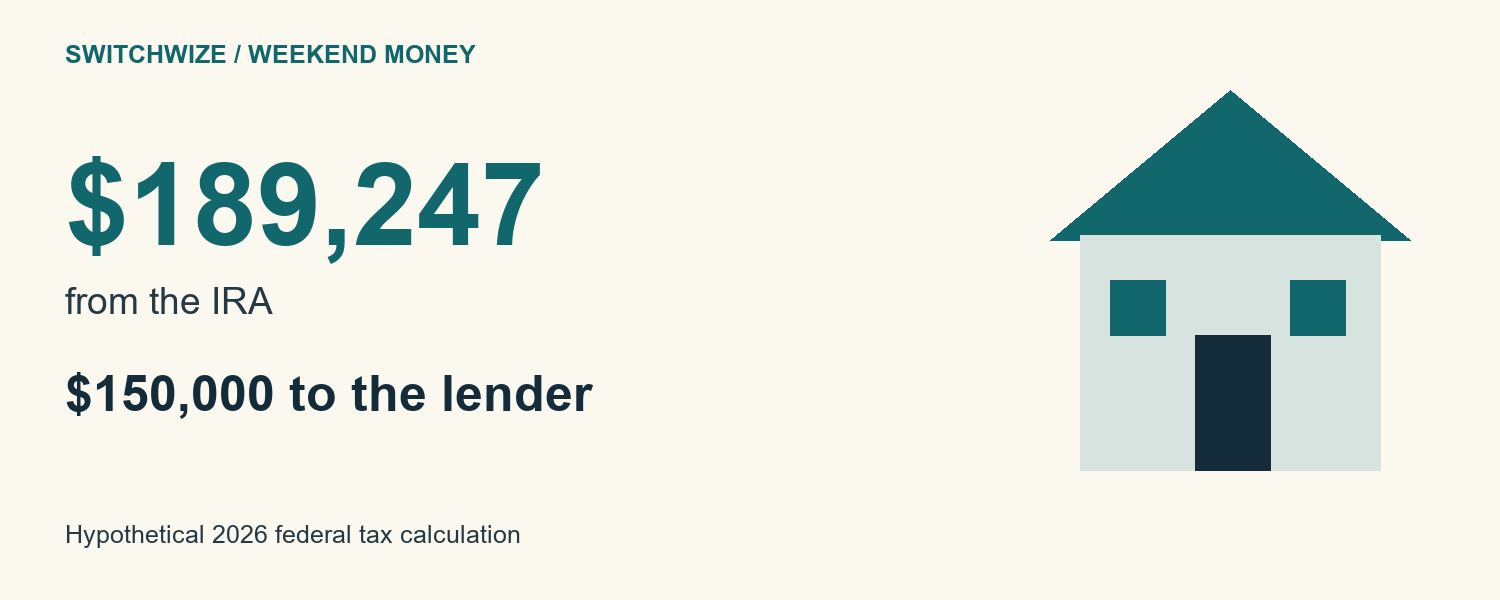
But taking $150,000 out of the IRA would not leave them with $150,000 to pay the bank after the additional federal tax. In our calculation, they would need to withdraw about $189,247 to fund the payoff and its tax bill from the same account.
Mark and Susan are fictional, both 62. The figures use 2026 married-filing-jointly tax rules and a fully pretax IRA. Their other adjusted gross income is an assumed $100,000, all ordinary income rather than capital gains. They take the $32,200 standard deduction, have no credits or other modeled deductions, and live in a state with no individual income tax. Neither receives Social Security in this example.
Those assumptions make the calculation reproducible. They do not make it a recommendation for every retiree.
A $150,000 withdrawal leaves a tax bill unfunded
Before any extra withdrawal, the couple’s modeled federal income tax is $7,640.
Withdraw $150,000 and their adjusted gross income rises to $250,000. The additional federal tax is $29,828. If they reserve that tax from the distribution, only $120,172 remains for the mortgage.
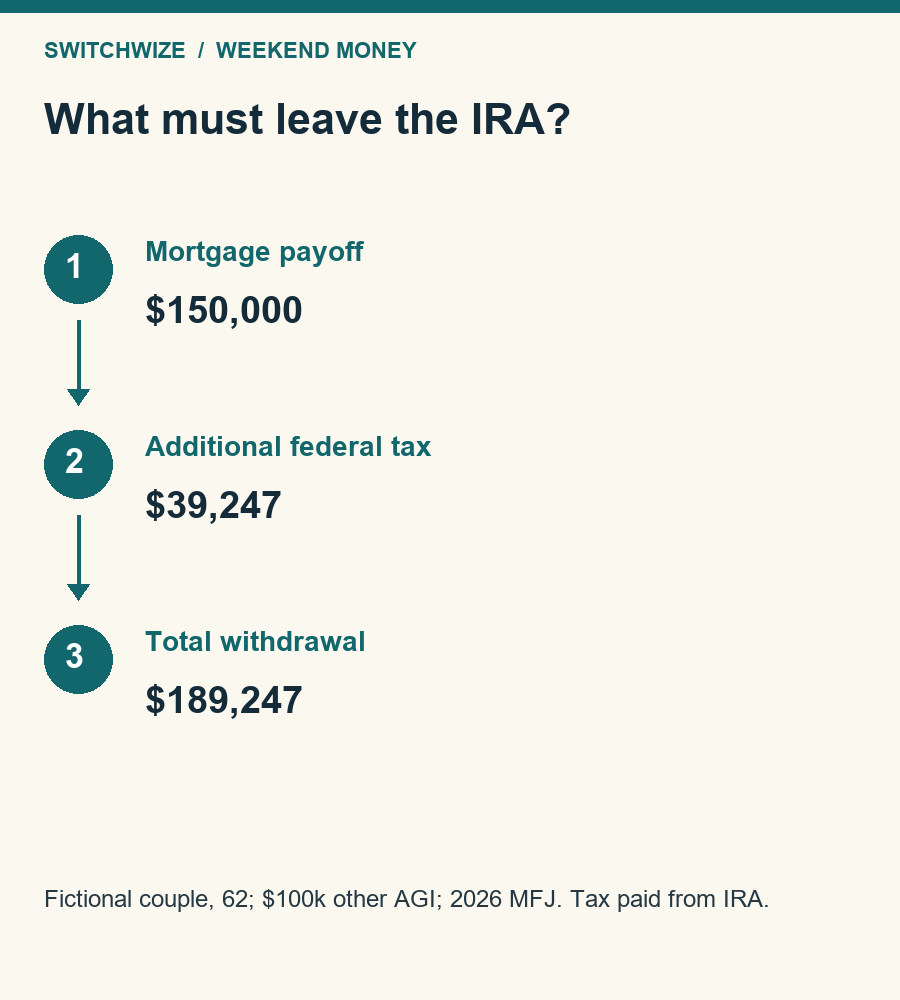
Taking another withdrawal to fill the gap creates more tax. Solving for both the payoff and the tax produces the $189,247 total: $150,000 for the lender and roughly $39,247 in additional federal tax.
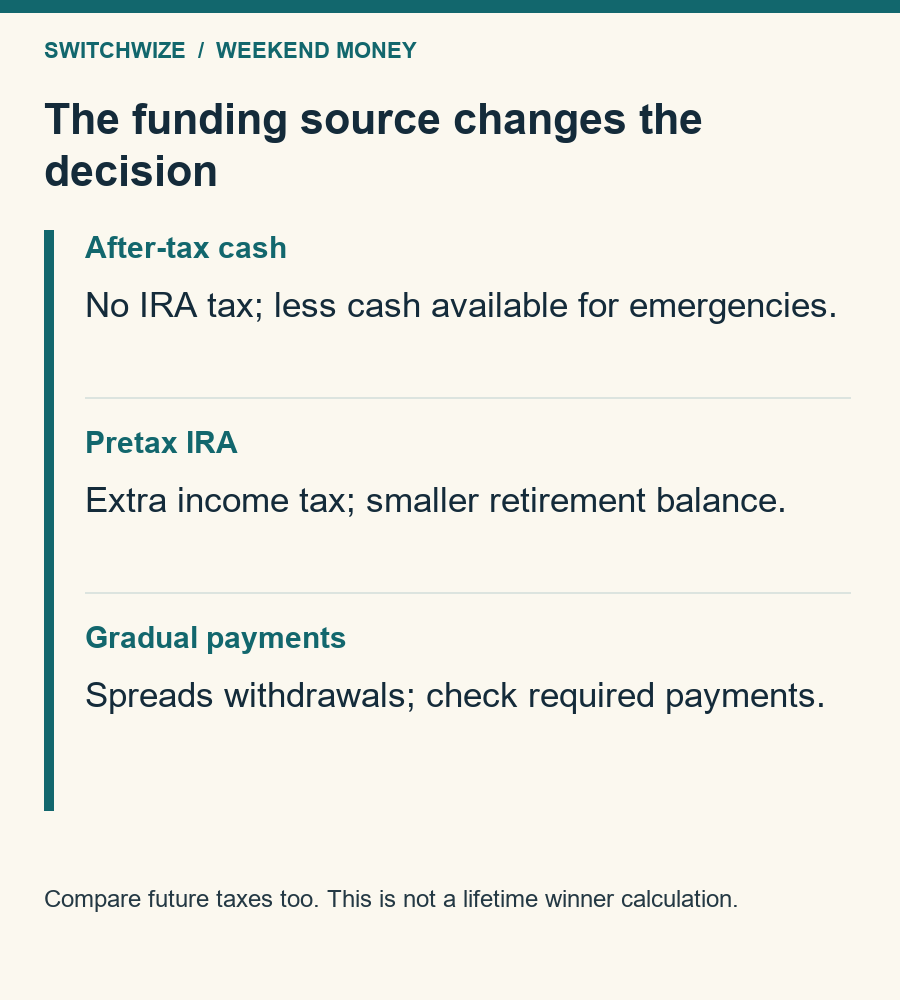
This is why the account holding the money matters. A bank savings balance, a taxable investment account and a pretax IRA are not interchangeable sources of spendable cash. Selling investments in a taxable brokerage account may create capital gains; a Roth IRA withdrawal can be tax-free if the account and withdrawal meet the rules. The tax bill depends on what is sold or withdrawn.
For Mark and Susan, no early-distribution penalty is modeled because they are over 59½. Younger households need to examine that issue separately.
The interest saved is smaller than many people expect
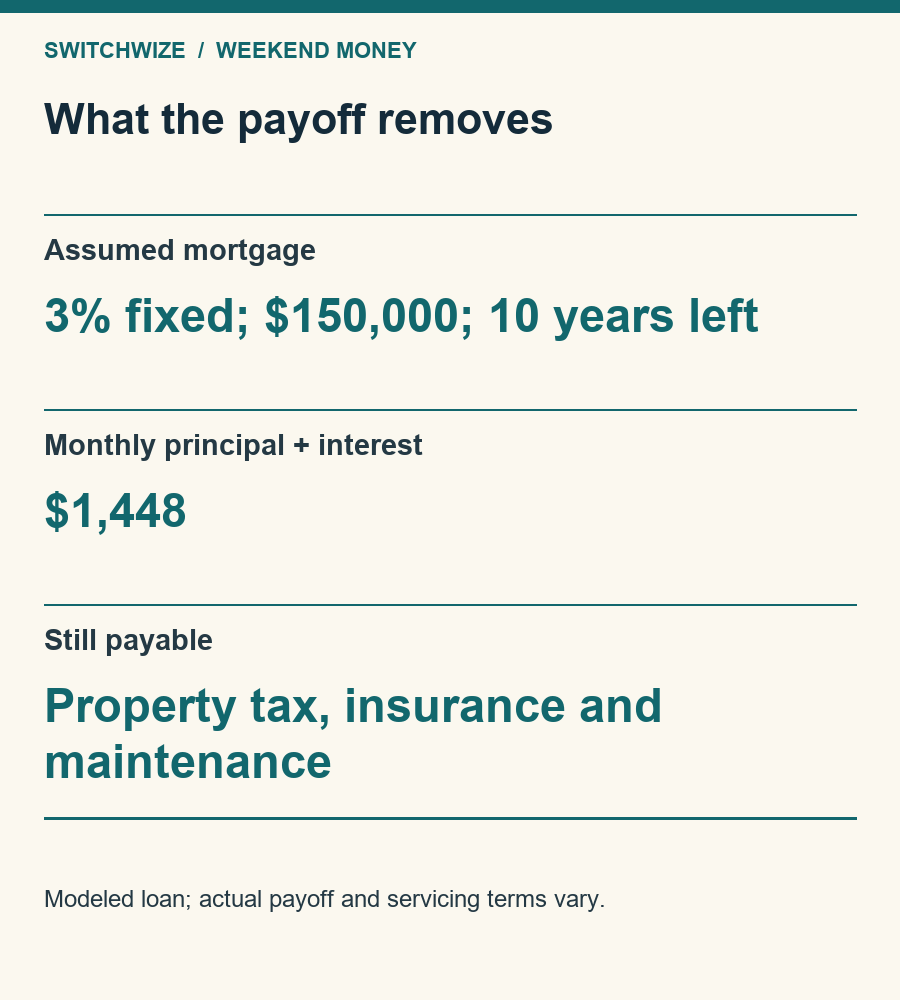
Assume the remaining mortgage has a fixed 3% rate and ten years left. Principal and interest come to about $1,448 a month. Total remaining interest is approximately $23,809 if they follow the schedule.
Eliminating that payment would be a meaningful improvement in monthly cash flow. It would not eliminate property tax, insurance, repairs or association fees.
The comparison between $39,247 of immediate tax and $23,809 of remaining interest is striking. It is also incomplete.
Leaving money in the IRA does not make future withdrawals tax-free. If the couple keeps the mortgage, they may withdraw IRA money over time to cover payments and owe tax then. A fair lifetime comparison must include those later taxes, investment returns, changes in income and what happens if one spouse dies.
Our finding is not that the payoff inevitably loses. It is that a large withdrawal can concentrate tax into one year, and a mortgage-rate comparison alone misses that cost.
Paying with cash solves a different problem
If the couple already has $150,000 in after-tax cash, they do not need an extra IRA withdrawal to cover tax. But paying the lender still gives up access to that cash and any interest it might earn.
That trade can be sensible. A smaller monthly obligation may matter more than maintaining a larger portfolio. Certainty is valuable, especially when income is fixed or investment losses would force difficult cuts.
The risk is using almost every liquid dollar to achieve it. Home equity can be valuable without being readily spendable. Accessing it later may require a sale or new borrowing on terms the homeowner cannot control.
A payoff plan should therefore include a separate answer to “What pays for the roof, the medical bill or the months when markets fall?” A house without a mortgage can still belong to a household short of accessible money.
A partial payoff needs a payment check
There is a third path between doing nothing and clearing the entire loan at once: reduce principal over several years.
Spreading IRA withdrawals can avoid concentrating all the income in one tax year. But it can also bring income into years when other deductions or premiums are affected. Calculate the actual years rather than assume smaller withdrawals always win.
And check the mortgage contract. An extra principal payment does not necessarily reduce the required monthly payment. It may shorten repayment instead. Some servicers offer a recast that recalculates payments after a qualifying lump sum, subject to their terms and fees. Confirm availability before building a retirement budget around it.
Refinancing is another transaction with its own closing costs, rate and repayment term. It should not be treated as a free way to change the payment.
Ask for four comparisons before sending the payoff
Ask your CPA or financial adviser to compare the same household under four choices: keep the loan, use after-tax cash, fund a full payoff from the IRA, or spread withdrawals and principal payments across years.
For each, compare the initial tax, liquid reserves, required monthly spending and estimated after-tax assets over a common horizon. Label return and future-tax assumptions. If Medicare applies, examine the relevant income years rather than reusing today’s premium thresholds for an unknown future year.
The preferred choice can change with the rate. A high-cost loan, ample cash or a strong need for predictable expenses can favor a payoff. A low-cost mortgage, thin reserves or an expensive IRA withdrawal can favor waiting or reducing the balance gradually.
Mark and Susan began with a $150,000 question. Their first calculation revealed a withdrawal closer to $189,000. Before making that transfer, they need to decide whether the monthly payment they remove is worth the tax concentration and the loss of accessible retirement assets.
Sources
IRS 2026 tax parameters · IRA distributions · Schwab mortgage-payoff discussion · CFPB: extra mortgage payments · Fannie Mae recast guidance · SSA Medicare income rules
Hypothetical 2026 federal model, not a product quote or lifetime optimization. No investment returns, state tax, Social Security, credits, itemized deductions, Medicare costs or prepayment charges are included in the displayed calculation. Exact payoff quotes include lender-specific dates and terms. Future IRA withdrawals may be taxable; initial tax and interest alone do not determine the lifetime winner.