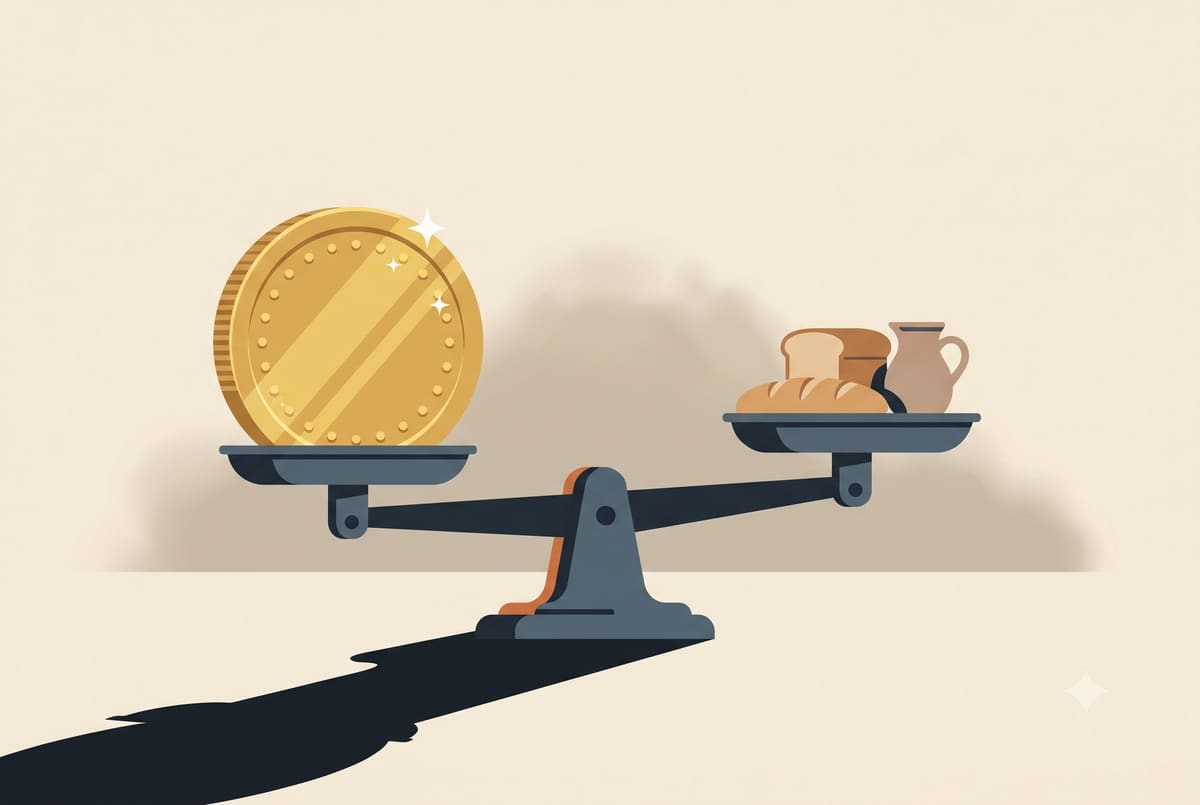
In 1928, a year before the crash that would make him famous for being wrong about something else entirely, economist Irving Fisher named a bias he'd spent years watching trip up savers and investors: "failure to perceive that the dollar, or any other unit of money, expands or shrinks in value." He called it money illusion. Ninety-eight years later, in May 2026, U.S. consumer sentiment fell to its lowest level since the modern survey began in 1952, lower than the depths of the 2008 financial crisis, lower than the peak of the pandemic, even as retail sales that same month ran nearly 5% above the year before. Fisher's century-old idea, and a thirty-year-old lab finding built on it, explain more of that gap than most of the coverage around it. They also point in the opposite direction of what actually happened. Understanding money illusion raise inflation psychology reveals why nominal wage gains feel hollow when purchasing power declines.
The gap that shouldn't exist
The University of Michigan's Consumer Sentiment Index, running continuously since 1952, fell to 44.8 in its final May 2026 reading, a third consecutive record low, below where the index stood at the start of every U.S. recession since the survey began. The proximate trigger was a Strait of Hormuz supply disruption that pushed gasoline prices sharply higher through the spring, a real shock, not a misperception. But retail sales in the same window were running about 4.9% above year-ago levels. Economists call the divide between how people say they feel and what they actually do "soft data" versus "hard data," and in 2026 that gap opened wider than it had in the index's 74-year history.
Some of this has a plainly rational explanation. The Bureau of Labor Statistics reported nominal average hourly earnings up 3.5% for the year ending June 2026. Real average hourly earnings, the number that actually reflects purchasing power, increased just 0.3% over the twelve months ending March 2026, then decreased 0.3% over the year ending April, then decreased 0.8% over the year ending May. Workers are getting nominal raises. They are not, on average, getting meaningfully richer. That's a genuine kernel of truth inside the anxiety. But the size of the sentiment collapse is too large to explain with a wage number bouncing within a point of zero.
The 1997 experiment that predicts the opposite
In 1997, psychologist Eldar Shafir, economist Peter Diamond, and psychologist Amos Tversky published "Money Illusion" in the Quarterly Journal of Economics, a paper since replicated multiple times, including with a Brazilian sample as recently as 2024. Their core finding, demonstrated across Princeton undergraduates, airport travelers, and shopping-mall visitors, is that people evaluate financial outcomes using the nominal dollar figure first, and only weakly correct for inflation, if at all.
Their most cited illustration involves two hypothetical employees. Ann works through a year with zero inflation and gets a 2% raise: her purchasing power genuinely rises by the full 2%. Barbara works through a year with 4% inflation and gets a 5% raise, a bigger number, but after inflation her real gain is only about 1%, half of Ann's. Objectively, Ann is better off. Asked who is happier and better treated, most respondents picked Barbara, the one with the worse real outcome, because the bigger sticker number won, even though the math said it shouldn't.
Run that finding forward and it makes a specific prediction: after several years of rising nominal paychecks, people should feel reasonably good about their financial position, complacent even. That's the opposite of a 74-year record low. The textbook bias points the wrong way. A related 1996 Brookings paper by George Akerlof, William Dickens, and George Perry found employers avoid nominal pay cuts even when an equivalent real cut, delivered quietly through inflation, draws no resistance, a mechanism that should also produce complacency, not anxiety. Two well-established theories both predict calm. Sentiment posted its lowest reading since Harry Truman was president.
What actually breaks the illusion
Three things appear to be doing that work. First, a raise is one event, once a year; a grocery bill or gas pump is a near-daily reminder, and losses register roughly twice as intensely as equivalent gains, per Kahneman and Tversky's foundational work on loss aversion: a single positive event is structurally outmatched by dozens of smaller negative ones. Second, some of it isn't illusion at all: the Hormuz-driven gas spike was a real, highly visible price shock at the most frequently observed price in American life. Third, the anxiety may be aimed at the future, not the past: the New York Fed's Survey of Consumer Expectations found one-year-ahead inflation expectations climbing to 3.7% in June 2026, the highest since September 2023, with medical care expected to rise 9.4% and rent 8.3%, both large, unavoidable categories. People may not be misjudging the raise they already got. They may be rationally dreading the bills they can see coming.
The illusion shows up outside paychecks too. Malcolm Baker, Robin Greenwood, and Jeffrey Wurgler documented in a 2009 Journal of Finance paper that stock splits, a purely cosmetic move that changes nothing about a company's actual value, reliably produce a short-term price pop, because investors perceive the lower per-share price as having "more room to grow." It's why cost-of-living clauses exist in union contracts and Social Security at all: an institutional admission that individuals reliably don't correct for inflation on their own, so the adjustment gets built in automatically instead. A related reference-point bias shows up in how savers judge today's interest rates against the peak they got used to, rather than the much lower decade that came before it.
Federal Reserve research adds a caution about trusting either the vibe or the data too much on its own. A Kansas City Fed study found sentiment surveys have historically added little to forecasting actual consumer spending, and Fed Chair Jerome Powell said much the same at a 2026 press conference: the link between sentiment and spending "has been weak." The 2026 numbers bear that out: record-low sentiment, alongside retail sales up nearly 5%.
None of this resolves into "don't worry, it's all in your head." Real wage growth genuinely has been close to flat, and that part isn't an illusion. It means the intensity of the anxiety is being amplified by mechanisms that have nothing to do with the number on your pay stub. Fisher's own diagnosis, written before he'd ever seen a smartphone or a same-day price alert, still names the fix: stop reading the dollar amount as the answer and start reading what it buys. If you want a cleaner read than either the sentiment headlines or the raw dollar figure, run your actual numbers and check them against inflation directly, rather than against how the last receipt or the last headline made you feel. And if the number still doesn't quiet the unease, that's a separate, well-documented pattern, not a sign the math is wrong.
This article is educational and is not financial or economic advice.
Quick answers
What is money illusion? The tendency to evaluate income, prices, and financial outcomes by their nominal, face-value dollar amount rather than their real, inflation-adjusted value, named by economist Irving Fisher in 1928 and demonstrated experimentally in a widely replicated 1997 study.
Why doesn't a raise feel like a raise right now? U.S. nominal wages grew about 3.5% for the year ending June 2026, but real, inflation-adjusted wage growth hovered near zero across BLS releases in spring 2026, alternating between slightly positive and slightly negative.
Shouldn't money illusion make people feel better about nominal raises, not worse? Yes, that's the counterintuitive part. The original 1997 research found people rate a bigger nominal raise as making someone happier and better-treated, even when a smaller nominal raise represented a larger real, inflation-adjusted gain. That effect predicts complacency about today's wage growth, not record-low sentiment.
Is consumer sentiment actually as bad as the headlines say? The University of Michigan Consumer Sentiment Index hit a record low in May 2026, the lowest since 1952, but retail sales the same month were running about 4.9% above the prior year, and Federal Reserve research has found only a modest historical link between sentiment surveys and actual spending.
Connect the lesson
Turn the article into a next step.
SwitchWize takeaway
Find your number, not the market's.
Run a Money Map to see how your cash, debt, and rates stack up against the best available options.
Start Money Map →Figures are third-party research and government data, not SwitchWize proprietary research: Shafir, Diamond & Tversky, "Money Illusion," Quarterly Journal of Economics (1997); Akerlof, Dickens & Perry, "The Macroeconomics of Low Inflation," Brookings Papers on Economic Activity (1996); Baker, Greenwood & Wurgler, "Catering Through Nominal Share Prices," Journal of Finance (2009); University of Michigan Surveys of Consumers (May 2026); U.S. Bureau of Labor Statistics Real Earnings releases (2026); New York Fed Survey of Consumer Expectations (June 2026); Federal Reserve Bank of Kansas City, "Forecasting with Feelings." Reviewed July 8, 2026.