- A six-month income interruption, a $20,000 commitment and a $10,000 unexpected bill leave $35,000 of a $100,000 balance beyond the modeled reserve.
- Extending that interruption to nine months cuts the remainder to $20,000.
- A household approaching retirement can have $108,000 beyond its modeled reserve and still have none assigned to long-term investing, because it expects to need the money in four years.
A household with $100,000 in the bank may have only $35,000 available for longer-term goals. The rest may already be needed for living expenses and commitments. Before putting idle cash to work, estimate those needs, test an income interruption, and compare the options for whatever remains after taxes. A high salary does not settle that calculation.
The SwitchWize cash deployment planner walks through that process. It can also show when the answer is to keep more cash.
These are hypothetical households, not client cases or recommended reserve amounts. Every scenario uses the calculator's actual arithmetic.
SwitchWize / Cash planning
Where does $100,000 go?
A six-month income interruption
- Living costs during interruption
- $30,000
- Expense due in month two
- $20,000
- Unexpected bill
- $10,000
- Remaining operating cushion
- $5,000
- Beyond the modeled reserve
- $35,000
$65,000 reserve + $35,000 remainder
The remainder still needs a purpose and a time horizon.
Illustrative scenarios · September 2026
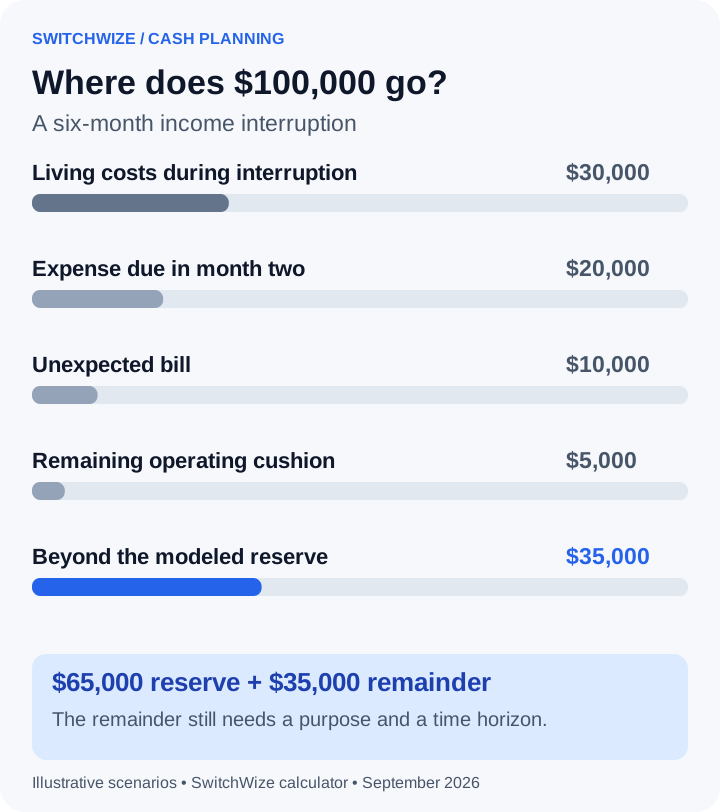
The first scenario reserves $65,000. The remaining $35,000 still needs to be assessed against other priorities and its time horizon.
Give the balance a purpose before choosing an account
Idle cash is money left without a purpose after accounting for spending, emergencies and known commitments. Cash for next quarter's taxes is not idle. Neither is a down payment awaiting a closing date. Both might earn more in a suitable account, but that is a different decision from investing them in assets that can lose value.
There is evidence for taking the reserve seriously. The CFPB's March 2022 study, Emergency Savings and Financial Security, combined survey responses with credit-record data. It found substantially healthier financial profiles among consumers with more emergency savings. This was observational research using 2021 survey responses, not a trial establishing that a particular reserve causes financial security. It also was not a study designed to set targets for high earners. CFPB report, introduction and methodology
The practical question is more specific: which bills would you still have to pay if income stopped, and for how long? A couple working for the same employer should consider whether both incomes could be interrupted together. A consultant should distinguish cash already earned from invoices that have not been paid.
The calculator begins with an editable six-month interruption. That default is a starting scenario, not a recommendation. Enter spending after any cuts you would realistically make; include debt minimums. Keep a dated expense out of that monthly total if you are also listing it separately as a planned expense.
Four situations that produce different answers
The examples assume income stops entirely at the start of the scenario, then returns to its stated level after the interruption. Monthly spending stays flat. Every listed commitment is confirmed, and the unexpected bill occurs in the first month. No extra debt payment or tax-advantaged contribution is selected.
The model retains at least one month of spending at month-end. It also funds the extra reserve selected in the consultant example. These assumptions are deliberately explicit: the outputs are only as useful as the household inputs.
SwitchWize / Cash planning
Same question. Different needs.
Cash held today, split by the modeled reserve. All bars use the same $300,000 scale.
Salaried household
$100,000 total
$65,000 reserved
$35,000 remaining
Homebuyer
$250,000 total
$221,000 reserved
$29,000 remaining
Consultant
$180,000 total
$141,000 reserved
$39,000 remaining
Approaching retirement
$300,000 total
$192,000 reserved
$108,000 remaining
Remaining cash is not automatically investable.
The homebuyer and retirement examples keep it unallocated.
Illustrative scenarios · September 2026
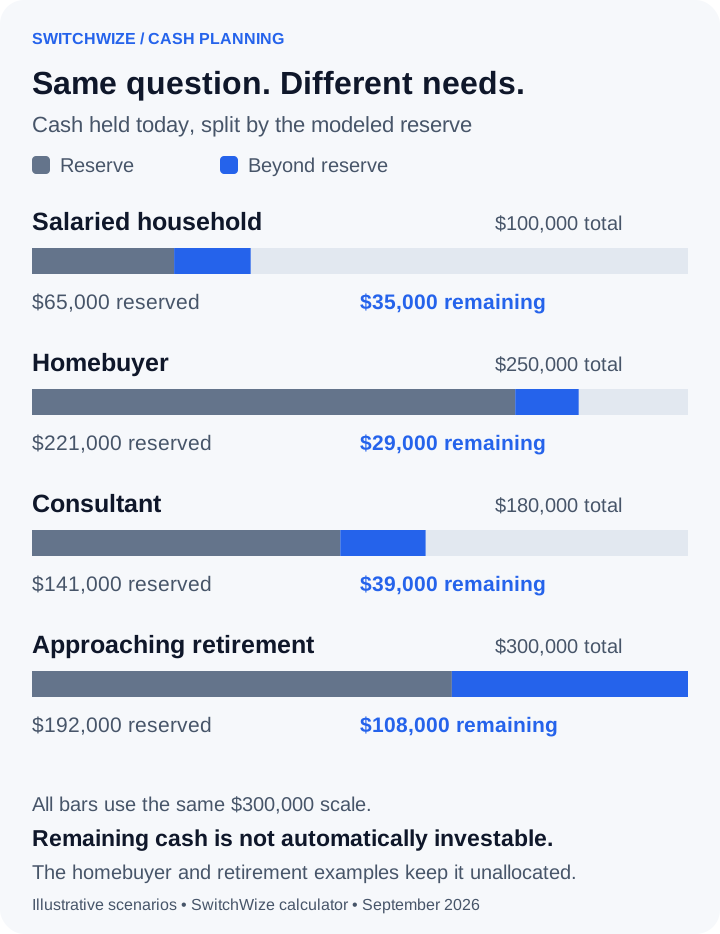
Source: SwitchWize calculator runs checked September 4, 2026. Cash beyond the reserve is not automatically suitable for investing. Full inputs follow.
1. A salaried household deciding what to do with a bonus
The household has $100,000 in accessible cash, spends $5,000 a month and normally takes home $8,000. It has a $20,000 expense due in month two. It tests six months without income and a separate $10,000 unexpected bill.
The reserve is $65,000: $30,000 for the six months of spending, the $20,000 commitment, the $10,000 bill and a $5,000 remaining operating cushion. That leaves $35,000 to consider for other priorities.
Try the change that matters: increase the interruption to nine months. The reserve becomes $80,000, leaving $20,000. If replacing the household's income would plausibly take longer, that assumption has more immediate importance than a small difference between savings yields.
Timing matters too. In a separate run, moving the $20,000 expense from month two to month twelve lowers the required reserve to $50,000 because income has resumed before payment. Marking that later expense as callable in month one takes the reserve back to $65,000. Do not assume a flexible payment date unless the commitment really allows it.
2. A homebuyer with a large balance and a short deadline
This household has $250,000, monthly spending of $8,000 and take-home income of $12,000. It needs $150,000 for a home purchase in month two and allows $15,000 for an unexpected bill. With six months of income lost, the reserve reaches $221,000.
The remaining $29,000 may look investable. But the household expects to need it within three years and does not accept investment losses on it. The planner therefore leaves it unallocated to long-term investing.
The SEC's investor guidance cautions against risky investments for goals five years away or less, because selling at the required date could crystallize a loss. That is relevant to a fixed closing deadline even if the buyer is comfortable with risk in a retirement account. SEC: Gauge Your Risk Tolerance
Before relying on the result, check whether the $150,000 includes closing costs and moving expenses. Then revise the monthly spending estimate for the new home. The planner uses a spending assumption; it does not automatically replace rent with the future mortgage payment.
3. A consultant whose income arrives unevenly
The consultant has $180,000 of personal cash, spends $7,000 a month and normally takes home $10,000 after business costs and taxes. There is a separate $30,000 commitment due in month three and a $20,000 unexpected-expense allowance.
Nine months without income requires a $120,000 reserve under these assumptions. Selecting three extra reserve months adds $21,000, taking the total to $141,000 and leaving $39,000.
That additional cash buys room for a slower recovery than the main scenario assumes. It is a chosen safeguard, not a research-derived optimum.
Keep business operating cash out of the personal balance. Include a personal guarantee or business capital commitment if it could require household money. A scheduled tax payment belongs among planned expenses; a possible future tax bill should not quietly become zero because its amount is inconvenient to estimate.
The calculator models one interruption beginning now. It does not simulate a succession of late-paying clients, changing revenue or repeated losses. If those are the concern, a business cash-flow forecast is needed alongside this household exercise.
4. A household approaching retirement
This household has $300,000 in accessible cash, spends $9,000 a month and currently takes home $16,000. It tests a twelve-month income interruption, a $50,000 expense in month six and a $25,000 unexpected bill. The modeled reserve is $192,000.
The household expects to need the remaining $108,000 in four years. The planner leaves it outside long-term investing, even if the user checks that they can tolerate losses.
That result answers a narrow question about the entered cash and horizon. It does not establish that the household can retire. A retirement plan must address income after work stops and withdrawals over a much longer period. Do not model permanent retirement as a temporary job loss followed by the return of a salary.
Life stage matters here because the use of the money changes. An age-based cash percentage would miss that distinction.
Choose where to hold the reserve before reaching for more return
For the part that must remain available, compare access as carefully as yield.
Insured savings: suitable for money that may be needed without a fixed date, provided the account's transfer arrangements meet that need. The standard FDIC limit is $250,000 per depositor, per insured bank, per ownership category. Multiple accounts in the same category at one bank share the limit. Use the deposit coverage calculator to investigate the account structure, then verify it with the institution. FDIC: Deposit Insurance FAQs
CDs and Treasury bills: compare maturity dates with the expense date. An early exit can involve a penalty or a market-price loss, depending on the instrument. The SEC's brokered-CD bulletin explains why selling a CD differs from withdrawing a bank deposit. TreasuryDirect requires marketable securities to be held there for 45 days before transfer or sale; selling requires transfer to a broker, dealer or bank. A TreasuryDirect holding should not be mistaken for cash that can immediately leave a checking account. TreasuryDirect: Selling a Treasury Marketable Security
Money market mutual funds: these are investment funds, not FDIC-insured bank deposits. Review their risks and access terms separately from a money market deposit account. SEC: Money Market Funds
The savings comparison and CD comparison can help identify accounts to investigate. This article's percentages are hypothetical examples, not current offers.
A higher quoted yield can leave less after tax
Suppose a savings account and a directly held Treasury both offer a comparable 4% annual effective yield. Assume a 32% federal marginal rate, an 8% state rate and no additional surtax.
SwitchWize / Cash planning
Equal yields. Different tax bills.
$50,000 held for one year at an assumed 4%. Taxes: 32% federal, 8% state, no surtax.
Savings account
$1,200
after-tax interest
4% × (1 − 32% − 8%) = 2.40% net yield
Direct Treasury holding
$1,360
after-tax interest
4% × (1 − 32%) = 2.72% net yield
$160 more after tax in this example.
Hypothetical comparable annual effective yields; no fees. Simplified tax math. Access and maturity still matter. Tax treatment: IRS Topic 403. Fund exemptions can differ.
Illustrative scenarios · September 2026
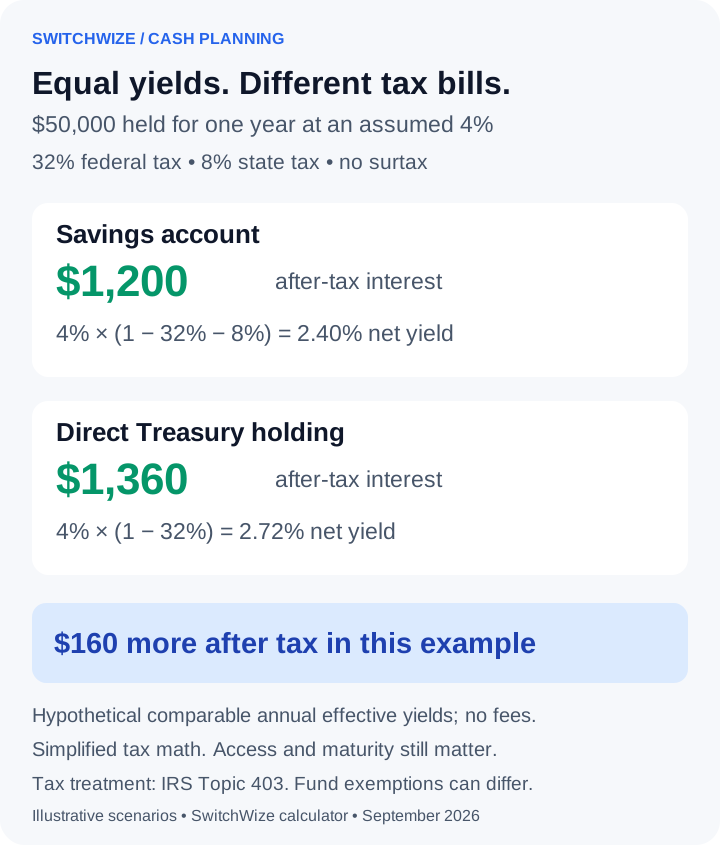
Using the planner's simplified calculation, the savings yield becomes 2.40% after tax; the Treasury yield becomes 2.72%. On a constant $50,000 balance for one year, that is $1,200 versus $1,360. A taxable savings account would need roughly 4.53% before tax to match the Treasury in this example.
Direct Treasury interest is subject to federal income tax but exempt from state and local income tax. Do not automatically extend that treatment to every Treasury fund. IRS: Topic 403, Interest Received
The calculation ignores deduction interactions and is not a tax-return estimate. Some high earners also owe the 3.8% net investment income tax. Confirm whether it applies before entering zero for the additional surtax. IRS: Net Investment Income Tax
Neither the tax advantage nor the extra $160 resolves an access problem. A payment due tomorrow still needs money that can arrive tomorrow.
Review debt and account eligibility before taxable investing
After funding the reserve, review expensive debt and any available employer match. For debt, the planner compares the entered APR with the after-tax savings yield. That limited comparison assumes non-deductible debt without prepayment penalties or forgiveness benefits. It does not weigh every possible use of the money or project an amortization schedule.
Next, check workplace retirement contributions, HSA eligibility and IRA rules. An HSA requires qualifying coverage and other eligibility conditions. Traditional IRA deductibility can be limited by income and workplace-plan coverage; direct Roth IRA contributions also have income limits. IRS: Publication 969, IRA deduction limits, Roth IRAs
Workplace deferrals generally come through payroll. Cash can support the household budget while those deferrals increase, but do not enter the deferral amount as a direct cash contribution in this calculator. Its contribution field is for independently verified direct IRA or HSA capacity. It does not assess backdoor Roth conversions or calculate contribution tax savings.
Investing the surplus now or gradually
Once a sum is genuinely available for long-term investing, delaying has a potential cost. Vanguard's February 2023 research compared immediate investing with three equal monthly installments. In its global-equity comparison using MSCI World returns from 1976 through 2022, immediate investing produced more wealth after one year in 68% of the rolling observations. That comparison assumed no interest on the uninvested portion during staging. It is a historical result, not a personal success probability. Vanguard: Cost Averaging, Figure 2 and notes
The paper also recognizes a behavioral reason for staging: a person strongly averse to losses might otherwise keep the entire amount in cash. A schedule can make a decision easier to carry out. It does not remove investment risk.
The planner lets you compare immediate, staged and delayed deployment under specified price paths. Its scenarios are not a replication of Vanguard's study. An early decline and an early rise can favor different entry schedules; none of the paths has an assigned probability. Choose an allocation you can sustain before debating its entry date. SEC: Asset Allocation and Diversification
For scale, the table below shows simple compounding for ten years, with no additions or withdrawals. Both returns are assumptions. Taxes, fees and inflation are excluded.
- At an assumed 1% annually
- $27,616
- At an assumed 5% annually
- $40,722
- At an assumed 1% annually
- $55,231
- At an assumed 5% annually
- $81,445
- At an assumed 1% annually
- $110,462
- At an assumed 5% annually
- $162,889
Calculation: starting amount × (1 + annual return)^10, rounded to the nearest dollar. This table illustrates compounding, not a comparison of equally safe products. A market investment can lose value. The interactive planner uses a separate model that includes entered tax and fee assumptions.
How to use the planner with your own numbers
- Your cash: enter accessible household cash, monthly spending and take-home income. Leave an unknown yield blank rather than inventing one.
- Your needs: list commitments and test an income interruption. Change the payment dates or extra reserve if an expense could arrive sooner or recovery could take longer.
- Your options: enter comparable yields and tax assumptions. Add only the debt or direct contribution capacity that you have checked.
- Your plan: specify when the remaining money will be needed. Inspect the adverse scenario before relying on the return illustration.
The current planner uses one horizon for the residual cash. If part is needed in three years and part in fifteen, list the near-term amount as a dated goal and apply the horizon to the genuine remainder. It does not build a separate investment portfolio for every goal.
Start with the cash deployment planner, then change the assumption you are least confident about. If the amount available for investing falls sharply, resolve that uncertainty before transferring the money.
Quick answers
Is $100,000 too much to keep in cash?
The balance alone cannot answer that. Cash committed to living expenses, emergencies or dated goals serves a purpose. In this article's hypothetical salaried-household scenario, $65,000 of a $100,000 balance is required by the selected stress test, leaving $35,000 before other priorities.
Can money needed within five years be treated as long-term surplus?
The planner does not assign residual cash to long-term investing when its entered horizon is five years or less. A longer horizon does not guarantee a positive return. Access needs and the ability to absorb losses still matter.
Does the calculator tell me which investment to buy?
No. It estimates a reserve from the entered scenario, compares certain after-tax yields and illustrates possible deployment paths. It does not choose a security, determine tax eligibility or replace a retirement plan.
How this guide was researched
The household cases are constructed examples verified against the SwitchWize calculator on September 4, 2026. They are not observations of actual clients or estimates of what a typical high earner needs. The model follows a 60-month ledger, with bills preceding income within each month. Later income can affect the reserve required for later obligations, so the result is not always a sum of every separate spending bucket.
Research and rules are linked at the relevant claims. Historical studies retain their original dates; assumed yields are not described as market data. No expert interviews or personalized eligibility reviews were conducted for this guide. See the calculator's methodology and the site's disclosure before using the examples to support a financial decision.
Frequently Asked Questions
Is $100,000 too much to keep in cash?
Can money needed within five years be treated as long-term surplus?
Does the calculator tell me which investment to buy?
What should I do after reading How Much of Your Cash Is Actually Available to Invest??
The 5-minute money briefing
One email per week. New rates, fed moves, and what to actually do about them.
No spam. Unsubscribe anytime.
Act on this: today's top savings



Ranked by SwitchWize's composite score. SwitchWize currently has no compensated product links.
Editorial review
What changed since the last update
Was this guide helpful?
Found an inaccurate, outdated, or missing claim? Report a correction. We verify reports against the relevant source before changing a guide or ranking.
