Reese opened a Roth IRA two weeks after turning 22, the same month student loan payments restarted. Fifty dollars a paycheck, on autopilot, into a target-date fund. By 23, the balance had cleared four figures, and for the first time a retirement account felt like proof that adulthood had actually started. This gen Z barbell money strategy, balancing retirement savings with present-day spending, captures the generation's contradictory but pragmatic approach to finances.
Fourteen months later, Reese pulled $2,600 back out of it. A lease renewal added $340 to the rent, a car repair ate the emergency fund in one afternoon, and a hardship withdrawal was the fastest legal way to close the gap. Three weeks after that, on a night that had nothing to do with any of it, Reese booked a $180 last-minute flight. Not because the money was there. Because a bad month makes "why not" feel like the only honest answer left.
(Reese is a composite. The story is illustrative. The math is real and typical.)
Two numbers, same generation
Say "Gen Z is bad with money" in any room of parents and nobody will argue. It's the label that survives every finance-influencer video stitched over a shopping haul: no plan, no patience, no idea what they're doing.
What that label leaves out: the same generation getting mocked for doom spending also started saving for retirement earlier than any generation on record. Twenty-three, on average, according to Nationwide Retirement Institute research published in January 2026. Millennials started at 28. Gen X at 34. Boomers at 40. Gen Z beat their own grandparents to a retirement account by nearly two decades of adult life.
Both facts are true at once. That overlap, not either fact alone, is the real story.
The detonating number
Here it is: 46% of Gen Z workers have already withdrawn money from a retirement account they started, according to a 2025 workplace survey from Payroll Integrations. Forty-two percent of those withdrawals went to pay off debt, not an emergency invented for the occasion. The generation that starts saving earliest is also the generation most likely to raid what it started, often within the first few years of the account existing.
The barbell nobody named
Start with the half everyone already believes. A Credit Karma survey from October 2024 found 37% of Gen Z adults admit to doom spending: buying things they don't need to blunt the anxiety of a bad news cycle, versus 27% of Americans overall. Forty-seven percent say they spend specifically to manage emotion, not need.
Now the half that never makes the clip. Clarify Capital surveyed Gen Z adults in 2024 and found "loud budgeters," the ones who openly turn down plans they can't afford instead of pretending otherwise, save an average of $629 a month. Nationwide's data shows the payoff compounds beyond the balance: savers who start by 25 report feeling confident about their future at more than double the rate of those who start later, 75% versus 46%. Bankrate separately found close to a third of Gen Z workers have saved nothing at all for retirement in the past two years, a gap its modeling puts at hundreds of thousands of dollars by the time it would have compounded.
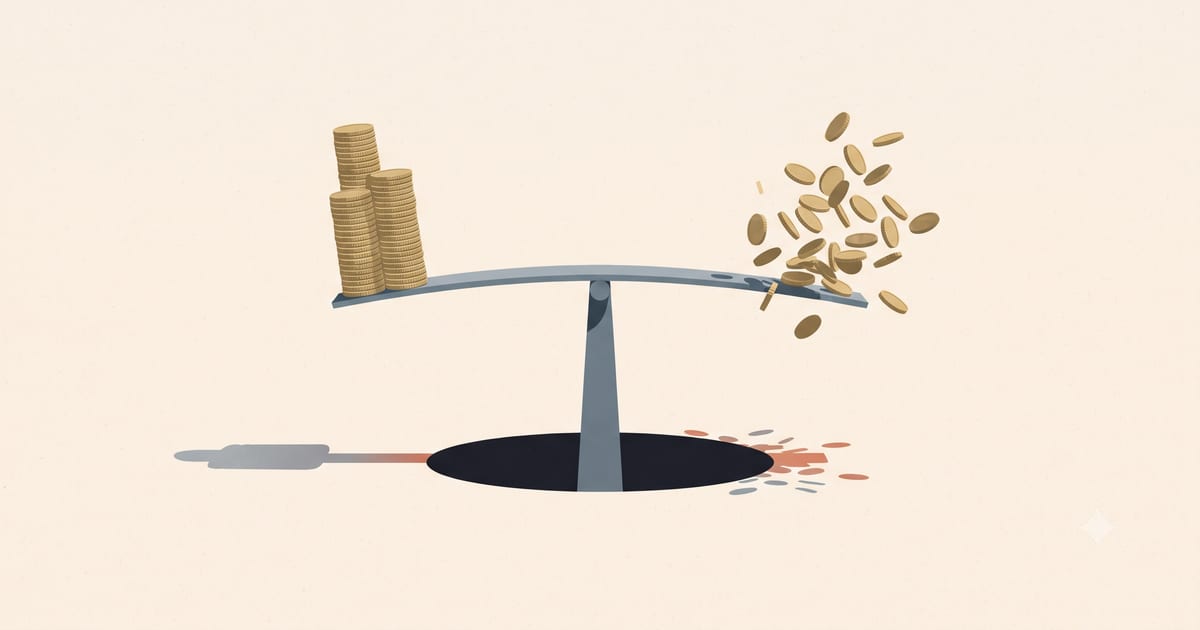
Read those numbers side by side and the generation doesn't look confused. It looks like it built a barbell without naming it: all in on the far end, starting earliest, saving hardest, when things are calm, and all in on the near end, spending fast, pulling the account, when the ceiling drops. Almost nothing gets held in the middle. A barbell is a legitimate strategy for a portfolio. It's a much worse one for a checking account, because the middle is exactly where the plan that survives a bad month has to live.
Why the instinct isn't irrational
The instinct makes sense once you see what produced it. Rent that jumps the way Reese's did. Layoffs that arrive by group message. A decade in which every stable plan handed down from a parent got quietly repriced. To someone who has watched five-year plans dissolve twice in ten years, committing everything to one five-year plan looks like the reckless move. Splitting the bet, locking some of it away early where a bad month can't reach it, keeping the rest loose where a bad month can, isn't confusion. It's hedging against a world that keeps changing the rules mid-hand.
A plan that only works when nothing goes wrong isn't a plan. It's a hope with a spreadsheet.
How to close the middle
- Open a high-yield savings account that exists for no other reason than to absorb a rent jump or a repair, separate from any retirement account.
- Automate a fixed transfer into it the same day retirement contributions go out, even if it starts small.
- Size the target to your last real shock expense, not a round number pulled from nowhere.
- Keep the retirement contributions and the occasional bad-week purchase; the fix isn't cutting either end of the barbell, it's building the middle. If you've already leaned on a Roth IRA as a backstop, treat it as the second line of defense, not the first.
The gap isn't the saving and it isn't the spending. It's the missing middle: nothing built specifically to absorb a shock before that job falls to the retirement account. Reese has since built that piece, a second account that exists for no reason other than to be the one that gets raided instead of the Roth. It didn't require giving up the retirement contributions, and it didn't require giving up the occasional bad-week purchase either. It required treating "start early" and "stay funded" as two separate jobs, because a generation already winning the first one still needs a plan for the second.
Reese is a composite character used to illustrate a typical pattern. The account balances and dollar amounts are hypothetical; the survey statistics on doom spending, loud budgeting, retirement-start ages, and early withdrawals are real as of the sources and dates cited above. This article is educational and is not financial advice.
Related reading: how much to save for retirement, sizing an emergency fund, and run your full Money Map.
Connect the lesson
Turn the article into a next step.
SwitchWize takeaway
Find your number, not the market's.
Run a Money Map to see how your cash, debt, and rates stack up against the best available options.
Start Money Map →Figures are third-party survey data, not SwitchWize proprietary research: Nationwide Retirement Institute (Jan. 2026), Credit Karma/Qualtrics (Oct. 2024), Clarify Capital (2024), Payroll Integrations "Employee Financial Wellness Report 2025," and Bankrate. Reviewed July 3, 2026. The Bankrate retirement-delay cost figure is described directionally pending a manual re-verification of the exact dollar figure. Reese is a composite; the account numbers are illustrative and typical, not a real individual's data.