
The short answer: Evaluate stock-lending income using actual loan days, your rate, taxes, voting rights and collateral terms rather than a headline annualized rate.
The advertised rate is only a starting point. Your share of the fee, days on loan, taxes and the protections you give up determine what the offer is worth.
By Jay Rege · November 4, 2026
A broker offers to pay you for shares you already own. You can remain exposed to the stock's gains, collect lending income and, under the program's terms, still sell.
The first question is not whether extra income sounds attractive. It is how much will actually reach your account.
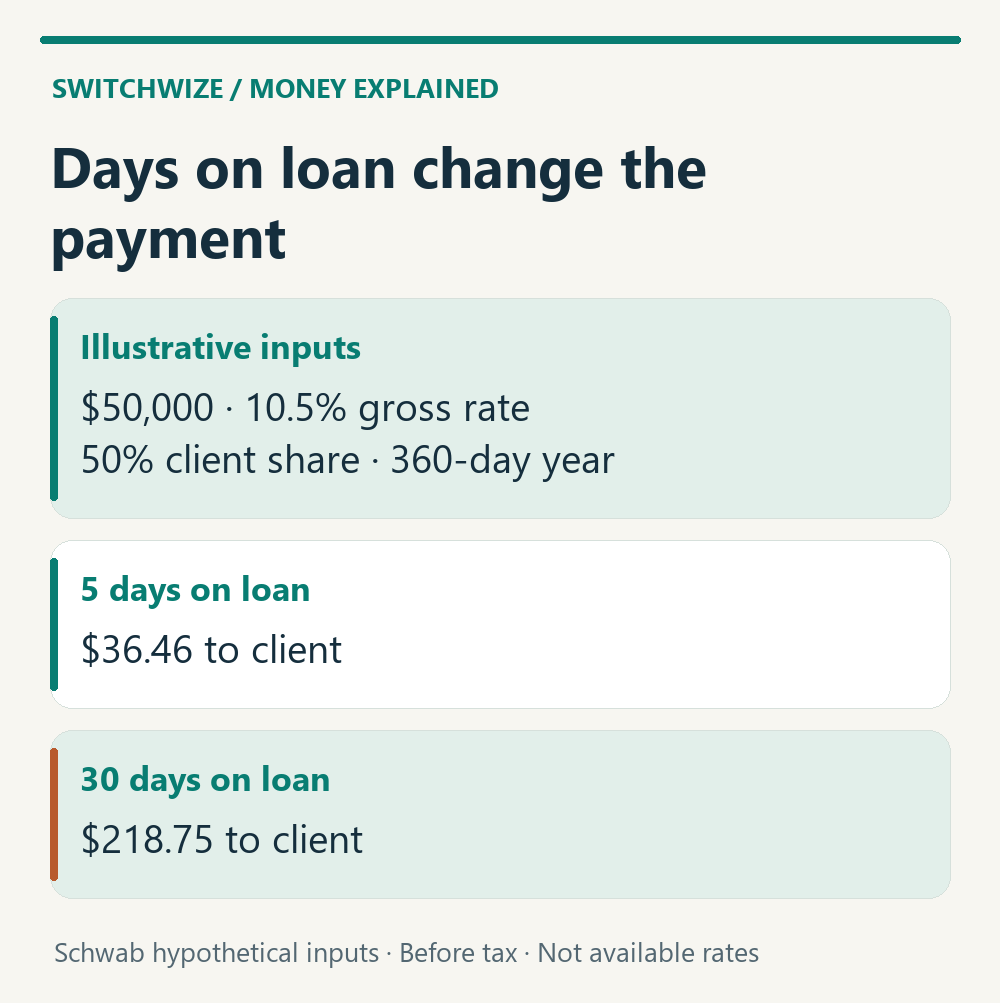
Schwab's published illustration makes the distinction unusually clear. It uses $50,000 of loaned shares and a 10.5% annualized lending rate on a 360-day basis. Its illustrative monthly lending income is $437.50. Half goes to Schwab and half to the client: $218.75 each. The 10.5% is an assumption in the example, not an offer available to every investor.
That is before asking how many days your shares would be borrowed, whether the rate would change and what taxes would do to the payment.
Apply the rate only to shares actually on loan
The SEC explains that fully paid lending programs let participating customers lend securities through their brokers. Borrowers may need shares for activities such as short selling. The customer gives permission under a lending agreement; merely owning an eligible stock does not establish that it will earn lending income.
Here is a calculation using Schwab's illustrative inputs. On $50,000, a 10.5% annual rate and a 50% client share produce about $7.29 per day for the client, using 360 days. Thirty days would produce $218.75. Five days would produce $36.46.
The difference is not a fee surprise. It is time. An annualized rate describes the pace at which income accrues while a loan is active; it does not guarantee a year of borrowing demand.
Our proposed way to evaluate an offer is simple: ask for the expected dollars over a realistic holding period, then compare them with the terms you are accepting. A large rate on a small amount borrowed for a few days can be a small payment.
The extra income does not remove stock-market risk
Fidelity describes its program as keeping the investor exposed to the market value of the shares. That is useful if you want to remain invested, but it also means a price decline can outweigh the lending income.
In a separate hypothetical example, a $50,000 stock position falls 5%, a $2,500 decline. A $218.75 lending payment would cover less than a tenth of that decline before taxes. This is not a prediction of a stock loss or a reason to sell. It shows why lending income should not be mistaken for protection of the investment itself.
The lending decision and the investment decision therefore need separate answers. Would you own these shares without the lending income? If not, a temporarily high rate should not do all the work of justifying the position.
Dividends, votes and account protection can change
The agreement matters because lending is not simply an extra yield attached to an unchanged account.
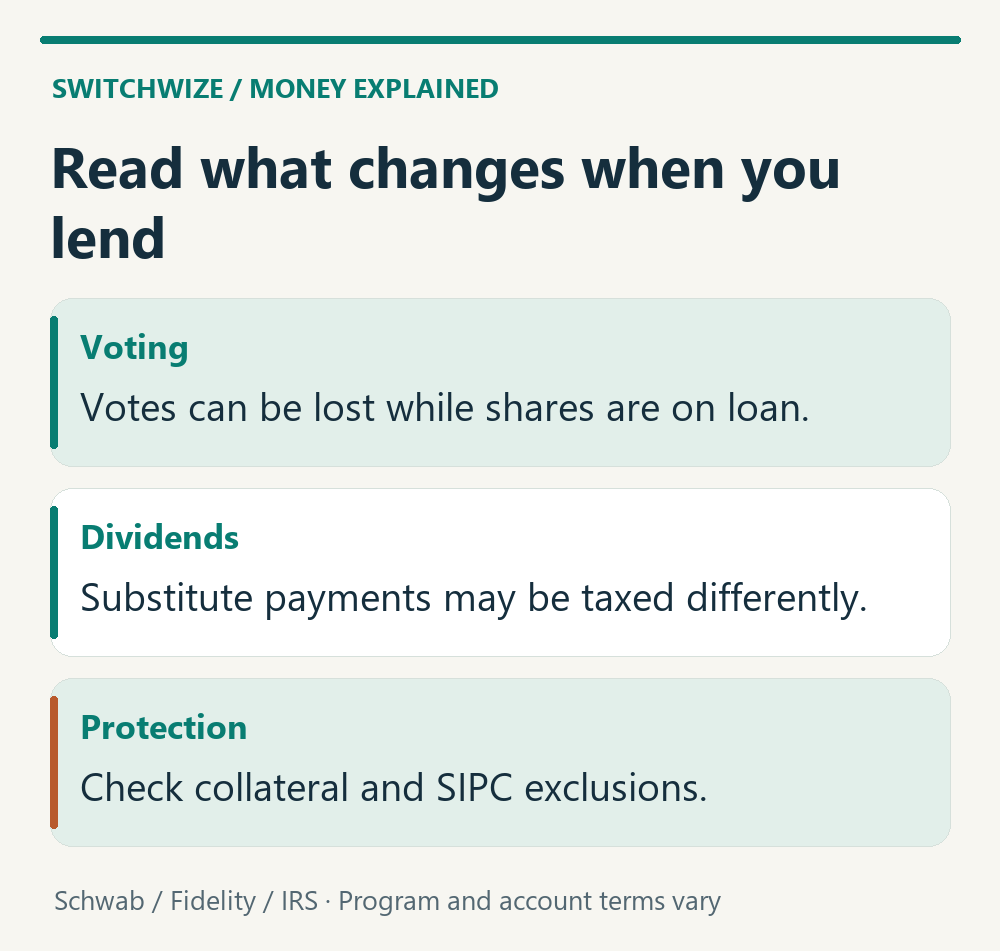
Schwab says voting rights are lost for shares while on loan. It also says the loaned securities position is not covered by SIPC, with the loan instead backed by collateral under the program. The investor should understand the counterparty and how collateral can be accessed if it defaults, rather than treating collateral as an assurance that nothing can go wrong.
Fidelity likewise warns that shares on loan lack SIPC coverage. It says cash received instead of a qualified dividend can create an additional tax burden. For eligible taxable accounts, it describes a tax adjustment, while warning in its investor document that the adjustment may not cover the full additional burden.
The IRS addresses substitute payments in its investment-income guidance. A payment replacing a dividend may not receive the same treatment as a qualified dividend. The tax effect depends on the payment and the investor, so compare the actual after-tax result rather than assuming an identical outcome.
These are reasons to read the agreement, not proof that lending is always a bad deal. A well-understood payment may reasonably compensate an investor for the trade-offs. Another investor may value the vote, tax treatment or simpler account more.
Compare statements, not headline rates
For a current offer, write down the security, amount likely to be borrowed, rate paid to you, day-count convention and how the rate can change. Then reconcile the actual loan days and income on the statement. Do not multiply a rate by the entire portfolio unless the whole portfolio is actually earning that rate.
Fidelity lets investors monitor lending activity and recall loans, while Schwab describes selling through its supplemental account. Procedures differ. If you may need to sell promptly, understand your broker's steps before enrolling, including any relevant settlement or recall constraints in your agreement.
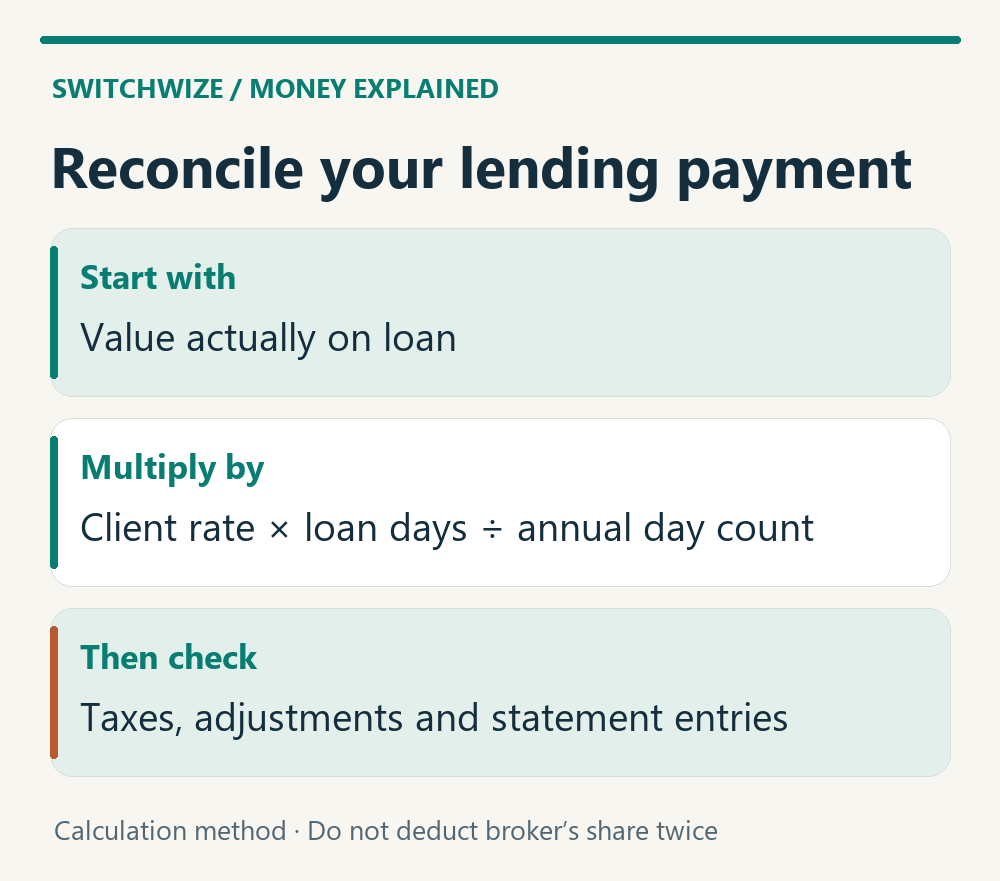
Ask whether a displayed rate is the gross borrowing rate or already your rate. Deducting the broker's share twice understates income; ignoring it when it has not been deducted overstates income. That small labeling question can change the comparison immediately.
The useful offer is one you can reconcile to dollars, dates and terms. Before agreeing to lend, ask the broker to show exactly how the quoted rate would appear on your statement after one week. That is a better starting point than annualizing income you may never receive.
Sources
Schwab: program FAQ and illustrative income; Fidelity: fully paid lending; Fidelity: investor program document; SEC: securities lending; IRS Publication 550.
Checked November 4, 2026. U.S. fully paid securities lending, not margin borrowing or a recommendation to buy a hard-to-borrow stock. Income examples use disclosed hypothetical inputs; actual rates, revenue shares, loan days, taxes and program terms vary. No customer account or current personalized lending offer was tested. Tax examples are illustrative, not an individualized review.