- The Fed held rates at 3.50 to 3.75% on June 2026, but its own projections turned toward hikes: the median end-2026 rate rose to about 3.8% and several officials now expect an increase, not a cut.
- On a $25,000 balance, the gap between the national average savings rate and a top high-yield rate is worth roughly $1,150 a year, and the new projections mean that gap is not closing.
- The reason to move idle cash was never the next Fed decision. It is the spread between what you earn now and the best available rate, and that spread is wider than the Fed's whole rate range.
For two years the advice to leave cash alone leaned on one quiet assumption: rates were high by accident and would soon come back down, so switching accounts was not worth the bother. The June 2026 Fed meeting retired that assumption. Now that the fed rate decision savings 2026 outlook has shifted, that rationale has evaporated entirely.
In June 2026 the Federal Reserve held the federal funds rate at 3.50 to 3.75%, its fourth straight hold. The number markets actually watch, the committee's own projection for where rates land by year end, moved the other way. The median rose to about 3.8% from 3.4% in March, and several officials now pencil in at least one hike before the year is out. The dot plot that the market read as a glide path down now points up. Savings rates on this page were last verified recently.
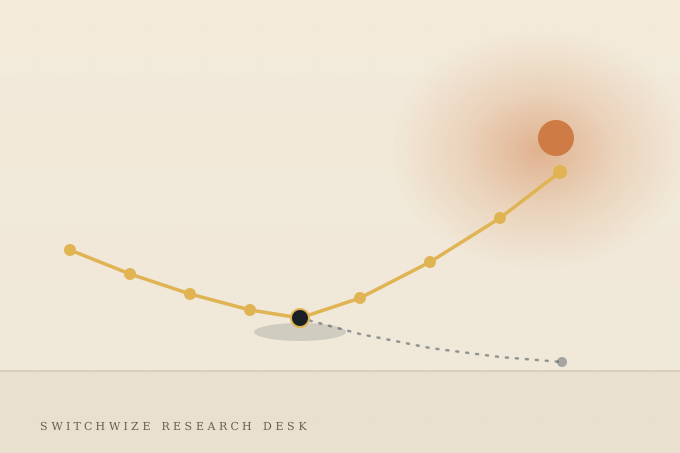
The short answer: the June 2026 Fed projections lean toward hikes, not cuts, so waiting for cuts to lift your savings rate no longer pays. Cash left at a big-bank rate keeps losing the full gap to the top available rate every month.
The number that decides your cash income is not the Fed's
Here is the part the headlines bury. Whether the Fed holds, hikes, or cuts a quarter point, none of it changes the single biggest fact about your cash: the gap between what a typical big bank pays and what a top account pays.
The national average savings yield is 0.38% APY, per FDIC data. The best high-yield accounts pay 4.20% APY. That spread is wider than the Fed's entire target range. A 25 basis point Fed move is a rounding error next to it.
Put it in dollars, which is the only unit that matters:
What the gap costs per year, by balance
- Interest at national average
- …
- Interest at top rate (4.20%)
- …
- Annual gap
- ~$460
- Interest at national average
- …
- Interest at top rate (4.20%)
- …
- Annual gap
- ~$1,150
- Interest at national average
- …
- Interest at top rate (4.20%)
- …
- Annual gap
- ~$2,310
- Interest at national average
- ~$380
- Interest at top rate (4.20%)
- ~$5,000
- Annual gap
- ~$4,620
On $25,000, the gap runs near $1,150 a year. That is the SwitchWize Bank Gap Index, the dollar cost of staying put, and you can see the live figure on the Bank Gap Index. The June 2026 projections do not shrink it. If anything, a higher-for-longer path keeps top yields elevated while big banks keep paying close to nothing, so the gap holds or widens. The balance ladder above is illustrative; the rate gap calculator works out the precise number for whatever you actually hold.
Why "wait for cuts" was always the wrong frame
The instinct to wait assumes your account improves when the Fed eases. A 0.40% account does not improve. Big banks barely moved their savings rates up when the Fed hiked from near zero, and they will not move them down in a way that helps you either. The national average rate is a misleading benchmark precisely because it is dragged down by the largest banks paying as little as 0.01%.
So the waiting math is lopsided. Each month you wait, you give up about one twelfth of the annual gap, which on $25,000 is close to $96. The thing you are waiting for, a Fed cut that lifts your low-rate account, is not coming. You can model your own number with the loyalty tax calculator, or project the multi-year compounding with the HYSA calculator.
Higher-for-longer changes the savings-versus-CD call too
When the market expected cuts, the textbook move was to lock a long CD and freeze today's rate before it fell. A hawkish projection weakens that case. If rates hold or rise, a liquid high-yield account keeps paying near current levels without locking your money for a year or more. You keep the option to move, and you give up very little yield to keep it. The deeper version of that decision lives in the work on what to do with idle cash when the Fed is not cutting and on whether falling-rate fears should change your plan.
What the June pivot means for your cash
- Move
- Move now
- Why
- The gap already costs hundreds to thousands a year and a hawkish Fed does not close it.
- Move
- Stay put
- Why
- You are collecting close to the best available rate; check back quarterly, do not chase basis points.
- Move
- Wait on locking
- Why
- A liquid account gives up little yield today while keeping the option open if the outlook shifts again.
- Move
- Optional
- Why
- The dollar gap is small in absolute terms, though the same math applies as balances grow.
Quick answers
Did the Fed raise rates in June 2026? No. It held at 3.50 to 3.75%, the fourth straight hold. The shift was in the projections, where the median end-2026 rate rose to about 3.8% and several officials moved to expecting a hike.
Should I wait for cuts before switching? No. A low-rate account does not improve when the Fed eases, and the gap to a top rate, about $1,150 a year on $25,000, costs you every month you wait.
Does higher-for-longer favor savings or CDs? It favors keeping cash liquid in a high-yield account, because holding or rising rates mean top accounts keep paying near current levels while you keep access to your money. Compare current high-yield savings rates before deciding where the balance sits.
Sources for the rate and projection figures
The Fed decision and dot-plot figures in this piece come directly from the June 2026 FOMC materials and are cross-checked against Federal Reserve statistical releases for the prevailing funds rate. Savings APY figures are pulled daily from bank websites and reconciled with FDIC national rate data. Dollar figures are illustrative and rounded; your result depends on your balance and the current rate. This is educational information, not personalized financial advice.
Source: S&P Capital IQ Pro; SNL Financial Data. Calculations: FDIC. Reflects the $2,500 product tier for savings and interest checking accounts.
Frequently Asked Questions
Did the Fed raise rates in June 2026?
Should I wait for rate cuts before moving my savings?
What does 'higher for longer' mean for a high-yield savings account?
Is now a bad time to open a high-yield account because rates might fall later?
Act on this: today's top savings


Ranked by SwitchWize's composite score. We may earn a referral fee, and it never changes the ranking order.
Editorial review
What changed since the last update
Was this guide helpful?
Found an inaccurate, outdated, or missing claim? Report a correction. We verify reports against the relevant source before changing a guide or ranking.
