Every quarter, the Federal Reserve Bank of New York (the New York Fed) publishes a single figure that reporters and financial newsletters treat as a verdict: the delinquency rate, the share of a given kind of debt that is 90 or more days past due. On May 12, 2026, its Household Debt and Credit Report delivered three of those verdicts at once. Credit card balances 90-plus days delinquent reached roughly 13.1%, the highest share in sixteen years. Auto loan delinquency reached 5.6%, the highest level the bank says it has ever recorded, past a mark set in the 2010 aftermath of the 2008 crisis. Student loan delinquency hit its worst level since the pandemic-era payment pause ended. Together, these three categories illustrate how household debt delinquency 2026 reflects a crisis of existing obligations rather than fresh borrowing gone wrong.
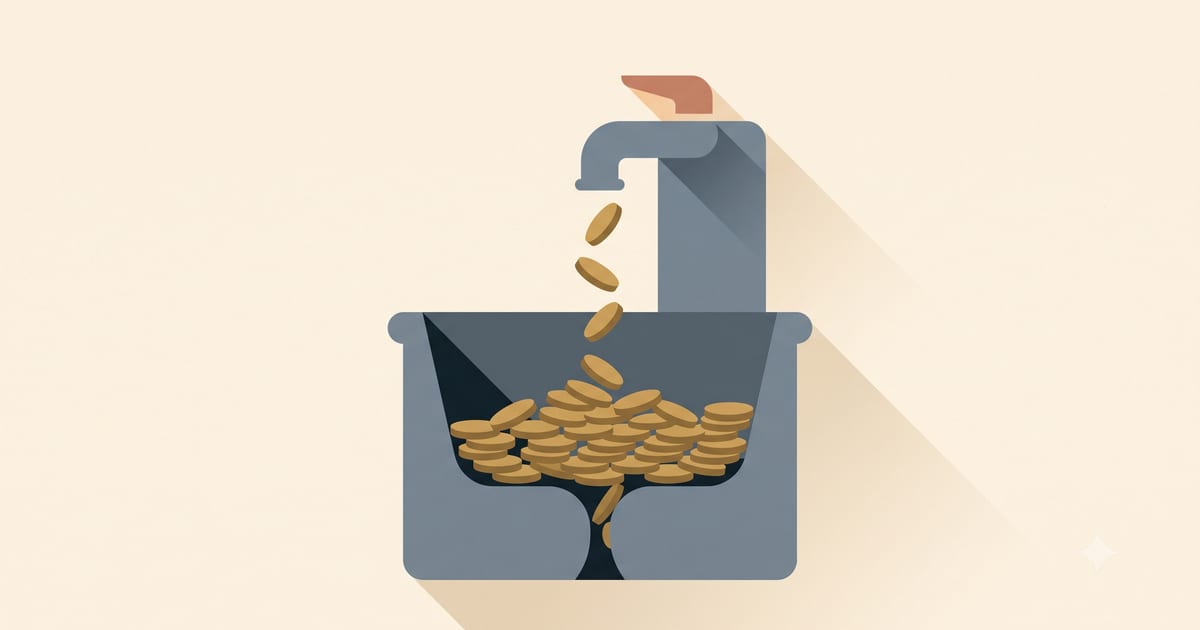
A delinquency rate is treated like a thermometer: one reading, rising means worse, falling means better. It behaves more like a bathtub. The water level can rise because the tap is open wider, more people falling behind for the first time, or because the drain has slowed down, people already behind taking longer to climb back out. Both produce an identical headline. Only one describes a fresh wave of financial distress, and the Fed's own supplementary data points mostly toward the second explanation.
The record everyone quoted
Total U.S. household debt reached $18.8 trillion in the first quarter of 2026. Credit card balances stood at $1.25 trillion, with about 13.1% of that balance seriously delinquent. Auto loan and lease balances reached close to $1.68 trillion, with 5.6% seriously delinquent, edging past the 5.3% set in the fourth quarter of 2010. Student loan balances held essentially flat at $1.66 trillion, but serious delinquency reached 10.9%, up sharply from 8.0% a year earlier. Every one of those figures is genuine. What almost never makes it into the retelling is what each number is actually built from.
What a delinquency rate is actually counting
A 90-plus-day delinquency rate is a stock measure, a snapshot of how much money currently sits in a bucket, compared against the total. It says nothing on its own about the two flows that produced that snapshot: how fast new dollars are entering the bucket, and how fast old dollars are leaving it by curing back to current. A bathtub filling because the tap is open wide looks identical, in a single photo, to one filling because the drain has clogged.
The New York Fed also publishes the second measurement, a transition rate, the share of balances that were current or only lightly late at the start of a quarter and slipped into serious delinquency by the end of it. For credit cards specifically, that rate did not worsen alongside the headline figure. It improved, ticking down to 8.6% annually from 8.7% the quarter before. A rising stock of delinquent balances next to a flat or improving flow of new ones isn't the signature of an accelerating crisis. It's the signature of a backlog, a pattern that shows up in the same rate data driving the broader credit card debt conversation: borrowers who fell behind a while ago, having a harder time climbing back out.
Why the drain, not the tap, explains auto loans
A Federal Reserve Bank of Philadelphia research team went looking for the mechanism directly and published its findings in April 2026. Its conclusion: the headline auto delinquency rate "likely overstates the degree to which auto borrowers' financial health is currently deteriorating." The flow into early-stage delinquency has declined modestly since a 2024 peak, and flow into serious delinquency has held steady for over a year. What moved is the exit side, a decline in the rate at which delinquent borrowers cure back to current, not an acceleration of new distress.
There's a second distortion layered on top: which borrowers the "record" actually describes. The 32-year-record framing that spread widely in early 2026, subprime borrowers' 60-plus-day rate hitting 6.90% in January, the worst since 1994, is real, and it's specifically about subprime and deep-subprime loans, only about 15% of the $1.68 trillion auto market at origination. Prime borrowers, the other 85%, sat at just 0.42%, below even the 2008 recession's 0.9% peak. Blend every tier together, and the combined rate in March 2026 was 1.49%. A genuine 32-year record inside a 15% slice of the market gets repeated as though it describes the whole thing.
If rising delinquency were translating into real losses, the clearest place it would show up is repossession. A January 2025 study from the Consumer Financial Protection Bureau, covering nine major lenders and loans from 2018 to 2022, found more than 99% of financed vehicles stayed with their borrowers throughout the study period, over 98% even among deep-subprime loans. That vintage ends before the recent spikes, so it isn't proof today's rate matches exactly, but it's the strongest available evidence connecting delinquency to actual loss, and it points the same direction as the transition-rate data.
A record built by a calendar
Student loan delinquency has a wrinkle the other two don't: for more than four years, it was largely not being measured at all. Payments paused in 2020. When the pause ended in September 2023, a twelve-month "on-ramp" shielded missed payments from being reported as delinquent. That on-ramp expired on September 30, 2024, and only after that date did the Department of Education, working with the Treasury, resume involuntary collections, the wage garnishment and offset process now reaching millions of defaulted borrowers. Comparing this year's rate to years when the same measurement simply wasn't being taken produces a record almost by construction, regardless of how much real hardship actually grew alongside it. Some of that jump, from 8.0% to 10.9%, is plausibly real strain layered on top of the calendar effect. This isn't arguing that part away, just naming how much of the size of the jump is a reopened reporting window rather than new hardship.
The honest complication
None of this means household finances are fine. A borrower stuck in serious delinquency for an extra year, even one who keeps the car, still accrues real cost: fees, collection calls, a longer scar on a credit report. A backlog is a more precise diagnosis than a fresh, economy-wide collapse. It is not a more comfortable one for the people caught inside it. It's also worth being honest about the limits here: the cure-rate research is specific to auto loans, credit cards only have the New York Fed's own transition-rate data pointing the same direction, without a matching named study attached, and some real share of the student loan jump is likely genuine hardship this piece can't cleanly separate from the calendar effect.
The number worth watching
The figure that matters isn't the one that makes headlines. It's the transition rate, sitting one table below the stock figure that gets screenshotted, the same distinction that separates genuine new distress from a stacked, invisible debt load in Buy Now, Pay Later data. A rising transition rate signals fresh distress. A flat or falling one, next to a rising headline rate, signals a backlog, borrowers who fell behind a while ago finding the path back to current, a workable modification, a refinance, a tax refund large enough to catch up, narrower than it used to be. If you're behind on a card or a car payment right now, that path back, not the national headline, is the thing worth chasing down with your servicer this quarter.
This article is educational and is not financial advice.
Quick answers
Is household debt delinquency really at 2008-crisis levels in 2026? In one specific measure, yes: credit card balances 90 or more days delinquent reached a share last seen near the 2008 financial crisis, about 13.1%. But the rate at which new borrowers newly fall behind each quarter, the New York Fed's own transition-rate measure, actually improved slightly over the same period, pointing to a backlog of already-struggling borrowers rather than a fresh wave of new distress.
Why did auto loan delinquency hit an all-time high if repossessions stayed rare? The "all-time high" figure blends a genuine 32-year record among the smallest, riskiest slice of the market, subprime and deep-subprime loans, roughly 15% of originations, with prime borrowers whose rate remains below its 2008 peak. Philadelphia Fed researchers separately found the headline rate is driven by a slowdown in cures, not an acceleration in new distress, and a January 2025 CFPB study found more than 99% of financed vehicles stayed with their borrowers throughout its study period.
Why did student loan delinquency jump so sharply? A twelve-month "on-ramp" that shielded missed federal payments from credit reporting expired on September 30, 2024. Comparing today's rate to the years when missed payments simply weren't being counted mechanically produces a record, separate from how much borrower hardship actually increased.
What number should I actually watch instead of the headline delinquency rate? The transition rate, the New York Fed's own measure of how many new balances are newly slipping into delinquency each quarter, published in the same report as the headline figure. A rising transition rate signals fresh distress. A flat or falling one, next to a rising headline number, signals a backlog instead.
Connect the lesson
Turn the article into a next step.
SwitchWize takeaway
Find your number, not the market's.
Run a Money Map to see how your cash, debt, and rates stack up against the best available options.
Start Money Map →Figures are third-party research and government data, not SwitchWize proprietary research: Federal Reserve Bank of New York, Household Debt and Credit Report, Q1 2026 (May 12, 2026); Federal Reserve Bank of Philadelphia, Consumer Finance Institute, "Do Recent Auto Loan Delinquency Rates Overstate Borrower Distress?" (April 2026); American Financial Services Association, "Stop Misreading Auto Data" (April 16, 2026); Wolf Street auto loan analysis using Fitch Ratings and Equifax data (May 19, 2026); Consumer Financial Protection Bureau, "Repossession in Auto Finance" (January 2025); U.S. Department of Education and NPR reporting on the resumption of federal student loan collections (December 2025). Reviewed July 15, 2026.