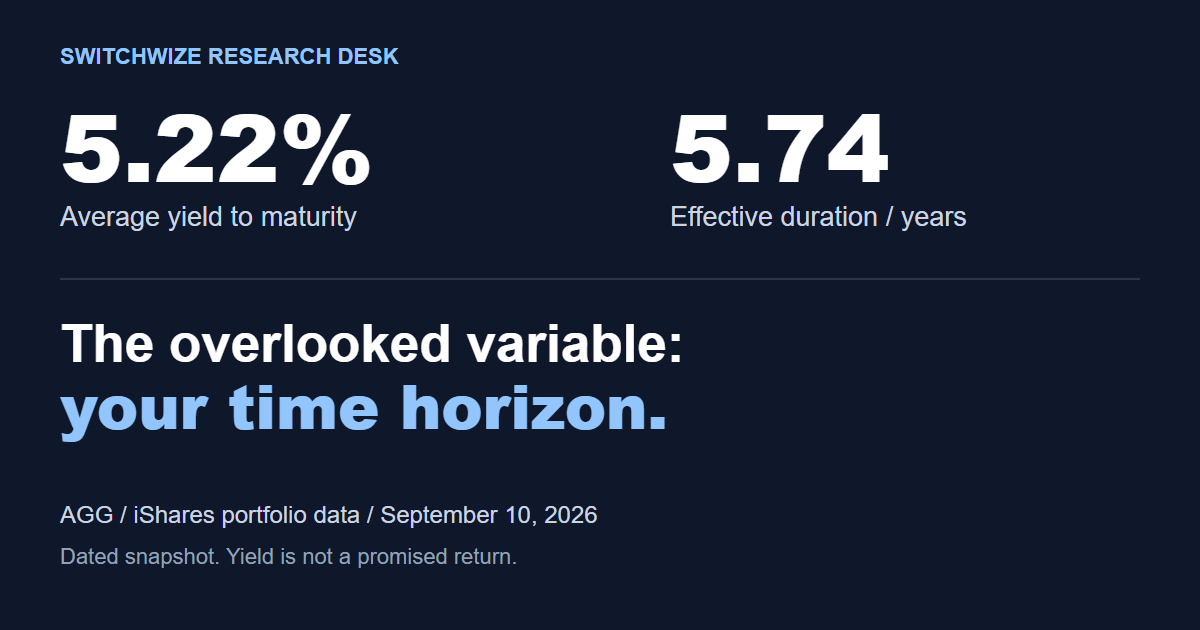
Update, October 25, 2026. We rechecked the bond fund example. On October 22, iShares reported AGG's average yield to maturity at 5.29% and its effective duration at 5.71 years, against 5.22% and 5.74 years on September 10. The 30-day SEC yield was 5.05%. On the same day, Treasury yields were 4.22% for 3 months, 4.41% for 1 year and 4.96% for 10 years (FRED). The percentage and dollar figures in the visuals below use the September 10 snapshot and have not been redrawn.
A bond fund can be a sensible long-term investment and a poor place for a down payment due in six months. A high yield is less useful if you have to sell at a loss to make the down payment. Understanding cash equivalents duration and yield helps you match your investment timeline to your financial goals.
The iShares Core U.S. Aggregate Bond ETF, or AGG, reported a 5.22% average yield to maturity and 5.74 years of effective duration, both dated September 10, 2026. Yield describes the income and payments priced into the bonds. Duration estimates how much their prices might change when market yields move. Neither tells you what you will earn by the day you need to sell. iShares portfolio data
Here is what that means for $10,000 invested in the fund. A hypothetical one-percentage-point rise in the relevant yields implies an immediate price decline of about $574, before income. A comparable fall implies an approximate gain of the same size. This shows how a change in yields could affect the price. It does not predict what will happen.

The useful question is therefore more specific than whether bonds are attractive: Can this money stay invested through a price decline, or must it fund a payment on a particular date?
When will you need the money?
Imagine two people considering the same fund. One needs the money for a house closing in six months. The other is building the bond allocation of a retirement portfolio with no planned withdrawal for a decade. These are hypothetical investors, not reported case studies.
The homebuyer could be left without enough for the down payment. The retirement investor may have time to buy more bonds at lower prices and earn higher yields on those purchases. It does not eliminate risk or ensure a profit. Vanguard on higher yields and investment horizons
A person can be both investors at once: long-term retirement money in one account, next year's tuition in another. Money in the same account can be needed at different times. That waiting period is what investors call a “time horizon.”
Start with the payment, then work backward to the investment.
What 5.74 years actually means
Duration is stated in years, but it is not a withdrawal restriction, a maturity date, or a countdown to recovering a loss. Here, duration helps estimate how much a bond or fund price could rise or fall when yields change:
Price change (%) ≈ −duration × yield change (percentage points).
A duration of 5.74 and a yield increase of one percentage point give an estimated price change of −5.74%. Multiplying by $10,000 gives −$574. A half-point increase gives approximately half that price effect. FINRA's duration explainer
There are three limits to that arithmetic. It estimates an immediate price change, not a total return over a year. It assumes the yields affecting the fund all change by the same amount. A Fed rate decision does not necessarily do that. And it holds duration fixed for the estimate; actual duration and cash flows can change.
AGG also holds corporate and mortgage-backed debt. Its price can also change if investors become more worried about borrowers repaying their debts, or if homeowners repay mortgages sooner or later than expected. Duration alone does not capture all of those risks. AGG prospectus and fund documents
Do not subtract 5.74% from 5.22% and call the result a one-year return forecast. One number describes immediate price sensitivity; the other is a portfolio yield measure. The timing of rate changes, distributions, reinvestment, expenses, and changes in holdings all matter.
A steady balance does not mean steady interest
A savings balance can remain steady while its income falls. A fixed-rate bond can keep making the same interest payments while its resale value falls. These are different forms of stability.

This distinction helps separate five products that often appear on the same shortlist:
High-yield savings. A bank deposit has no bond-style daily market price for the depositor. Its interest rate can change. Eligible deposits are FDIC-insured up to $250,000 per depositor, per insured bank, per ownership category; accounts in the same category at one bank are combined. That protection does not freeze the APY. FDIC coverage
Treasury bills. Bills are issued with terms from four to 52 weeks, bought at a discount or at face value, and repay face value at maturity. A bill due before a known expense can avoid the need to sell early. When it matures, buying another bill means accepting whatever yield is available then. TreasuryDirect: bills
Treasury notes. Newly issued notes run from two to ten years and pay fixed interest every six months. They can trade below your purchase price before maturity. A note that repays you in ten years can react much more strongly to rate changes than one that repays you in three months. TreasuryDirect: notes
Money market funds. Government and retail money funds generally seek a stable $1 share price, while certain institutional funds have floating prices. None is FDIC-insured. The interest they earn changes as they replace old holdings or receive new rates. The average time until their holdings are repaid is not the same measure as duration. SEC: money market funds
Ultrashort bond funds. Their prices can fall. Some hold company debt or loans bundled into securities, so repayment problems can cause losses too. A short duration does not make them insured deposits or money market funds. Check the actual portfolio, fees, and effective duration rather than relying on the category name. SEC: ultrashort bond funds
Savings and money funds belong in this comparison, but assigning them a single bond-duration number would be misleading. “Cash equivalent” also has narrower accounting meanings; this is a household-planning comparison, not an accounting classification.
How much price movement are you accepting?
The illustration below uses the same $10,000 balance and one-percentage-point yield increase across five hypothetical examples. The Treasury notes are assumed to be bought at face value, with 4% annual interest payments and a 4% yield. The ultrashort example uses an assumed duration, not an average for all such funds.
See how prices could change
What could a yield move do to your money?
Change the amount or move the slider. Bars show the estimated immediate price change, before income.
Losses extend left; gains extend right. Select any bar to see the calculation.
3-month bill: −$25 (-0.25%)
$10,000 × −0.2451 duration × 1.00% yield change. Uses unrounded duration.
Zero-coupon teaching model. This is price sensitivity, not your return over a holding period.
Examples, not current offers. Notes assume 4% annual interest and 4% yields; the bill pays at maturity. Ultrashort duration is assumed. The estimate assumes yields move together. It leaves out interest earned, fees, taxes and other risks, and is less precise for larger moves. Full assumptions are in Sources and method.
The difference matters most when you may need to sell. An individual Treasury held to maturity repays face value if paid as promised, even if its market price fluctuates along the way. Face value may differ from your purchase price. A standard bond fund keeps managing a portfolio; its average maturity is not a date on which it promises to return your original investment. FINRA: bond funds
How quickly you can sell is a separate question. Investors call this liquidity. Being able to sell quickly does not mean being able to sell without a loss. Account rules matter too: TreasuryDirect requires a transfer to a bank, broker, or dealer for an early sale, and its initial 45-day holding restriction prevents transferring a four-week bill before maturity. TreasuryDirect sale rules
Why accept price swings at all?
Avoiding price swings has a cost: you may have to accept a new interest rate sooner.
Suppose $10,000 earns a simple 4% annual rate. If that rate falls to 3% halfway through the year, income totals $350 instead of $400. The principal has not fallen. The income available to spend has.

A one-year investment bought at face value with a fixed 4% simple interest rate would still pay its scheduled $400, assuming the borrower pays as promised. Selling it before maturity could still expose you to a price change. This example is hypothetical and excludes fees, taxes, and compounding.
If you will not need the money for years, you may choose bonds to keep receiving fixed interest payments. When yields rise, the bonds you already own may fall in price, but new purchases can earn more. When yields fall, the reverse can happen. Your result depends on when rates change, what you buy next, and when you withdraw the money.
That is why 5.74 years is not a guaranteed break-even period. A bond fund keeps buying and selling bonds. It does not automatically become safer just because you are getting closer to needing the money. Check whether it still suits your plans. A real example of how long a break-even can take: a 10-year Treasury note bought in January 2022, near a multi-decade low in yields, is still below its purchase price four and a half years later, even with every coupon reinvested.
First compare the yield definitions
AGG's 5.22% is an average yield to maturity. It is not a savings APY, a promised annual distribution, or a guaranteed return on the fund. The issuer also publishes a separate 30-day SEC yield. Different labels answer different questions.
| Label | What it measures |
|---|---|
| APY | Annual deposit interest including compounding, under stated assumptions. |
| 7-day yield | A recent week of money-fund income, annualized. |
| 30-day SEC yield | A standardized annualized bond-fund income measure after expenses. |
| Yield to maturity | A bond's price relative to its promised cash flows. |
A variable APY assumes a rate that may not persist. A bond's yield to maturity uses promised payments; achieving the associated compounded outcome also depends on reinvestment. A fund's portfolio yield is not a contractual maturity payout to its shareholders. CFPB: APY, Fidelity yield definitions
More duration does not always offer more yield, either. The Treasury yield curve can slope upward, flatten, or invert. An inverted curve can offer a higher yield at a shorter maturity. These diagrams show possible shapes, not current market rates. Fidelity: yield curves

Taxes can change the comparison. Direct Treasury interest is generally exempt from state and local income taxes; bank interest generally is not. Fund distributions require their own tax review. And even a stable nominal balance can lose purchasing power to inflation. IRS: interest income
Set aside money for each planned expense
A hypothetical household has $30,000: $10,000 for unpredictable expenses, $10,000 for a payment in about three months, and $10,000 for another in about six months.

Keep the emergency money accessible. For the planned payments, consider bills that repay you before the bill is due. Leave enough time for the money to reach the account you will pay from. The illustration is a planning method, not a recommended allocation.
Before buying, record four things: the amount needed, the spending date, the loss you can tolerate before that date, and when sale or maturity proceeds become spendable. Then compare what you could earn after costs, deposit insurance, the risk of not being repaid, fees, and account restrictions. The cash rate-scenario calculator tests whether savings or a held-to-maturity Treasury bill could cover a specific payment under rising or falling deposit-rate assumptions. The Treasury bill ladder calculator and cash comparison calculator provide additional views.
Before choosing an investment for its yield, ask: If its price falls, can I leave the money invested, or will I need to sell to pay a bill?
Sources and method
Reviewed September 12, 2026. AGG's yield and effective duration are issuer-reported observations dated September 10, 2026, checked against the iShares portfolio page. They are a dated snapshot, not a live quote or a recommendation to buy the fund. The $574 sensitivity calculation is our first-order estimate using that reported duration; it is not an observed loss.
All other numerical investment scenarios are hypothetical. Note durations use par bonds with 4% annual coupons and 4% nominal yields, semiannual compounding, and exact coupon dates. The bill is a zero-coupon teaching model using that same compounding convention, not an auction discount-rate quote. Modified durations are independently checked against small-change repricing. Effective duration is a different measure used for the issuer's AGG figure.
Price estimates exclude income, taxes, fees, credit-spread changes, and convexity, and assume a parallel yield shift. The income example uses simple interest with interest withdrawn. Curve shapes are schematic. Sources are linked beside the claims they support; calculations are available below.
Common questions
What does 5.74 years of duration mean?
It estimates a 5.74% price decline for a one-percentage-point rise in relevant yields, or an approximate gain for an equivalent fall. On $10,000, that is about $574 before income. This is a rough price estimate, not a prediction of how long it takes to recover a loss. It becomes less precise for larger yield changes.
Is a bond fund's 5.22% yield a guaranteed return?
No. AGG's 5.22% average yield to maturity was a dated issuer snapshot from September 10, 2026. A fund's realized return also depends on price changes, income, reinvestment and fees. Your selling date matters; the quoted yield is not a promised payout or total return.
Does a high-yield savings account have zero duration?
Bond duration is not normally assigned to a retail savings account. Its withdrawable balance has no direct market-price response to rate changes, while the bank can change its variable interest rate.
Are Treasury notes cash equivalents?
A newly issued two- to ten-year Treasury note is not interchangeable with cash for household planning. It can have meaningful price sensitivity if sold early. Remaining maturity and the date the money is needed matter.
Can an ultrashort bond fund lose money?
Yes. Its market price can fall because of interest-rate changes, credit-spread changes, or losses in its holdings. A low duration does not provide deposit insurance or guarantee principal.
Does a higher yield mean a higher return?
Not necessarily. Realized return depends on price changes, income, fees, reinvestment, taxes, and the holding period. Different yield labels also measure different things.
Connect the lesson
Turn the article into a next step.
SwitchWize takeaway
Find your number, not the market's.
Run a Money Map to see how your cash, debt, and rates stack up against the best available options.
Start Money Map →AGG yield and effective duration are issuer observations dated September 10, 2026. Other numerical scenarios are hypothetical, not current offers or forecasts. Calculated Treasury durations assume 4% coupons and yields with semiannual compounding; the bill uses a zero-coupon teaching model. Ultrashort duration is an assumption. Sources and downloadable calculations appear in the article.