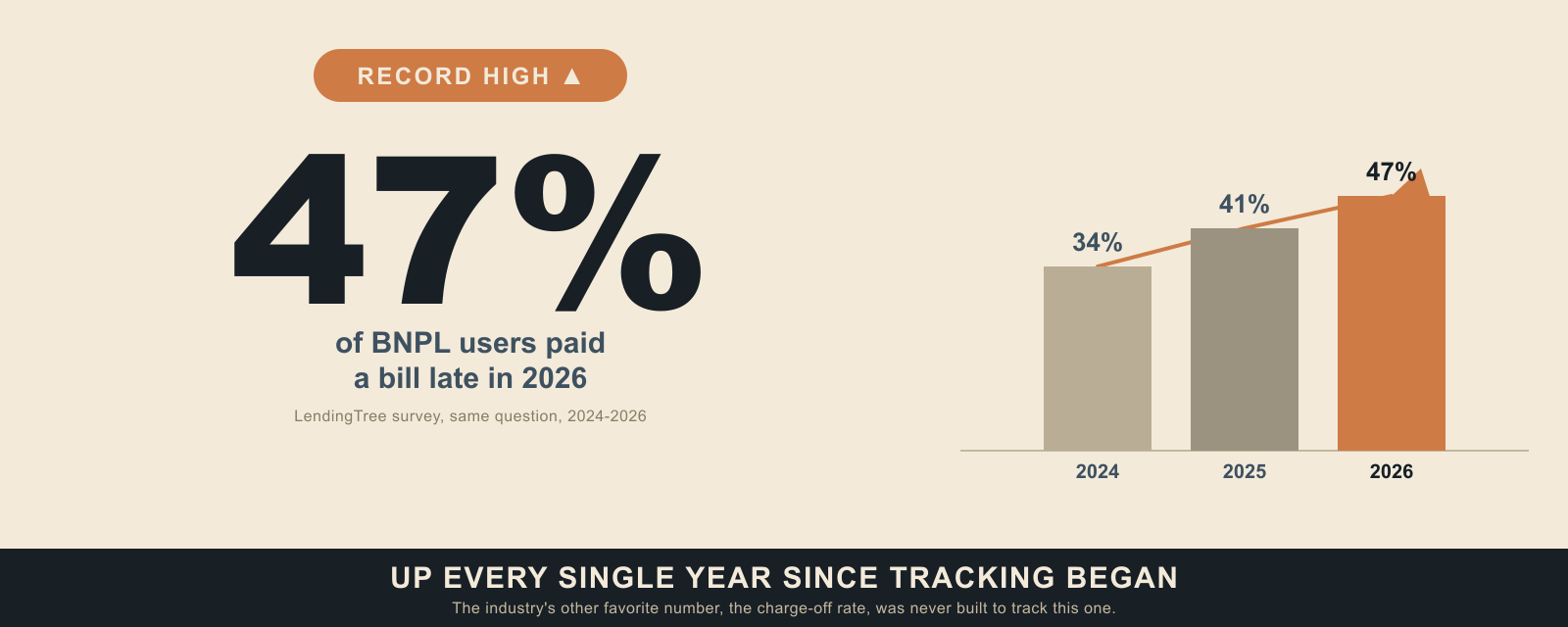
On a checkout screen, it looks like almost nothing: four boxes of $33.75, the fourth one due six weeks out, a button in a friendly font that says "Pay in 4." That is the average Buy Now, Pay Later (BNPL) loan in America today, the split-the-bill checkout option built by companies like Affirm, Klarna, and Afterpay. Ask the people actually holding these loans how it's going, and the trend has run one direction for three straight years: 34% said they had paid a bill late in the past year in 2024. 41% in 2025. 47% in 2026, the highest share since anyone started asking the question. Ask the industry instead, using the number it actually reports to its own regulator, and the story reverses. Both numbers are real. They are just not measuring the same thing, and only one of them describes what it feels like to be the person holding the loan. Understanding the buy now pay later pain of paying psychology reveals why consumers and regulators see such different pictures of risk.
The number that measures you
LendingTree has asked BNPL users essentially the same question every spring since 2024: have you paid a bill late in the past year? The answer has gotten worse every single time it's been asked. Thirty-four percent said yes in 2024. Forty-one percent in 2025. Forty-seven percent in 2026, the most recent reading, nearly half of everyone using these loans. Same question, same kind of sample, three years straight, and it hasn't leveled off.
The same survey found something more revealing than the late payments alone: 63% of users had more than one BNPL loan running at the same time, and a quarter had three or more going at once, often spread across different apps that have no idea the others exist. More than half said they couldn't get by without BNPL at all. Nearly a third had used it to buy groceries, something no short-term loan should ever be needed for, a number that climbs to almost four in ten among Gen Z users. The CFPB ran its own version of this check using real loan and credit records instead of self-reported survey answers, and it backed up the pattern: 62% of borrowers had overlapping loans, a third across more than one lender, and roughly one in five counted as heavy users, opening a new loan more than once a month on average, part of a broader pattern of BNPL risk regulators are only now starting to measure properly.
None of that shows up in the number the industry actually reports.
The number that measures the bank
The Consumer Financial Protection Bureau (CFPB) published its most recent look at the Buy Now, Pay Later market in December 2025, using data handed over by the six biggest "pay-in-four" lenders: Affirm, Cash App Afterpay, Klarna, PayPal, Sezzle, and Zip. Its headline number is the charge-off rate, the share of loans a lender eventually gives up on collecting, and it fell from 2.63% in 2022 to 1.83% in 2023, the lowest in five years of data. Late fees dropped too, from 5.2% of loans down to 4.1%. Lenders handed out 335.8 million of these loans that year, worth $45.2 billion, averaging $135 each.
That number answers a narrow, bank-side question: how often does a lender fail to collect what it's owed? It says nothing about whether the person who did pay was late, stressed, or juggling four other apps to make it happen. A charge-off rate is a number a lender reports to its own regulator and its own investors. It was never built to describe a borrower's experience, and by that measure, it's doing exactly what it was designed to do.
The Federal Reserve ran its own count in June 2026 and put total 2025 BNPL lending at roughly $160 billion, with the "pay in four" style alone up nearly 80% since the CFPB's last measurement. Two companies, Afterpay and Affirm, now handle about 60% of all of it between them. One detail in the Fed's report is worth pulling out on its own, because it's a cost borrowers actually feel: the share of BNPL loans that are truly interest-free has fallen from 83% during the pandemic to just 63% today. More than a third of what gets marketed as "buy now, pay later" now quietly charges interest, wearing the same friendly branding as the free version.
It was the bank-side number that got the regulator's attention, too, and then its retreat. The CFPB had ruled in May 2024 that BNPL should carry the same consumer protections as credit cards. A lender trade group sued. The Bureau folded, formally pulling the rule in May 2025 and confirming that summer it wouldn't try again. Nobody at that podium was citing the 47% figure above.
Why the gap exists
In 2001, two MIT researchers ran an experiment that explains a lot of this. They auctioned off tickets to a Boston Celtics game. Half the bidders were told that if they won, they'd pay in cash. The other half was told they'd pay by credit card. Nothing else about the auction changed, same seats, same game. The credit-card bidders bid almost twice as much, on average, as the cash bidders, a gap the researchers found couldn't be explained by who simply had more money on hand. The only thing that changed was how the payment would feel.
That's the same idea behind a theory two economists laid out a few years earlier: spending money hurts a little, and that small sting is one of the main things that normally keeps people from overspending. Cash makes the sting immediate, you watch the pile get smaller in your hand. A credit card mutes it. And anything that pushes the moment you feel the cost further away from the moment you get the thing will make people spend more, not because they're doing worse math, but because the alarm that's supposed to go off never rings. BNPL takes that idea about as far as it can go: often there's no card to swipe at all, the "0% interest" framing barely registers as borrowing, and splitting one payment into four smaller pieces means each piece is small enough to slide by unnoticed.
The market has already run this experiment at scale, not just theorized about it. Stripe tested it directly in 2024 across more than 150,000 checkout sessions: half the shoppers saw a BNPL option at checkout, half didn't. The stores that showed it made up to 14% more revenue, and more than two-thirds of those BNPL sales were purchases that wouldn't have happened otherwise, not people simply switching from a card they'd have used anyway. The effect was strongest on purchases between $500 and $1,500, exactly the range where paying in full would normally make someone stop and think twice. Every party in the transaction, the store, the app, the lender, benefits from making that moment of hesitation disappear.
The honest complication
Credit-scoring companies have actually noticed the blind spot, which is the one part of this story that isn't bleak. FICO announced in February 2025 that it had built the first mainstream credit score that factors BNPL loans in directly, expected to roll out with lenders that fall. The tricky part FICO had to solve is the exact problem described above: normal holiday shopping with four pay-in-four plans looks identical, on paper, to someone already in real trouble, a real shift from BNPL staying invisible to your credit score entirely, which was the norm until this year. FICO's fix groups loans that were opened close together in time, so a burst of holiday purchases doesn't get treated the same as a burst of desperation. In FICO's own tests, most people's scores moved by about 10 points either way, and even heavy users with five or more loans from one lender mostly saw their scores hold steady or improve. That's a genuine fix aimed at the real problem. It just hasn't been tested yet against the harder version: loans stacked across different companies that still don't talk to each other.
There's a second, tougher finding worth sitting with. A December 2025 study in the medical journal JAMA Health Forum surveyed a representative sample of more than 2,100 American adults and found that people using BNPL were significantly more likely to report symptoms of depression, anxiety, or PTSD than people who didn't, more than a third of BNPL users showed signs of probable depression, compared to about a fifth of non-users. The researchers are careful to say this doesn't prove BNPL causes worse mental health. It could just as easily run the other way, people already under stress reaching for the easiest credit available, or both at once. Either way, it points to the same conclusion as the stacking data: the people leaning hardest on BNPL are often the ones least able to absorb a debt load that stays invisible until it isn't.
Track the number that's actually yours
None of this makes the industry's charge-off number dishonest. It is reporting exactly what it was built to report, and that number was never designed to catch loan-stacking, because stacking is a cross-lender problem and each lender's compliance report can only see its own book. If you're one of the 47%, or worried about becoming one, the number worth tracking isn't the industry's. It's the same question LendingTree keeps asking, turned on yourself: are you paying every one of these on time, and could you still say that if a fifth app started asking for its cut too? Add up what's owed across every app at once, not just this week's installment, and the total looks nothing like what any single provider's dashboard, or its charge-off rate, was ever built to show.
Money Map runs that cross-app total automatically for anyone who wants to see their own number, and once it's visible, the same payoff order that works on any other debt still applies: a balance split into four small pieces is still a balance.
The 1998 research on the pain of paying predicted this outcome before Klarna or Affirm existed: take away the moment that spending is supposed to hurt, and the first thing that disappears isn't the money. It's the part of you that would have noticed it was gone.
This article is educational and is not financial advice.
Quick answers
Is Buy Now, Pay Later actually getting riskier for the people using it? By their own account, yes: self-reported late payments climbed from 34% of users in 2024 to 47% in 2026, the highest share since LendingTree started tracking the question. The number the industry reports, its charge-off rate, moved the other way over the same stretch, but that number measures how often lenders fail to collect, a bank-risk metric, not how often borrowers are struggling.
Why do the industry's numbers and consumer surveys disagree? They're not measuring the same thing. A charge-off rate tracks one lender's own collections record, a number built for lenders and regulators. It can't see a borrower holding several BNPL loans across different apps at once, a pattern separate CFPB research found affects 62% of BNPL borrowers.
Is BNPL still regulated like a credit card? No. The CFPB ruled in May 2024 that BNPL should carry the same protections as credit cards, then formally withdrew that rule on May 12, 2025, and said in June 2025 it doesn't plan to try again.
Does BNPL affect your credit score? It's starting to. FICO announced new scoring models in February 2025 that factor in BNPL loans for the first time, rolling out with lenders from fall 2025, built to avoid penalizing normal short-term use while still catching genuine overextension.
Connect the lesson
Turn the article into a next step.
SwitchWize takeaway
Find your number, not the market's.
Run a Money Map to see how your cash, debt, and rates stack up against the best available options.
Start Money Map →Figures are third-party research and government data, not SwitchWize proprietary research: LendingTree BNPL Tracker survey (same "paid late in the past year" question asked each spring 2024-2026, n≈2,000-2,060); Shupe & DeLuca, CFPB Office of Research (January 2025); CFPB "The Buy Now, Pay Later Market" report (December 2025, charge-off and late-fee data); Federal Reserve FEDS Note, "Buy Now, Pay Later Beyond 'Pay in 4'" (June 2026); Prelec & Simester, "Always Leave Home Without It," Marketing Letters (2001); Prelec & Loewenstein, "The Red and the Black: Mental Accounting of Savings and Debt," Marketing Science 17(1) (1998); Stripe BNPL checkout A/B test (June 2024); Shah, Prus, Castrucci, Galea & Ettman, JAMA Health Forum (December 12, 2025, n=2,121); FICO press release on FICO Score 10 BNPL (February 2025); Federal Register, CFPB rule withdrawal (May 12, 2025). Reviewed July 10, 2026.