
The short answer
A stock gain can be taxed at 0% and still reduce help with your health-insurance premiums. If you received more help than your final income allows, you must repay the excess. For 2026, the old repayment caps no longer apply. Check this cost before you sell.
You may owe no federal tax on a stock gain and still have to repay insurance aid. Here is what to check before you sell.
By SwitchWize Research Desk · November 1, 2026
Illustrative story · Fictional household
David and Laura Bennett have retired before 65 and need $10,000 to cover expenses. They could sell shares worth that much, bought years earlier for $2,000. Their $8,000 long-term gain would fall within the federal 0% capital-gains bracket.
The sale could still leave them owing $16,032 on their tax return. David and Laura buy Marketplace health insurance, and the government has been paying part of their premium each month. The stock gain would put their annual income above the limit for that help, requiring them to repay it.
Their insurance repayment would be larger than the cash raised from the sale. Before selling, they need to check whether another way to get the $10,000 would cost less.
If you work for yourself or retire before Medicare, check two things before selling: the tax on your gain and the insurance aid you could lose.
An $8,000 gain costs this couple $16,032 in aid
David and Laura file jointly and have no dependents. For this example, they live in the contiguous United States or Washington, D.C., and qualify for help with Marketplace premiums throughout 2026. Neither has access to employer or government coverage that would disqualify them. As early retirees, they have no self-employed health-insurance deduction in this calculation.
Before selling the shares, the income used to calculate their insurance aid is $80,000. Assume their plan and the local benchmark plan each cost $24,000 a year. The benchmark is the second-lowest-cost Silver plan available to them and is used to calculate their aid. These are illustrative premiums, not current quotes.
At this income, the 2026 rules expect the couple to pay 9.96% of their income toward the benchmark plan:
$80,000 × 9.96% = $7,968 from the couple.
$24,000 − $7,968 = $16,032 in annual premium tax credit.
Assume all $16,032 of this premium tax credit goes directly to their insurer during the year, at $1,336 a month, leaving David and Laura to pay the rest.
The stock sale would raise David and Laura's annual Marketplace income from $80,000 to $88,000. For a two-person tax household, the general federal income ceiling for the 2026 credit is $84,600. Above it, their federal credit falls to zero.
Temporary for matting marker
They would have to repay all $16,032 paid to their insurer, losing more than twice the $8,000 gain that caused the problem.
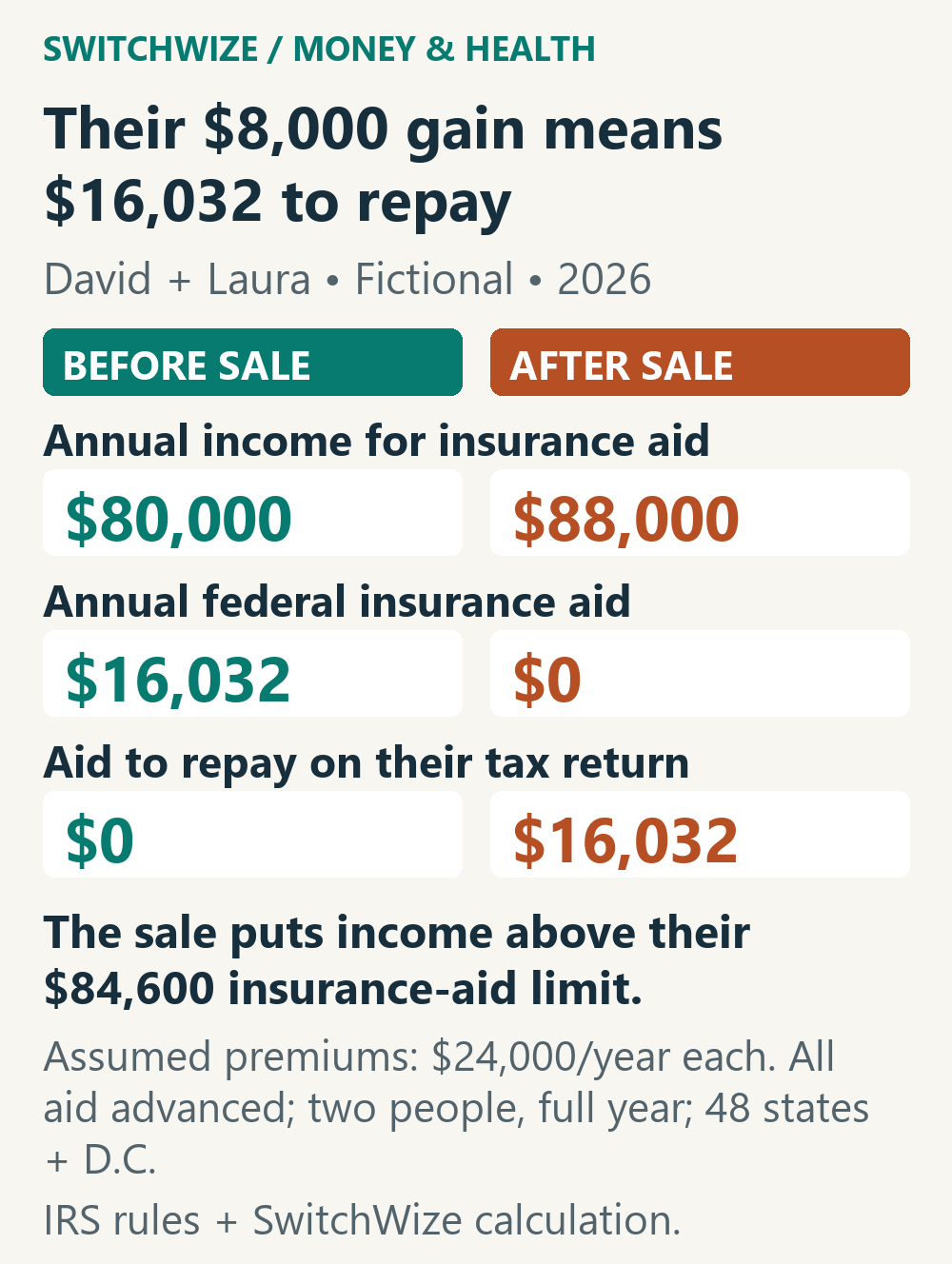
The bill repays insurance aid received earlier; it is not a capital-gains tax. A different benchmark premium or fewer months of eligible coverage would change the amount. This example excludes state taxes, state insurance assistance and other tax effects.
The stock gain counts toward the insurance income limit
For federal income tax, the Bennetts start with $80,000 of ordinary income, such as taxable retirement income, and subtract the 2026 married standard deduction of $32,200. That leaves $47,800 in taxable ordinary income. Add the $8,000 stock gain and their total taxable income is $55,800, below the $98,900 upper limit for the married 0% long-term capital-gains bracket. This assumes no other gains, qualified dividends or losses that would change the calculation.
For insurance aid, the standard deduction is not subtracted. The Bennetts' income starts at $80,000 and rises to $88,000 after the sale, putting them above the $84,600 limit.
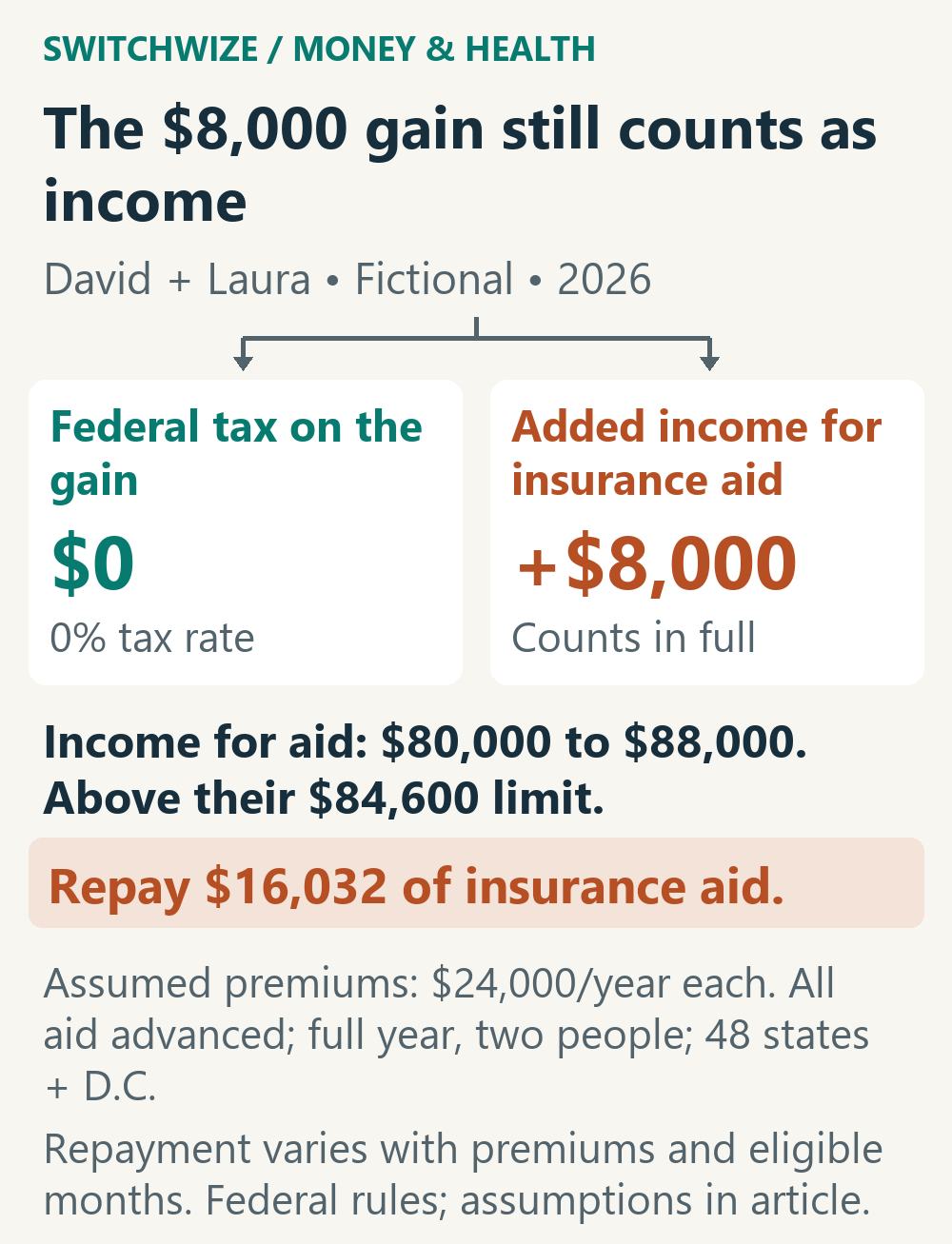
Before the sale, they have $51,100 of room for gains within the 0% federal bracket, but only $4,600 of room before crossing the insurance-income limit.
Checking only the capital-gains bracket would miss the smaller insurance limit. Ask your adviser to calculate the change in your premium credit alongside the tax on the sale.
Two rule changes make 2026 different from 2025
For 2026 coverage, federal premium credits generally end above 400% of the federal poverty line. That is the source of the Bennetts' $84,600 limit. Temporary rules allowed eligible households above 400% to receive credits during 2021–2025, but that expansion has ended.
A separate change removes the caps on repaying excess advance credits starting with the 2026 tax year. Previously, qualifying households below 400% could have their repayment limited. Now they must return the full amount of any excess aid, even if their income stays below that limit. This does not mean repaying every dollar of aid if they still qualify for some of it.
If David and Laura's final income rises to $83,000 instead of $88,000, they remain below the cutoff and in the same contribution-percentage range. Their expected contribution rises by about $299, so their credit falls by about $299. They would repay that excess rather than the full $16,032. Actual tax-form rounding can differ slightly.
You may still be better off earning more. Work out the insurance cost alongside the extra income, especially if you are close to the limit.
Savings or different shares could add less income
David and Laura could also check whether another account can supply the $10,000 with less added income.
Moving $10,000 they already hold in savings into checking would not itself create income, although interest earned on those savings still counts. Selling other shares worth $10,000 that cost them $9,000 would create a $1,000 gain instead of $8,000, assuming no adjustments to the purchase cost and no losses to offset the gain.
Each option would give the Bennetts $10,000 to spend. If available, savings or shares with a higher purchase cost could meet their immediate need without pushing them over the insurance-income limit.
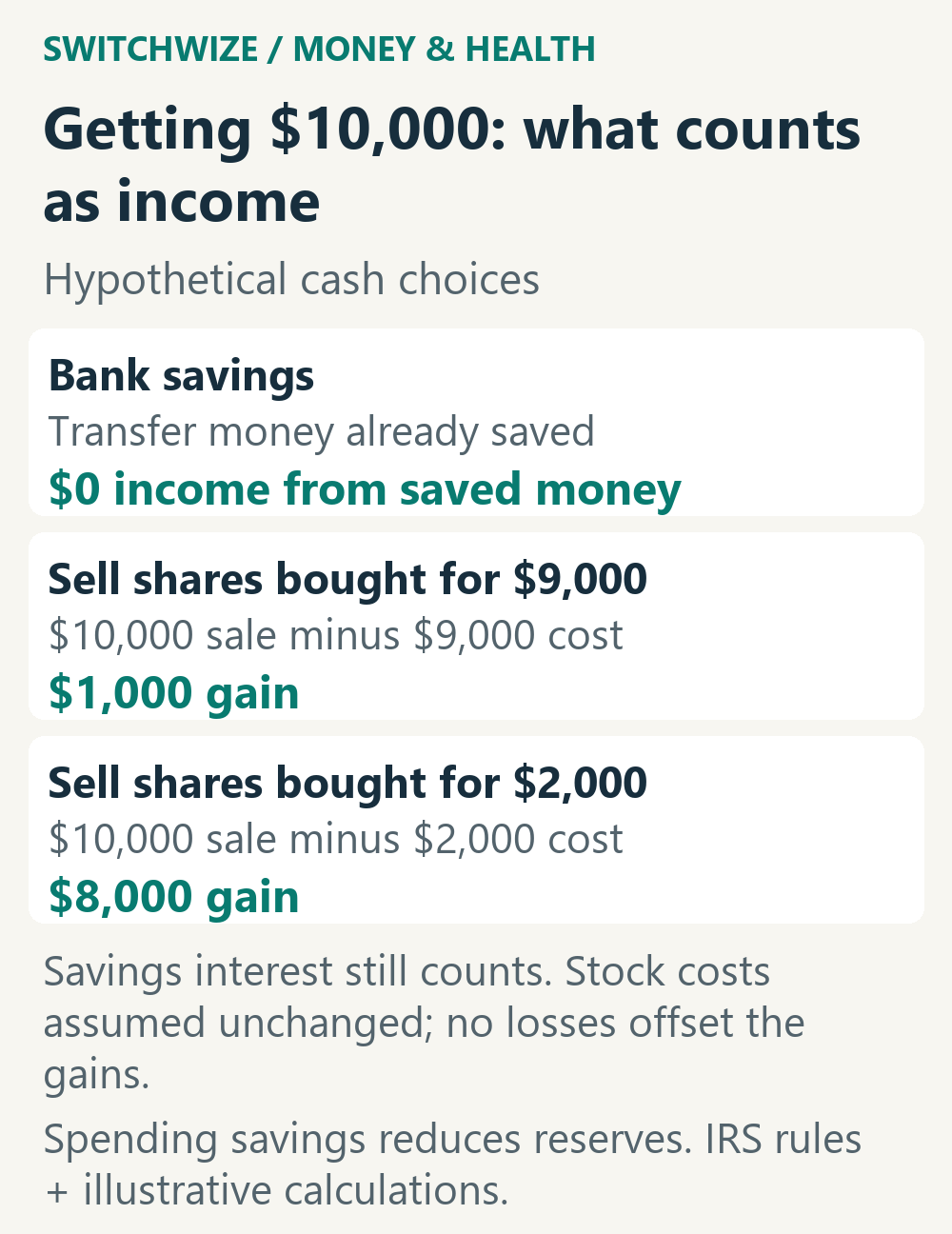
The insurance calculation is one part of that decision. Spending savings leaves less for emergencies; selling different shares changes what remains invested. Compare those effects, transaction costs and future taxes before choosing an account.
Several other transactions deserve the same attention:
- A Roth conversion: moving money from a traditional IRA to a Roth IRA adds the taxable portion to income. Include any lost insurance aid when weighing the conversion's long-term benefit.
- Municipal-bond interest: even when it is exempt from federal income tax, this interest counts toward the income used for Marketplace aid.
- Retirement withdrawals: taxable IRA distributions generally count. Roth withdrawals that meet the rules for tax-free treatment generally do not; check that your withdrawal qualifies.
If you run a business, start with income after business expenses. Some deductions may reduce the income counted for aid. The self-employed health-insurance deduction needs particular care: it depends on how much premium you pay yourself, which in turn depends on your credit. Ask your tax preparer to calculate the deduction and credit together.
A December gain can change aid paid earlier in the year
The help on your monthly insurance bill is based on an estimate. Your tax return checks it against your actual income.
Form 1095-A shows your Marketplace coverage and the aid paid to your insurer. You use Form 8962 with your federal income tax return to work out whether you received too much or too little.
A gain late in the year can affect aid paid in earlier months. Even if you switch from the Marketplace to other coverage during the year, the aid for your eligible months depends on your annual income.
Report an income change promptly so the Marketplace can adjust future payments to your insurer. You may still need to repay aid already paid.
If your income is uncertain, you can choose to have less of the estimated credit paid to your insurer during the year, or pay the premium yourself and claim any credit when you file. Using less in advance can reduce a later repayment. You will pay more each month, however, and your final income still determines the credit you qualify for.
For a freelancer with uneven earnings, using less aid each month may reduce the risk of a later bill. First check whether you can afford the higher monthly premium.
Review 2026 income while shopping for 2027 coverage
This November, the Bennetts need to review their 2026 income before making the sale and estimate their 2027 income for next year's coverage. Those are separate calculations.
The income limits also change between coverage years. The table shows 400% of the federal poverty guideline for each household size.
- One person: 2026 ceiling $62,600; 2027 ceiling $63,840.
- Two people: 2026 ceiling $84,600; 2027 ceiling $86,560.
- Four people: 2026 ceiling $128,600; 2027 ceiling $132,000.
Contiguous 48 states and D.C.; general federal income ceiling, not a guarantee of eligibility. Alaska and Hawaii have higher guidelines. Other eligibility rules still apply.
For 2026 coverage, the income limits come from the 2025 poverty guidelines; the tax return filed in 2027 settles any difference between advance aid and the final credit. For 2027 coverage, the limits come from the 2026 guidelines and the return is filed in 2028. Use the premium and contribution percentage for the coverage year you are calculating.
HealthCare.gov enrollment for 2027 opens November 1. Its current deadline for January 1 coverage is December 15, with the first premium paid as required. Check your own state Marketplace for its dates.
Choosing a new plan will not fix an overpayment for the old year.
Check the insurance cost before you sell
Before a year-end sale or conversion, put these numbers on one page:
- Your expected annual income for Marketplace aid, including the sale or conversion and income such as tax-exempt interest.
- The income limit for your household size, state and coverage year. Leave room for uncertain interest, dividends or business earnings.
- Your premium credit with and without the transaction, using the correct benchmark premium and months of eligibility.
- The aid already paid to your insurer, how much you might need to repay and how you would pay it.
If you are considering a deduction to reduce income, first check eligibility, limits and the actual contribution deadline. Do not assume every deduction is available or that everything must be completed by December 31.
Keep the insurance decision broader than this tax calculation. A cheaper premium is little comfort if the plan excludes your doctor or medication, or leaves you with a deductible you cannot fund.
Before selling, ask your tax preparer to compare the accounts you could use. For each option, have them show the cash raised, the tax due and the insurance aid you would lose. That gives you the cost of getting the money before you commit to the sale.
Sources
Rules and reconciliation: IRS premium tax credit Q&A; Congressional Research Service, P.L. 119-21, section 71305; IRS Publication 974.
Numbers: 2026 contribution table, Rev. Proc. 2025-25; 2026 tax thresholds, Rev. Proc. 2025-32; HealthCare.gov poverty guidelines.
Income and next steps: Income to include; IRS capital gains and basis; Report changes; Enrollment dates.
Checked November 1, 2026. Federal Marketplace premium credits; not Medicare income surcharges or Medicaid eligibility advice. All household and premium figures in the worked example are hypothetical. Calculations assume full-year eligibility, unchanged premiums and family size, all credits advanced, and no other tax effects; actual monthly calculations and rounding may differ. State taxes and state assistance are excluded. Publication 974 currently describes 2025; it is used for general mechanics, not 2026 repayment limits or rates. No household interviews or individualized tax review were conducted.