The wealth habit that looks boring until year ten
Most households lose money not through a single bad decision but through a slow, invisible leak: the savings account earning almost nothing, the automatic subscription nobody reviews, the retirement contribution that stayed at three percent long after income doubled. These are compounding problems — small drags that repeat month after month, quietly working against you while you focus on bigger-sounding questions.
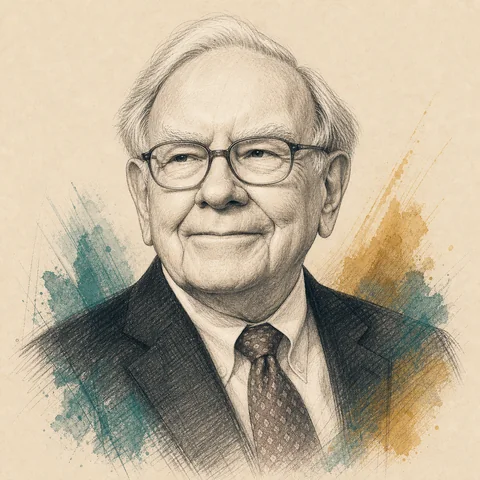
Warren Buffett's Berkshire Hathaway shareholder letters return to this idea across decades. The engine of long-term wealth is not a brilliant trade or a perfectly timed market entry. It is the steady, unglamorous reinvestment of retained earnings, repeated year after year, until the math becomes undeniable. Berkshire's own trajectory illustrates the pattern: early results looked modest, middle years were encouraging but not dramatic, and the later decades produced figures that surprised even close observers — all from the same underlying discipline.
The corporate lesson translates directly to households. If your savings sit in an account paying the national average of 0.38%, while the best high-yield savings accounts offer 4.27%, that gap compounds against you every single month. On a $15,000 emergency fund, the difference can exceed … a year — money that simply evaporates through inertia. The fix is not complicated. Automate one improvement, leave it alone, and give it years. That is the warren buffett compounding money lesson applied to your kitchen table.
What repeatable habit is quietly shaping next year before you notice it? Look for automatic savings, automatic debt reduction, recurring fees, and repeated impulse decisions.
A single automated action, chosen and left alone, consistently outperforms multiple habits maintained imperfectly. Pick one, automate it, and declare it done.
A $15,000 emergency fund earning the national average instead of a competitive high-yield rate can leak over $500 annually — a silent drag that compounds year after year.
Compounding curves bend late. The early years look unimpressive by design — that is when most people quit, and when patience creates the most advantage.
Why boring is the feature
Compounding does not announce itself. In year one, the results are modest enough to dismiss. In year three, they are encouraging but not dramatic. Somewhere around year seven to ten, the curve begins to visibly bend upward — and that is when people notice. By then, the habit is old news to the person running it.
This delayed visibility is not a flaw. It is the mechanism. Financial habits that generate headlines — rapid asset moves, frequent account changes, chasing the latest product — create friction and interrupt compounding. Each interruption resets part of the clock. The boring habit keeps the clock running.
For example, consider a household where Priya, a 34-year-old project manager, moved $12,000 from a traditional savings account earning 0.38% to a high-yield savings account earning …. In year one, the difference felt small — roughly … in extra interest. But she left the account alone, added $200 per month automatically, and did not touch it. By year five, her balance had grown past $25,000, and the compounding gap between her old rate and her new one had generated over $3,000 in additional interest she would have otherwise lost. No clever trades. No market timing. Just one switch and one automated transfer.
This is especially important if you're someone who checks account balances frequently and feels tempted to "optimize" every quarter. The warren buffett compounding money lesson suggests the opposite: set the automation, then step away. Buffett's letters describe Berkshire's approach as resisting the urge to act when there is nothing genuinely productive to do. Patience is active, not passive. Choosing to leave a working habit in place is a decision, not an oversight.
The structure of a compounding habit
A compounding habit has three parts: a trigger, an action, and a leave-it-alone period.
The trigger is automatic. A pay cycle, a calendar date, a deposit hitting an account. Automation removes willpower from the equation entirely. Willpower depletes; automation does not.
The action is small enough to sustain and specific enough to measure. A fixed monthly transfer to a high-yield savings account. A standing instruction to route a portion of each raise toward savings before it reaches spending. An annual one-percentage-point increase in retirement contribution rate. Any of these works. The specificity is what makes it repeatable.
The leave-it-alone period is the part most people get wrong. They monitor too closely, interpret short-term noise as signal, and adjust too often. Buffett's letters are explicit that intrinsic value accumulates over years, not quarters. The same principle applies here. Monthly check-ins on a habit designed to pay off over a decade introduce more harm than benefit.
If you're deciding between a high-yield savings account earning 4.27% and a 12-month CD at …, the right answer depends on whether you need liquidity. For an emergency fund you might access at any time, the savings account wins on flexibility. For money you know you will not touch for a year, the CD locks in a guaranteed rate. Either choice beats leaving money idle — the key is making the decision once and automating the contribution.
Visit your Money Map once a year to confirm the habit is still in place and still sized correctly for your current income — then close the tab.
The one-thing rule
Most people who fail at compounding habits do not fail from laziness. They fail from multiplicity. They start three habits simultaneously, maintain them imperfectly, and abandon all three when life gets complicated.
The one-thing rule: choose a single repeatable improvement, automate it completely, and declare it done. Not done for the month — done as a decision. It runs until a material life change (new job, income shift, major expense) triggers a deliberate review.
The question to answer is not "which habit would be best in theory?" It is "which single habit can I automate today and genuinely leave alone?" The answer to the second question almost always outperforms the answer to the first.
Benefits of the one-thing approach:
- Reduces decision fatigue to a single setup session
- Eliminates the risk of abandoning multiple half-built habits
- Creates a clear annual review target instead of a scattered monthly checklist
- Builds genuine momentum that compounds psychologically as well as financially
Drawbacks and risks to consider:
- You might pick a suboptimal habit and miss a higher-impact opportunity
- A single focus can become an excuse to ignore other financial problems that need attention
- Automation can mask account issues (fee changes, rate drops) if you never check at all
- Life changes may make the original habit wrong, and annual review might not catch the shift fast enough
The honest trade-off: one automated habit will almost certainly beat zero habits or five half-maintained ones. But it is not a license to ignore everything else. Use your annual review to ask whether the one thing is still the right one thing.
The customer decision
- What to check
- Compare your account's APY to 4.27% — if the gap exceeds 1%, the leak is material
- Next step
- Compare savings rates
- What to check
- Confirm at least one recurring transfer moves money from checking to savings or retirement before you can spend it
- Next step
- Run a Money Map
- What to check
- List every automatic charge on your card statement — cancel anything unused for 90+ days
- Next step
- Review your cards
- What to check
- Check whether your highest-rate debt (likely a card at 24.00%) has an automatic above-minimum payment
- Next step
- Explore loan options
- What to check
- Set a single calendar reminder to re-check all four rows above — once per year, same week
- Next step
- Read the methodology
How to apply in 20 minutes
- Name the default. Write down the one account, loan, card, or habit this article made you question. Be specific: "Chase checking account, no automated savings transfer" is useful. "I should save more" is not.
- Find the number. Log in and locate the APY, APR, fee, balance, or payment amount that determines the actual cost. For savings, compare your rate against 4.27%. For credit card debt, note your APR relative to the average of 24.00%.
- Compare one credible alternative. Do not shop for hours. Check one high-yield savings account, one CD rate, or one balance-transfer offer with clear terms. As of June 2026, top high-yield savings accounts pay 4.27% and 12-month CDs reach ….
- Set up the automation. Open the new account if the gap justifies it. Create a recurring transfer — even $50 per paycheck — and schedule it to align with your pay cycle.
- Set a review date. Add a calendar entry for one year from today. Label it: "Review compounding habit — keep, adjust, or replace." Then stop thinking about it until that date arrives.
Find the one automatic financial habit — a low savings rate, an ignored subscription, a minimum-only debt payment — that is quietly compounding against you.
Set up a single recurring transfer or payment that works in your favor without requiring monthly willpower. One-time inconvenience, permanent benefit.
Resist the urge to monitor weekly or adjust quarterly. Compounding habits need time, not attention. Annual review is enough.
Check that your rate, balance, and life circumstances still match the habit. If they do, change nothing. If they do not, make one deliberate adjustment.
What the tenth year looks like
A person who asks a decade-long compounder how they built their position often hears some version of: "I just kept doing the same thing." That answer frustrates people who expected a more sophisticated explanation. There is no sophisticated explanation. The sophistication was in setting up the automation and resisting the urge to disrupt it.
For example, consider a couple — Marcus and Dani, both 30 — who in 2016 automated a $300 monthly transfer into a high-yield savings account. They started with $2,000. Over ten years, assuming an average rate of 3.5% (rates fluctuated, but they never chased the top rate — they just stayed in a competitive account), their balance grew to roughly $46,000. Of that, about $38,000 was their own contributions and $8,000 was interest. The interest alone exceeded a full month of their combined take-home pay. No windfall. No inheritance. Just $300 a month that nobody touched.
Berkshire's letters document the same pattern at institutional scale. The decisions that built the most value were often the decisions not to change what was working. Retained earnings compounded. Productive assets were left productive. Patience was treated as a strategy, not a temperament.
At the household level, the parallel holds. The tenth year does not reward the person with the most complex plan. It rewards the person who picked one thing, automated it, and did not touch it.
When this may not apply
The compounding habit framework is powerful, but it is not universal. Staying the course can be the wrong move when:
- The dollar gap is genuinely small. If your current savings rate is within 0.1% of the best available, the effort of switching may not justify the return. Focus your energy elsewhere.
- You carry high-rate debt. If you owe money on a credit card at 24.00%, directing extra cash toward that balance almost always beats optimizing savings interest. The math is not close.
- You are in the middle of a major life event. A job loss, a medical crisis, a move — these are moments where simplicity has real value. Adding a new financial habit during acute stress often leads to abandoning it within weeks.
- The product terms have changed. Some banks lower promotional rates after six months. Automation does not mean blindness. If your annual review reveals a rate cut, treat that as a legitimate trigger to reassess.
- Your emergency fund is not yet funded. The compounding habit works best with money you will not need to touch. If you are still building a baseline emergency fund, prioritize that over optimizing the rate.
Treat this framework as a review trigger, not an automatic instruction. The goal is a household setup that still fits the facts in front of you — and sometimes the right answer is to wait, gather one better fact, and then decide.
A final review rule
If this article points to a possible improvement, write the decision down before acting. Note the current rate, fee, balance, or payment; compare one credible alternative; and decide what would make the change worth the effort. That short record keeps the review practical and prevents a useful principle from turning into vague motivation.
Use the same three-line note every time:
- What you have now — the account name, rate, fee, or payment amount.
- What the alternative offers — the specific rate, term, or feature you found.
- What would make the switch worth doing — the dollar gap, convenience gain, or risk reduction that justifies the effort.
If the answer is unclear, the right move may be to wait. If the answer is obvious, the next step should be small enough to complete this week. The goal is not constant movement. The goal is a household money setup that compounds in your favor, year after year, until the math becomes undeniable.
For a broader scan of where your money sits today, use the SwitchWize Money Map.
Frequently asked questions
How does the warren buffett compounding money lesson apply to someone with no investments? You do not need a stock portfolio. Compounding applies to any repeating financial behavior — savings interest, debt payments, even fees. Moving an emergency fund from a low-rate account to one paying 4.27% is a compounding improvement that requires no market knowledge at all.
Should you switch savings accounts every time a higher rate appears? Generally, no. Frequent switching creates friction and can interrupt automatic transfers. If your account pays within 0.5% of the best available rate and the bank is FDIC-insured, staying put is usually the better compounding decision. Review once a year.
How much money do you need for compounding to matter? Any amount. On $1,000, the dollar difference between 0.38% and 4.27% is modest in year one — roughly …. But the habit of automating transfers matters more than the starting balance. The person who starts with $1,000 and adds $100 per month will surpass $15,000 within a decade, with meaningful interest on top.
What if you're deciding between paying off debt and building savings? If your debt carries a rate above 4.27% — and credit card debt at 24.00% certainly qualifies — prioritize the debt. The "return" on eliminating a 24% interest charge far exceeds any savings yield. Once high-rate debt is cleared, redirect that same automatic payment into savings. The habit transfers; only the destination changes.
How often should you review a compounding habit? Once a year is enough for most people. More frequent reviews tend to introduce noise rather than insight. Set a calendar reminder, check that your rate is still competitive and your automation is still running, and move on. The Consumer Financial Protection Bureau offers free tools to compare account terms if you need a neutral benchmark.
Sources and methodology
This article draws on themes from public Berkshire Hathaway annual shareholder letters, including Buffett's recurring discussions of retained earnings, intrinsic value, and the compounding effect of patient reinvestment. Those letters address Berkshire as a business; the household applications here are SwitchWize editorial interpretation, not direct instructions from the letters. This article is educational and does not constitute personalized financial advice. Consult a qualified financial professional for guidance tailored to your situation.
- Berkshire Hathaway shareholder letters archive· Checked 2026-06-13
- FDIC — Are My Deposits Insured?· Checked 2026-06-13
- Consumer Financial Protection Bureau — Savings accounts· Checked 2026-06-13
- SwitchWize methodology· Checked 2026-06-13
- The Capital Letters editorial collection· Checked 2026-06-13
Next scheduled verification: 2026-07-13
Source: S&P Capital IQ Pro; SNL Financial Data. Calculations: FDIC. Reflects the $2,500 product tier for savings and interest checking accounts.
Connect the lesson
Turn the article into a next step.
Switchwize takeaway
Protect the base first.
Review cash, debt, fees, and product fit before chasing the next financial upgrade.
Run a smarter financial checkup →Disclaimer
This article is educational and does not provide personalized investment, tax, legal, or financial advice. Warren Buffett and Berkshire Hathaway are not affiliated with or endorsing SwitchWize. References to shareholder letters are public-record citations used for educational interpretation only.
Up next in Buffett's letters
Warren Buffett Behavior Money Lesson: Honest Reviews
14 min read