A margin of safety is the gap between what could go wrong and what you can absorb before being forced into a bad decision. It is not a backup plan; it is the structural feature that keeps every other plan intact when one thing goes sideways. Without it, a household runs at full capacity in good months and at crisis in bad ones.
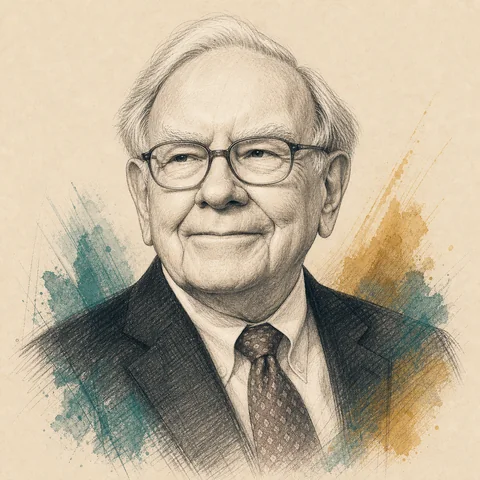
Warren Buffett borrowed the concept from Benjamin Graham, who defined a margin of safety as paying well below intrinsic value so that even a poor outcome leaves you solvent. At Berkshire's scale the same principle governs capital reserves, insurance float management, and acquisition discipline: build in enough cushion so that a realistic adverse event does not force a distressed sale, a bad financing, or a decision made under pressure. The household translation is direct. A cash buffer sized to a realistic shock is the margin of safety. A home purchased at the edge of affordability has none. A balance sheet where every dollar is deployed is structurally identical to one that requires perfect execution every month to stay solvent. Buffett's insight is that the cushion is not the cost of safety; it is the cost of keeping your options.
The Warren Buffett risk money lesson, built into a cash cushion
The Warren Buffett risk money lesson for households starts with the adversarial question: what is the realistic worst case, and what does surviving it require? Not the catastrophic scenario, a meteor strike or a total income loss, but the plausible one: six months of reduced income from one earner, a major uninsured repair, a large medical copay, or a rate reset on an adjustable obligation. Estimate the full cost of that event in dollars, then compare it to your immediately liquid resources.
If the realistic shock exceeds the liquid buffer, you have a margin-of-safety gap. The gap is not an emergency yet; it is a structural condition that converts any future shock from manageable to forced. If you're deciding how large the margin needs to be, the target is not comfort. It is the realistic shock cost plus one additional month of essential expenses, enough to absorb the event and continue operating without making a decision under pressure.
Estimate the cost of the most plausible adverse event, compare it to liquid resources, and size the gap between them.
A margin-of-safety gap is a condition, not a crisis. It converts the next realistic shock from manageable to forced.
A buffer held in a low-yield account still works but costs you each year in foregone yield. Move it to a competitive rate without sacrificing access.
A mortgage, a dependent, a business interest, or an insurance change can meaningfully shift what the realistic shock costs.
What the decision looks like
- What to check
- Estimate your realistic shock cost and compare it to liquid resources you can reach without penalty in one business day.
- Next step
- Compare savings rates
- What to check
- Estimate the yield gap on your buffer account and the risk exposure that runs while the margin is insufficient.
- Next step
- Run a Money Map
- What to check
- Ask whether the reserve account offers same-day or next-day access and a competitive rate.
- Next step
- Read the methodology
How to apply this in 20 minutes
- Name the realistic shock. What single event would cost your household the most right now?
- Estimate the full dollar cost. Be honest, not optimistic.
- Total your liquid resources. Cash and savings you can reach in one business day, penalty-free.
- Identify the gap. If the shock exceeds the buffer, the gap is the margin of safety you need to build.
- Set a monthly transfer. Fund the gap before optimizing anything else.
Name the realistic adverse event and estimate its full dollar cost honestly before examining your resources.
Compare liquid resources to the shock cost. The difference, if negative, is the margin-of-safety gap.
Move the buffer to a competitive account that does not sacrifice access, so the cushion earns something while it waits.
Re-run the check annually or after any major life change that shifts the realistic shock estimate.
Why the cushion is not a cost center
The common objection to a cash buffer is that idle cash earns less than invested capital. This is true in isolation, and Buffett addresses it directly in Berkshire's letters: the cost of holding a large cash position is the opportunity cost of the returns you did not capture while the cash sat. Berkshire holds it anyway, because the returns foregone are the known cost of being able to act well when something unexpected happens. The household equivalent is proportional. A buffer sized to a realistic shock earns less than the same dollars would in an index fund; it earns more than a forced sale at a bad price, and far more than a card balance at roughly 24.00% compounding through the months it takes to recover.
For example, consider a homeowner named Lin with $5,000 in savings and a $400-a-month investment contribution. A $9,000 roof repair arrives after an ice storm. With insufficient liquid reserves, she carries $4,000 on a high-rate card while her monthly contribution continues elsewhere. Over six months she pays roughly $400 in interest before the balance clears, more than one month's investment contribution, and the investment account was not available at the critical moment. A $10,000 buffer would have absorbed the repair without touching a card and without interrupting anything else. The cost of holding it: the difference between a savings rate and an investment return on $10,000 for the years it sat waiting. The benefit: one clean resolution of a $9,000 problem, with no interest, no disruption, and no decisions made under pressure.
The rate on the buffer matters too
There is a second-order improvement available at no cost to access: moving the buffer to a competitive account. As of June 2026, reviewed high-yield savings accounts pay near 4.27% while the national average sits around 0.38%. A $10,000 buffer at the national average and the same buffer at the best-reviewed rate are equally liquid and equally FDIC-insured, but the difference in annual yield is material across several years.
The margin of safety is more complete when its holding cost is minimized: right-sized in dollars, held at a competitive rate, and accessible without friction or penalty.
Match the review to the life stage
The size of a realistic shock changes as life does. A renter with no dependents has a different realistic worst-case than a homeowner with two children and a mortgage. A salaried employee has a different profile than a freelancer with irregular income. The margin of safety review is not a one-time calibration; it is an annual check that keeps the buffer matched to the life it is protecting.
How current rates change the margin
As of June 2026, the spread between a high-rate card and a competitive savings account is large enough that the cost of needing to borrow to cover a shock is significantly higher than the cost of holding the buffer that would have avoided the borrowing. This is especially important if you're someone who tends to run lean on cash in order to maximize investment contributions, because the one month the buffer is needed, the math of a forced card balance reverses months of patient optimization in a single statement cycle. If you're deciding where to prioritize, fund the margin of safety to the realistic shock level before accelerating any other goal, because it is the structural feature that keeps all other goals intact.
The phrase margin of safety sounds like a concept for investors, not for households paying bills. But the mechanism is identical at any scale: hold enough cushion that an adverse event, not a catastrophic one but a realistic one, cannot force a decision that makes things worse. Weigh the trade plainly. The cost is the foregone return on cash you hold in a savings account instead of investing, a real cost that compounds over years of calm. The benefit is that one bad month does not become six bad months because you had to carry the repair on a card, sell an investment at a low point, or make a housing decision under income pressure. The asymmetry is what makes the case: you pay the cost every year in the form of slightly lower returns on the buffer, but you only collect the benefit in the one or two years out of a decade when something actually goes wrong. Most people never feel the value of a margin of safety because, by definition, when it works, nothing dramatic happens. They simply pay the bills, absorb the shock, and continue making good decisions in a month that would otherwise have been a difficult one. The measure of the margin is not what you do with it; it is what you do not have to do because of it.
When this may not apply
The better move is not always to switch, refinance, cancel, or optimize. Staying can make sense when the dollar gap is small, the service benefit is real, the product is tied to a broader household need, switching would create operational risk, or you are in the middle of a larger life event where simplicity is valuable. Treat the framework as a review trigger, not an automatic instruction.
Sources and methodology
This article draws on the concept of margin of safety as Warren Buffett has described it across decades of public Berkshire Hathaway shareholder letters. The household cash-buffer application is a SwitchWize editorial interpretation. Rate figures draw on the FDIC national rate series and the Federal Reserve G.19 and refresh with the daily ingest.
- Berkshire Hathaway shareholder letters archive· Checked 2026-06-11
- FDIC National Rates and Rate Caps· Checked 2026-06-11
- Federal Reserve G.19 consumer credit· Checked 2026-06-11
- The Capital Letters editorial collection· Checked 2026-06-11
Next scheduled verification: 2026-07-11
For a broader scan, use the SwitchWize Money Map. This article is educational and does not constitute personalized financial, tax, or legal advice.
Source: S&P Capital IQ Pro; SNL Financial Data. Calculations: FDIC. Reflects the $2,500 product tier for savings and interest checking accounts.
Connect the lesson
Turn the article into a next step.
Switchwize takeaway
Protect the base first.
Review cash, debt, fees, and product fit before chasing the next financial upgrade.
Run a smarter financial checkup →Disclaimer
This article is educational and does not provide personalized investment, tax, legal, or financial advice. Warren Buffett and Berkshire Hathaway are not affiliated with or endorsing SwitchWize. References to shareholder letters are public-record citations used for educational interpretation only.
Up next in Buffett's letters
Warren Buffett Behavior Money Lesson: Honest Reviews
14 min read