A $12 subscription is costing you more than $12
Most households carry between five and eight recurring subscriptions they rarely use. That sounds like a minor annoyance, not a financial problem. But the real cost is not the $12 or $15 monthly charge itself — it is the compounding effect of where that money does not go. Every month a forgotten streaming service debits your checking account, that same $12 fails to reduce a credit-card balance charging 24.00% in interest, fails to land in a high-yield savings account earning 4.27% APY, and fails to start the chain reaction that makes your next financial decision easier.
Amazon's shareholder letters describe a business concept that maps directly onto this problem: the flywheel. In Amazon's model, each improvement to one part of the business — lower prices, more selection, faster delivery — feeds the next part, and the whole system accelerates. The 2004 letter also makes a blunt distinction between reported earnings and actual free cash flow, arguing that real, spendable cash is the metric that matters. Households face the same trap when they focus on income or net worth on a screen rather than the usable cash they can actually deploy each month.
The practical question is not "How do I budget better?" but "What one repeatable action can I take today that makes next month's action easier?" That is the flywheel principle applied to a kitchen table, and it starts with finding the leak you have been ignoring.
What repeatable habit is quietly shaping next year before you notice it? Identify automatic savings, automatic debt reduction, recurring fees, and repeated impulse decisions.
Measure real usable cash each month — not income, not net worth on a screen. Usable cash is what pays bills, cushions shocks, and funds the next good choice.
Route the dollars freed by one completed action directly into the next priority. The flywheel stalls when freed cash drifts back into discretionary spending.
Why free cash flow matters more than your paycheck
Businesses that confuse revenue with cash flow eventually run out of money despite looking profitable. Households make the same mistake. A family earning $7,000 a month after taxes might assume they are in solid shape, but if $6,850 is spoken for by fixed bills, subscriptions, minimum payments, and impulse spending, they have $150 of usable cash flow. That is their real financial capacity — not the $7,000.
The 2004 Amazon shareholder letter makes this point about corporate finance: reported earnings can paint a flattering picture while actual free cash flow tells a harder truth. For a household, the equivalent exercise is brutal but clarifying: subtract every automatic debit, every minimum payment, every recurring charge, and every non-negotiable expense from your take-home pay. The number left over is your free cash flow. If it is close to zero, no budgeting app or savings goal will help until you widen that gap.
This is especially important if you are someone who earns a decent income but consistently feels broke by the third week of the month. The problem is almost never income — it is the accumulation of small, automatic outflows that individually seem harmless.
For example, consider a household with Marcus earning $5,400/month after taxes. His fixed costs (rent, utilities, insurance, groceries, transport) total $3,800. His subscriptions and memberships add $187. His minimum credit-card payments are $280 on a $4,200 balance at 24.00%. His usable cash flow is $1,133 — but he does not know that, because he has never subtracted everything. Once he does, he can see exactly where the flywheel has room to spin.
The flywheel in five steps: how one cancelled subscription becomes retirement savings
The power of a flywheel is not any single action. It is the connection between actions. Here is the full loop:
- A small win frees cash. Marcus cancels two unused subscriptions ($12 and $15/month) and negotiates his phone plan down $20. He now has $47/month freed.
- Automation captures the cash. He sets a $47 automatic transfer on payday into a separate "freed cash" checking account so the money does not blend back into spending.
- The cash attacks a priority. He directs the freed cash account toward his $4,200 credit-card balance. Combined with his existing $280 minimum payment, he is now paying $327/month. At 24.00% APR, this cuts roughly four months off his payoff timeline and saves him real interest dollars.
- Completing the priority frees more cash. Once the card is paid off, Marcus no longer owes the $280 minimum. He now has $327/month ($47 freed + $280 former minimum) available.
- The freed cash funds the next priority. He splits it: $200/month into a high-yield savings account earning 4.27% APY for his emergency fund, and $127/month into a low-cost retirement account.
Notice what happened: a $47 monthly save turned into $327 of monthly forward momentum without Marcus earning a single additional dollar. That is the flywheel.
- What to check
- List every automatic debit, subscription, and recurring fee from the last 90 days of bank statements
- Next step
- Run a Money Map to identify where cash is going
- What to check
- Calculate the annual interest, fee drag, and opportunity cost of leaving freed cash undeployed
- Next step
- Compare high-yield savings rates to see what idle cash could earn
- What to check
- Identify which balance has the highest APR and whether minimum payments cover more than interest
- Next step
- Review card options if a balance-transfer offer would accelerate payoff
- What to check
- Check whether your bank supports automatic transfers on payday to a separate account
- Next step
- Set up a recurring transfer equal to your total freed cash this week
- What to check
- Note the date you last reviewed insurance, subscriptions, and bank fees
- Next step
- Calendar a 20-minute review in 12 months
How to apply in 20 minutes
- Pull 90 days of transactions. Download or screenshot your last three months of bank and credit-card statements. Highlight every recurring charge.
- Tag each charge as "keep," "cut," or "reduce." Be honest. If you have not used a subscription in 30 days, mark it "cut." If you are overpaying for a service you do use, mark it "reduce."
- Total the monthly dollars freed. Add up the "cut" charges and the estimated savings from "reduce" items. This is your flywheel seed money.
- Set one automatic transfer. Move the total freed amount to a dedicated account on your next payday. Do not rely on remembering — automation is the system.
- Assign the money a single job for 60 days. Pick one priority: pay down the highest-APR debt, build a $1,000 emergency buffer, or fund a near-term sinking fund. Do not split it across five goals yet.
- Schedule a Day-60 review. On your calendar, mark the date to evaluate: Did the priority complete? If yes, redirect the cash to the next priority. If not, continue for another 60-day cycle.
Find one recurring charge you can cancel or reduce this week. Even $12/month becomes $144/year and seeds the flywheel.
Set a payday auto-transfer for the freed amount into a separate account so it does not blend back into spending.
Direct all freed cash at a single target — highest-APR debt or a $1,000 emergency buffer — for 60 days before splitting across goals.
When the priority is done, reroute the entire payment (freed cash plus former minimums) to the next priority. Never let it drift.
Where to park freed cash while the flywheel spins
If your flywheel priority is building an emergency buffer or saving for a near-term expense, the account you choose matters. As of June 2026, the national savings average is just 0.38% APY. A high-yield savings account can pay 4.27% or more — the difference on $2,000 over a year is meaningful when every dollar of momentum counts.
If you are deciding between a high-yield savings account and a short-term CD, consider liquidity. A 12-month CD might offer … APY, but your flywheel cash needs to stay accessible if you are using it for debt payoff or emergency reserves. A high-yield savings account lets you pull the money when the next flywheel step arrives.
For money you will not need for 12 months or longer, compare CD rates to lock in a guaranteed return. But for active flywheel cash — money that is assigned a job within the next 60-90 days — keep it liquid.
Behavioral logic: why systems beat willpower
The 2014 Amazon shareholder letter describes how Marketplace, Prime, and AWS reinforce each other: more sellers attract more buyers, more buyers justify faster shipping investment, faster shipping increases Prime membership, and Prime membership funds AWS infrastructure. No single part drives the whole machine. The system does.
Households work the same way. A person who relies on willpower to "spend less" is fighting friction every day. A person who sets up an automatic transfer on payday, cancels a subscription once, and routes freed cash to a single priority is building a system. The system does the work after the initial setup, and each completed priority reduces future friction.
This is especially important if you are someone who has tried budgeting apps and abandoned them within two months. The problem is usually not the app — it is that budgeting is a willpower strategy disguised as a system. A flywheel is an actual system: design it once, let it run, and intervene only at scheduled review points.
If you are deciding between spending 20 minutes setting up automation or spending 20 minutes categorizing last month's expenses in a budgeting app, choose the automation. Categorization tells you what happened. Automation changes what happens next.
When this may not apply
The flywheel framework assumes you have at least some recurring cost to cut and some ability to automate transfers. That is not always the case.
- If your income is irregular or below your fixed costs, the first priority is stabilizing cash flow, not optimizing it. A flywheel requires a baseline of predictability to spin.
- If the dollar gap from cutting a subscription is genuinely tiny (say, $3/month) and the subscription provides real value — a security tool, a health resource — the friction of cancelling may outweigh the benefit.
- If you are in the middle of a major life event (job loss, medical crisis, divorce), simplicity is more valuable than optimization. Consolidate to fewer accounts, not more, and revisit the flywheel when stability returns.
- If switching accounts or products creates operational risk — such as disrupting automatic bill payments tied to a specific account — sequence the switch carefully. Close the old account after the new one is fully functional.
The flywheel is a review trigger, not an automatic instruction. Use it to ask better questions, not to force action when standing still is the smarter move. For a broader view of where your money stands today, try the full Money Map.
Frequently asked questions
How much money do I need to start a flywheel? There is no minimum. The point is to redirect money you are already spending, not to find new money. If you cancel a $12 subscription, your flywheel starts with $12/month. The power comes from connecting that freed cash to a priority, not from the initial amount.
Should I pay off debt or build savings first? If you have no emergency buffer at all, start with $500-$1,000 in a high-yield savings account earning 4.27% APY before aggressively attacking debt. Without a buffer, any unexpected expense forces you back onto credit cards and stalls the flywheel. After the buffer is set, direct freed cash at your highest-APR balance.
How often should I review my flywheel? Do a quick check every 60 days to see if a priority has completed and needs redirecting. Do a full review — subscriptions, bank fees, insurance, interest rates — once a year. Put both on your calendar. Reviewing more often than every 60 days usually creates decision fatigue without meaningful new information.
What if I do not have any subscriptions to cancel? Subscriptions are the easiest starting point, but the flywheel works with any recurring cost: bank fees you can eliminate by switching accounts, insurance premiums you can reduce by shopping quotes, or a loan payment you can lower through refinancing. The principle is the same — free up recurring cash and redirect it.
Is this just another word for budgeting? No. Budgeting tracks where money went. A flywheel designs where money goes next and automates the movement. You do not need to categorize every coffee purchase. You need to make one structural change, capture the savings, and connect it to a priority.
Sources and methodology
This article interprets lessons from Amazon shareholder letters: the 2004 letter's emphasis on free cash flow as the meaningful financial measure, and the 2014 letter's description of how reinforcing business systems (Marketplace, Prime, AWS) create durable momentum. The household applications are SwitchWize editorial frameworks for reviewing consumer financial decisions, not investment advice or personalized recommendations.
For rate-sensitive decisions, verify current APY, APR, fees, FDIC insurance status, eligibility, and account terms directly before acting. Consumers can also review their rights and protections at the Consumer Financial Protection Bureau.
- Amazon 2004 shareholder letter· Checked 2026-06-13
- Amazon 2014 shareholder letter· Checked 2026-06-13
- FDIC — Deposit insurance overview· Checked 2026-06-13
- Consumer Financial Protection Bureau· Checked 2026-06-13
- SwitchWize methodology· Checked 2026-06-13
Next scheduled verification: 2026-07-13
SwitchWize uses these articles as educational interpretation, not endorsement or personalized advice. The source letters discuss companies and capital allocation at institutional scale; the household applications are editorial frameworks for reviewing consumer financial decisions.
Source: S&P Capital IQ Pro; SNL Financial Data. Calculations: FDIC. Reflects the $2,500 product tier for savings and interest checking accounts.
Connect the lesson
Turn the article into a next step.
Switchwize takeaway
Protect the base first.
Review cash, debt, fees, and product fit before chasing the next financial upgrade.
Run a smarter financial checkup →Disclaimer
This article is educational and not individualized financial advice. It does not recommend any specific security, bank, or investment product. Numeric thresholds and rules of thumb are labeled as editorial guidance; adjust them to fit your situation or consult a licensed financial professional for personalized planning.
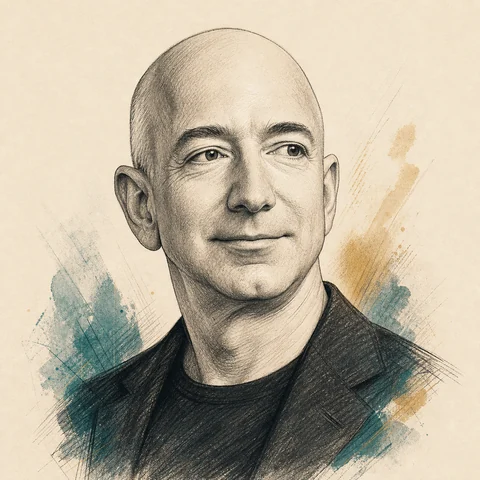
Up next in Bezos's letters
Jeff Bezos Compounding Money Lesson for Your Household
13 min read